Tuesday, August 31, 2010

Slow-going sweater

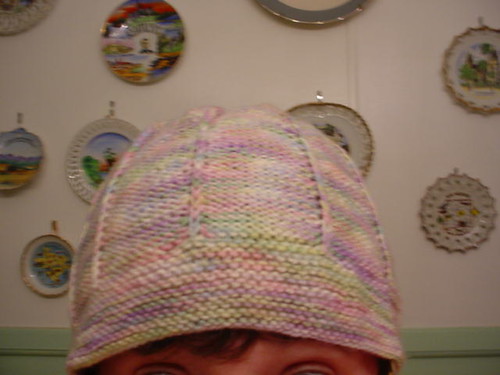
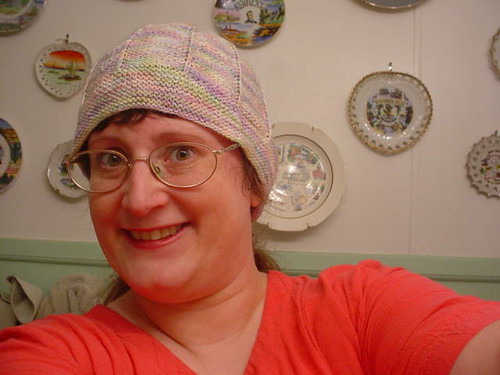
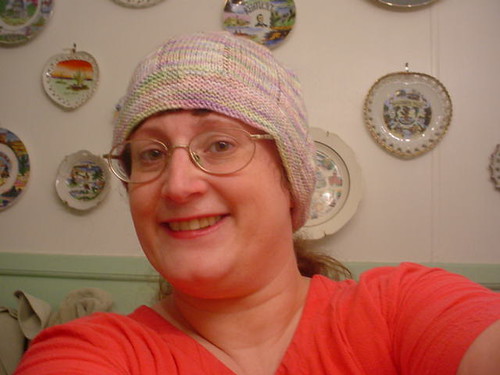
I've been working away on Honeycomb, but because it's a sweater knit of approximately sport-weight yarn, and every seventh row is pretty much nothing but cable crosses, it goes slowly.

It's hard not to get discouraged when you've knit for an hour or so and not even finished a single, 12-row repeat.

***

I'm working on a hopefully-discussion-generating presentation on plagiarism (with a focus on off-the-Internet plagiarism) for the OAS meetings. I'm reading a lot of papers written on the topic, mostly research papers based on surveys of students. (An aside: can you trust someone to truthfully report plagiarism, even on an anonymous survey?)

Men report higher levels of plagiarism than women do. Students with poorer grades prior to college report higher levels of plagiarism. Students who are heavy internet users report more internet plagiarism (especially people who use what one writer termed "creative" download methods for music and movies - I presume the author meant "shady if not outright illegal" with that coy "creative")

However: a couple studies found that online vs. offline plagiarism levels don't differ. In other words: it's not going up, just how students do it changes. The numbers have held steady, ranging from 40% to 50% having plagiarized more than once, depending on the school (and on how you define plagiarism: some surveys included "copying a string of five or more words," others required whole paragraphs to be copied for it to count, apparently)

There's also a lively debate about "education vs. enforcement" - can we cut plagiarism down by really talking about why it is a problem (for one thing, it's theft of someone else's work, and for another, the student doesn't really learn what they're supposed to learn by cutting and pasting) and by coming up with "creative" assignments that are less likely to have papers available on places like "schoolsucks" and "non-plagiarized-research-papers" (both websites where a person can allegedly buy papers. I don't know if they put in the coy disclaimer of "this is for research purposes only, don't turn this in" but I've heard that some sites claim that).

I don't know. The independent research project I do in ecology is pretty dang "creative," and I also try to work closely with the students on it, and over the years I've done it I've found one wholesale plagiarized paper (from a student in a previous semester), one I seriously suspected of being plagiarized but I had no way to prove it, and a proposal for a project that was about 80% cribbed off of a website (that was easily found by me with a Google search). (Maybe those are actually pretty good stats, seeing as I've been doing the project nearly 10 years. But then again, it's only been in the past 5 years or so that I've really been hardnosed on checking - after getting that first "It looks hinky but I can't prove it" paper).

I will say I hate the whole "enforcement" step of things. It makes more effort for me (searching papers - we don't have Turnitin, so I have to manually search phrases using a search engine) and more effort for the students (requiring them to hand in a paper copy for me to mark on, plus either a paper or electronic copy for my files. I haven't yet had anyone play the "intellectual property" card and refuse, though someone could and I'd probably have to accept it.) And also, I hate playing cop. I hate suspecting people. (Though I hate it more when I get a paper and realize it "sounds" like it came from somewhere else, and it turns out to have.)

So far, the only penalty I've ever given was a 0 on an assignment, which in some cases is enough to drop the person a letter grade. I've never pursued it further, partly because my policy is "first violation, get a zero; second violation, worse penalties" and I've never yet had anyone violate twice (that I caught) in the same semester. (I did have someone plagiarize one semester, fail the class, come back the next semester, and plagiarize again - and then say to me, when I handed him back his paper with a 0, "Aw, man, I didn't think you'd check this time." Seriously? SERIOUSLY?)

But also, I've heard anecdotal evidence from folks at other schools that (a) pursuing a plagiarism case towards expulsion of the student is a giant headache and (b) if their parents are donors, or they're an athlete, or if they're a friend of someone in the administration, you might as well just go bash your head against a brick wall for a while instead. (I have no idea how it works HERE, though all campuses tend to be a little similar in some ways.)

I don't know. I guess I come down on the side of "educate the students, but still check up on them - and still prosecute clear cases of plagiarism." Because while it's very nice, and thinking-very-well-of-human-nature to believe that "if we just teach them well enough not to plagiarize, they won't," there are still people with the attitude - and I remember hearing this attitude from some, as an undergrad - of "this is all a game, it doesn't count, these papers are busywork [or another 8-letter word beginning with b]" and so the person doesn't quail at copying - and in fact, in some cases, feels triumphant when they've "pulled it off."

I don't know. I guess I had right and wrong too heavily instilled in me*; even the stuff I suspected was "busywork" I did my own work on. (I was also too afraid of getting caught.)

(*though perhaps, "having right and wrong too heavily instilled" is not such a bad thing after all)

Of course, the fact that I'm also a biiiiiig nerrrrrrd who likes learning stuff contributes to that, I'm sure: I took a certain pride in doing my own work and learning whatever the goal was to be learned. (And in the cases where I didn't do so well and didn't get the grade I had hoped for: well, at least it was all my own work, and if I failed, I failed on my own merits and not because I grabbed someone else's crummy work)

And actually, that makes catching cheating and plagiarism more frustrating and, I think, more challenging: I'm not used to thinking about ways to be devious so I don't always consider all the possibilities. (For example, I allow students to use their cellphone calculators on tests, if that's the only calculator they claim to have. Granted, I do periodically look over their shoulders to make sure they're not texting a friend for the answer, but still...I know some profs who actually require students to turn in their cell phones to the front desk on test day, and they can retrieve them after the test.)

It's actually a huge field, the study of plagiarism. And there are all kinds of complexities: cultural differences, for example - in some cultures, it's seen as a form of respect to copy an authority's words (rather than paraphrasing), in other cultures the "everyday rules" on intellectual property seem to be looser (and this is still the case, and I've heard of pattern-writers venting their frustration about their for-sale online patterns being freely copied and distributed without charge in those cultures). And there's the issue of ESL students who are not totally English-proficient...(then again: I wrote essays, in French, without resorting to using someone else's work. But then again - part of the point of writing them was for my French teacher to see how well I was grasping grammar and style, it wasn't solely the content that was important...)

****

And finally, a smile for the day. This is quoted from the Guardian newspaper in the UK, from a column by Oliver Burkeman, published on Saturday the 28th. (Someone quoted this on CPaAG on Ravelry and I wanted to share it further). Call it a triumph of "creative politeness," or "how to defeat the self-entitled Speshul Snowflake":

"Today, a true tale of heroism that takes place not in a war zone, nor a hospital, but in Victoria station in London in 2007, during a tube strike. Our hero – a transport journalist and self-described "big, stocky bloke with a shaven head" named Gareth Edwards, who first wrote about this experience on the community blog metafilter.com – is standing with other commuters in a long, snaking line for a bus, when a smartly dressed businessman blatantly cuts in line behind him. (Behind him: this detail matters.) The interloper proves immune to polite remonstration, whereupon Edwards is seized by a magnificent idea. He turns to the elderly woman standing behind the queue-jumper, and asks her if she'd like to go ahead of him. She accepts, so he asks the person behind her, and the next person, and the next – until 60 or 70 people have moved ahead, Edwards and the seething queue-jumper shuffling further backwards all the time. The bus finally pulls up, and Edwards hears a shout from the front of the line. It's the elderly woman, addressing him: "Young man! Do you want to go in front of me?""

I particularly love that last bit. (And yes, I'm quoting Burkeman's words wholesale, right after bemoaning the high levels of plagiarism. But the difference? I made it CLEAR I was quoting, and I cited the source. [and arguably, a blog is not exactly the same as a journal article or a college term paper])

Sunday, August 29, 2010

Fall is coming!

Fall is, without a doubt, my favorite season of the year. I think of Fall as "the season for staying home" - I admit it, I'm sort of a homebody, but there's something so pleasant about a rainy fall Saturday afternoon, when you can sit at home and watch a good old movie on television, or a chilly fall night curling up with a book or some knitting.

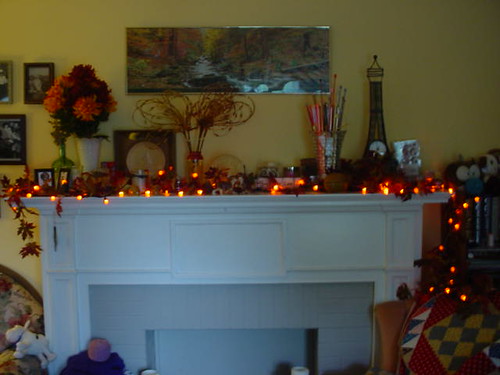
And now that my house is clean, I turned my attention to decorating the mantel for fall:

fall mantel

I wasn't going to put the leaf garland out there again - I feel like it's not safe to have candles burning on the mantel with it up there - but then I remembered that I had wound the little strand of orange LED fairy lights around it, so I put it up anyway.

Maybe having the fall decorations up will encourage the cooler weather to come back.

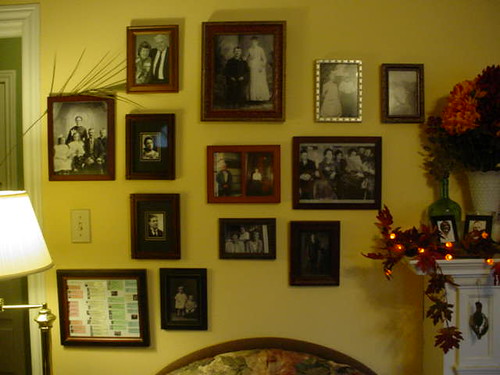
Another thing I did yesterday was to frame and put up some of the pictures my mother sent. The arrangement of photographs on the wall is perhaps not optimal from an interior-decorator's sense, but it's kind of something that has grown organically as I added photographs to the ones already up there.

It makes me happy to have all of these.

photographs

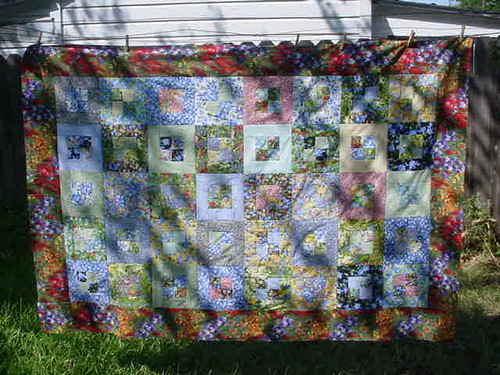
The other thing I did this weekend was to (a) do a bit of cleaning in my sewing room (to get it back to functionality as a sewing room - doing things like clearing stuff off the ironing board so I can actually press quilt blocks) and (b) finishing the framed-four-patch quilt I made using a Moda Jelly Roll:

finished framed four-patch

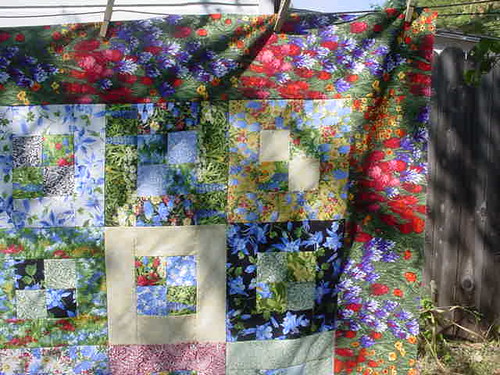
I had had all the blocks sewn into rows, but had not put the rows together, so I did that and then put on the borders. (I made them just a tiny bit narrower than the pattern recommended). I like that it's a darker, more intensely colored fabric that frames the quilt. (It's a Michael Miller print of Texas wildflowers. I don't know if it's specifically called that, but there are bluebonnets and something that looks like Indian blanket and something that looks like Indian paintbrush in it - all wildflowers you see in Texas).

Here's a close-up:

Framed four-patch close up

Saturday, August 28, 2010

Christmas in August?

I really need to be finishing my grading, but taking a break and browsing some of the Ohio history sites (this is one linked to the library in the little town where I grew up), I ran across this photo.

Every year, as far as I remember, when they were in business there, Terex did that - set up a Santa's sleigh display with their heavy equipment as the reindeer. I remember as a kid my family driving out there specifically to see it.

I think in the 1970s, when I remember it, they actually had a red bulb for Rudolph's nose. That photo looks like it could be from the 1960s, judging from the way the women are dressed. (Or maybe the early 70s, I don't know.)

Terex doesn't exist in Hudson any more.(I think they still exist as a company). Their former headquarters now belong to JoAnn Fabrics, and I also think that some of the catalog companies (Wireless/Signals/Bas Bleu and others) have their catalog "offices" there, at least those catalogs have a Hudson address, even if the distribution centers are located elsewhere. (I've never been quite familiar enough, when calling in an order, to ask if the order taker is actually IN Hudson, and then commenting I grew up there).

****

Speaking of photos, if I can get my act together and my work done, I'm going to go downtown to one of the nice little shops and see if I can buy a few photo frames for the family pictures I have. I know that at least three of them, I really want to frame and put up on the wall.

Friday, August 27, 2010

ALL THE THINGS!!!

Yup, I did it. I managed to CLEAN ALL THE THINGS! this afternoon. It took me from about 1:00 until just now, except for a short break to take the recycling to the drop-off point and to run by the uni library to donate some books I had been planning to donate. (The head librarian, who is a friend of mine, was happy to see them. In particular, I gave the two big Folio Press art books - one on Leonardo and one on Michelangelo - that were freebees a couple years when I rejoined Folio. They're very nice books, but they're HUGE and they take up a lot of room, and I found I never really looked at them. So maybe some of our art students can benefit from having access to them. The head librarian did comment that even though their budget had been cut again, they were still doing pretty well on acquisitions, thanks to donations from faculty. (And now I'm thinking - if I get a little "mad money" like from reviewing textbooks, maybe I'll order and donate a bunch of various field guides, I know our collection is weak on those)).

So anyway. I cleaned ALL THE THINGS!!! (well, almost - I didn't wash the windows (they didn't need it) and my sewing room - which no one but I see - is still kind of a mess, and I think getting it clean and organized is going to be a longer term project).

I also used the new "steam pocket" tool I bought last week. I had been thinking of getting one of these (or a steam mop) for a while. (I opted for the small handheld thing because it seemed useful for more purposes - you can steam clothing or hanging curtains with it, and steam clean countertops, things like that).

It's pretty brilliant, especially for cleaning the tub (one of my least favorite chores) and for cleaning stuck-on stuff off tile floors. (I had had a carton of something - cans of pop or maybe water bottles - that got damp and left part of the cardboard adhered to the kitchen floor in one corner. The steam cleaner broke up the cardboard and un-stuck it, and while I still had to sweep up the bits, it was preferable to sitting there scraping at it with some kind of tool.) I suspect the steamer would also work for removing wallpaper, as long as the wallboard or plaster behind it wouldn't be hurt by lots of steam.

And besides, there's something appealingly Mad Scientist about being able to clean surrounded by huge gouts of steam. (And it's also warm. I suspect working with the thing will be more pleasant in the winter.) And it appeals to the germophobic part of me because they claim it sterilizes as it cleans. (Heh. You can probably eat off my kitchen floor right now: I swept it, then used an electrostatic cloth, then wetmopped it, and then finally steamed it. Yes, that maybe seems a little compulsive but I have WHITE tile in there, and it's really heck to get it clean.)

So: my house is clean. I decided I'm going to get dinner OUT (partly so I don't wind up cussing when I drop food on my clean kitchen floor but mainly because I'm TIRED, y'all). And then I'm going to do the 1/2 hour or so of piano practice I still need to do. And then, if I have the energy, write my Sunday School lesson for this week. (I might. I find that cleaning kind of revs me up and then I'm all excited and happy because my house is so clean).

And then, finally, before bed I'm going to take a bath (with nice bath salts- and the way my back and arms feel right now, I think I will need the epsom salts in it) in my nice clean (and sterile!) tub.

Weekend is here

Because I have no afternoon classes or office hours today, I've decided that this afternoon is going to be CLEAN ALL THE THINGS!!! day - I'm going to go home after my last class and do that. (I actually started last night - cleaned SOME OF THE THINGS!!! - so I wouldn't have so much to do today).

It had gotten bad. (Or, what I consider bad, your mileage may vary). The biggest thing to deal with is the accumulation of clutter/stuff in a place where it's not supposed to be. That's what takes the time, the dusting and sweeping and scrubbing and all that moves fast once everything's put away.

I don't have a lot of work-work to do this weekend - a wee dot of grading, and also work on a presentation for OAS - and frankly, I think I'd rather come in early on Saturday morning and do that stuff (especially since it will be fairly quiet on Saturday morning and sometimes on Friday afternoon there are people in freak-out mode over something wanting help).

Part of the reason I hadn't gotten to the cleaning before now - even though I'd keep looking at the different rooms and going "Ugh, I really need to clean" - is that the first week or so of classes is kind of crazy, and I'd get home after a day of herding cats and making the possibly-impossible happen, and just look at it and go, "No, I put in a hard day. I want to knit instead."

And also, I think, the extreme heat we'd been having affected my energy levels and mood far more than I realized. I kind of shut down and went into as much of an aestivation mode as I could. And so, anything that was likely to make me feel warm (like moving around putting stuff away and scrubbing floors) and anything that seemed to be a lot of activity, I just wound up being kind of "Meh" about. So I'm going to take advantage of the (possibly fleeting) cooler weather and get my house cleaned up.

Thursday, August 26, 2010

I don't know

I've wanted this pink t-shirt with angel wings drawn on the back for the LONGEST time, but I can't quite decide if I'm willing to declare myself a "Hopeless Romantic."

because, actually, in many ways, I think I am quite the opposite of a romantic*.


I don't know. I wish they offered the same t-shirt in pink with nothing written on the front.

I'll have to think about it more.

(*Now, if they had one that said "Hopeless Baroque" on it, I'd be all over that. Music humor. Heh.)

Not quite finished

I'm still picking away on the first sock of this pair. "Knit plain" for the foot should go faster than it's going.

not quite finished

These are the "Ninja" socks from Judy Sumner's "Knitted Socks East and West." I'm using the recommended yarn - KnitPicks' Risata - which is a cotton/wool blend with some elastic in it. (It's kind of like a thin version of Cascade Fixation). It works up into a nice fabric.

I'm calling these "Not Quite Ninjas" because instead of using the black or dark grey that would be the "traditional" Ninja color, I'm using a very dark purple (called Marionberry).

Here's a close-up that better shows the stitch pattern on the leg. It's a zig-zag of knits and purls with a lacy section.

not quite ninjas

Wednesday, August 25, 2010

Calling the cops

I thought of it, lying there awake. But I did not, for three reasons:

1. It would have woken me up more than I already was, I thought maybe I had a prayer of getting back to sleep if I just laid there and waited for the person to drive away.

2. Next-door neighbor IS a cop. I figured if something could be done, he'd be doing it.

3. I've learned (from my one experience doing it, and from talking to other people who have done it also) that the only thing calling in a noise complaint gets you is an anonymous entry in the Police Blotter and possibly some 'tude from the person answering the phone.

I'm reminding myself that this is not as bad as Summer 2003, when I had a House Full Of Buffoons next door, who partied even louder than this car was every night of the week. (Which is when I did call in a noise complaint or two, and nothing ever happened.)

But still. It makes the idea of buying 10 acres of land and building a tiny cottage in the middle of it (and posting the land, and maybe even looking into getting an electric fence around the perimeter) more appealing. (Not that I have the funds to do that or anything.)

I'm tired today

I don't know what kind of a person thinks it's an acceptable idea to drive a booming boom car into a residential neighborhood at 3:30 am, park it, leave the stereo playing, and sit there for almost an hour.

I want back the hour of sleep that turkey stole from me. (And yes, I was woken from a sound sleep. I was dreaming about how some friends and I had worked out a deal with a local sports grill/bar - we didn't like any of the food on the menu, so they let us bring in our own food and cache it there. Until one day I went in to get some of the granola bars we had stored, and the barmaid started screaming at me that I couldn't take them, the bar now owned the food, and it wasn't mine. I think there was some overlay of a coming catastrophe, that I was running around trying to gather food before I had to evacuate or something. Not the best dream but I'm still not happy at being awakened.)

(This is why I cringe a little when an environmental specialist talks about how the Salvation of the World is putting everyone in cities, in high-density housing. There is a sufficiently large number of people who don't want to think of their neighbors, or who assume that everyone can sleep through loud music in the middle of the night. Or who cook fish or peel durians in the next apartment over, when the energy-efficient ventilation system is on the fritz. Or people who have loud fights (or loud, um, "other activities.") Or whatever. And I'm just misanthropic enough - and just sensitive enough to noise and smell - that I would be in misery a lot of the time around that many people.)

Old family photos

I mentioned earlier that one thing my mom and I did over my most recent visit was to go through some old photographs she had, and pick out a bunch to take to a photo reprinting/restoring place (JMC Photos in Bloomington, IL, and I can highly recommend them, even going back to the days when they processed Kodakchrome slides I took while doing fieldwork). Some of the photos she wanted copies of to send to a distant cousin who had done some research on the Ames/Burt side of the family, some were for me, some were for my brother, some were for nieces and nephews of hers.

The photos came on Monday.

Most of the photos existed as photos, which are easy enough to copy (but I've seen some bad copies of old photos made). A couple, she had negatives for - the big, black-and-white negatives. I'm not sure what film format they were, it was obviously not 35 mm, the negatives were (IIRC) something like 2" by 3".

And there was one photo that had been cut up - it was a picture of my great grandmother with my grandmother as a baby and two of her siblings. Apparently at some point my grandmother needed a photo of herself as a baby (Probably for one of those "Guess who this baby grew up to be" ice-breaker things somewhere) and so she cut the photo. We had all the pieces, but a photo in pieces is fairly useless. My mom kept wondering if JMC could put it back together (Even after I told her, "If you had a scanner and Adobe Photoshop, *I* could put them back together. It wouldn't be a very good job, but you could print out a photo that was in one piece.")

At the photo place they said, "Sure, this will be easy - none of the faces have cuts across them, and the creasing on the photo is minor."

And true to their word (and to the Clone Pixel tool), they did it - I can't even tell where the cuts were on the corrected photo.

I'm super-happy to have the photos. There's a very nice one of my great-grandparents, later in life, standing out in front of the farmhouse where they lived most of their married lives. When I get that one framed, I'm going to hang it up next to the wedding portrait I have of them - this one was taken some 55 years later.

And there's a nice one of my grandma and my two aunts. As I said, I'm sure it was taken well before I was born (Aunt Chickie, in particular, is slimmer than I ever remember her being) - but they look (in the faces) like I remember them, and that makes me happy. (I'm going to frame that one and put it up on the wall, too).

People have different ways of remembering loved ones. I know some people who keep the "ashes" (cremains) of family members in their houses. And there's a company that will make an artificial gemstone using cremains. And the Victorians had their hair jewelry - brooches and pendants containing small braids of hair, often from someone who had died.

I have to admit that I wouldn't find any of those things particularly comforting. What I want, to remember someone I loved who is now gone, is a good photo of them - preferably from a time in their lives when they were well and happy, and were maybe doing something they loved. One of the reasons I like the photo of my grandma and my two aunts so much is that they're sitting out on my grandma's porch, obviously talking (visiting was a big pastime up in the town where my grandma lived), and they're smiling at the camera. And as I said, they all look "like themselves" - not like they started to look after they started to get sick. (My grandmother suffered terribly from osteoporosis, one of my aunts had been a long-time smoker and got cancer...)

And there's one of my grandfather as a young man. My mother says she can't judge how old he was in the photo (I'd say 20...he was born in 1880, married in 1917, and the photo was taken some years before he married. Men's clothing doesn't hold as many "clues" to the year as women's clothing does, so it's hard to tell - he's in a dark suit with one of those stiff collar things and a narrow tie.) It's a nice old photo, though, sepia-toned. And when I look at I can definitely tell that this man was my mother's father...I can even see a bit of his features in my brother's face.

There were a couple of surprise pictures - I guess I hadn't noticed her taking in the negatives (these were ones she only had negatives for). There's one of her in cap and gown for high school graduation, and another one of her as a teenager goofing around in her parents' back yard (trying to ride a tricycle that is too short for her). It's funny, my mom looks much the same (at least in the face) as a teenager as she does now. (Perhaps that's part of my distress about being treated by some people as being younger than I actually am/feel: maybe I really DO look younger than my actual age and all women in my family just DO. I suppose I should really be happy about that...)

Also, it puts to rest a claim someone made on Ravelry, that "no woman in the 1950s would be caught dead wearing jeans." My mom is probably 16 or 17 in that photo, and she's wearing jeans. With the cuffs rolled up, "sloppy Joe" style. And a plaid blouse. And, I think, saddle shoes, but I might be misremembering that detail. (I know my mom said she wasn't allowed to wear jeans to school because of a dress code, but from what she's said, it sounds like she wore them a lot at home.)

Tuesday, August 24, 2010

Progress on quilt

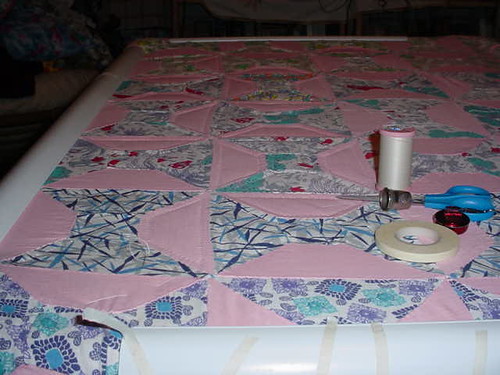
I've been picking away at working on the vintage bow-tie quilt. It seems easier to work on this right now, where most of the bulk and the weight is held by the frame, than the other quilt (the one in the hoop, where most of the weight sits on my lap).

I'm getting close to where I can move the quilt so I can easily reach the next couple rows' worth of blocks:

August vintage bowtie

I've read some machine-quilters remark that they "can't see why" some people choose to hand-quilt. Well, I'm not crazy about trying to quilt on a machine: I don't find it restful, and it's hard on your forearm muscles. (Maybe longarm quilting is different). But with handquilting, I can be sitting down, mostly relaxed. It's a slow enough process that there are really no "oh, fudge!" moments - like, where the machine gets away from you and you put in a line of stitching you don't want. And what errors you do make seem to be easily enough fixed. (Most of the errors I make anyway are forgetting to quilt part of a block, and I can always go back later and do that).

It requires attention, but it requires a different *sort* of attention from machine quilting. In my few experiments with machine quilting, I was tense and on alert the whole time - looking out for things that might lead to an "oh, fudge!" moment. With hand quilting, I still have to pay attention to what I'm doing, but it's a *slower* sort of attention, if that makes sense. You don't have to think about "is the bobbin close to running out? Am I in danger of snapping the needle?* Am I straying too far from the pattern? Am I going too fast/too slow?"

(*Well, yes, this is actually possible but you can usually see it coming more readily in hand-quilting.)

There are more things to worry about with machine quilting (or at least, I find there to be), and so I don't enjoy the process the way I enjoy hand quilting.

But machine quilting has its place. If you need something done fast, if you want a quilt that's tough and sturdy (and that a new parent wouldn't feel bad about letting a child use), if you've made a quilt of heavier fabric or mixed fabric types that might be hard to hand quilt, it's fantastic. But hand quilting also has a place - yes, even still, even in this busy world. It's beautiful, when done well, it's restful for the person doing the quilting (or at least, I find that to be so), it preserves a tradition...

I think there's also something...spiritually instructive? about doing stuff like hand quilting. Yes, it is very slow. Some days your progress looks infinitesimal next to what you have left to do. But if you keep at it - if you "keep on keepin' on," eventually you get the quilt done. And you have that tremendous feeling of accomplishment. And for someone like me, I can look at the quilts I have hand-quilted, and think about them, and when I'm faced with some other task that looks insurmountable at the beginning, I can kind of grit my teeth and go, "Yeah? You've ALREADY hand-quilted a quilt with a 1 1/2" grid of squares on it; you can do this."

Monday, August 23, 2010

light saber toast

I really need to get my stuff together and do one last read-through of a manuscript, and decide it's GOOD ENOUGH and then submit it.

But I saw this, and it was just silly in the way that tickles me, and it made me laugh:

One more thing...

On the not-adulthood issue.

I can't believe I didn't think of Hyperbole and a Half's "Why I'll never be an adult" post (n.b.: strong language) when I was talking about the whole issue of being a grown-up, being seen as such, or not.

Pull quote: "It's like I think that adulthood is something that can be earned like a trophy in one monumental burst of effort and then admired and coveted for the rest of one's life."

Yes, this. Like there's some official designation that you get, like some kind of a stamp on your hand: NOT A CHILD. And you can SHOW that to people. And they will BELIEVE you.

(I think I earned that stamp, if I hadn't before, when I scheduled and then went to, a dentist's appointment to have a crown-prep done. Even though I dreaded it. Even though I believed it would hurt enormously. Even though people OH SO HELPFULLY told me horror stories of dental work that a friend of a friend had to have)

But I guess, really, adulthood is like so many other things: pursuing a faith discipline, or writing a dissertation, or going to work, or learning to play the piano, or whatever - some days you are successful at it and you feel good as a result, other days, it's either just a boring slog to be gotten through, or, worse, something happens that sets you back.

But yes, I suppose there are other adults out there, who, after answering all their e-mail and going to the [expletive deleted] bank, and CLEANING ALL THE THINGS!!! kind of wear themselves out? And have to, I don't know, sit on the sofa and watch cartoons for a while? Or are kind of useless for a couple days? Or at least, I hope so.

Twelve hair grips

That's the number I have holding up my bun today. (I have decided that I will once again commence wearing a ponytail, rather than an updo, at work, once the temperature drops below 85).

***

The "northern Michigan" is actual U.P. Escanaba was the largest city near my grandmother (she lived in Rapid River.) So many of the place-names up there, when I see them again, they evoke memories of the long summer trips we'd take up there (Partly so my mom could see her relatives, but also partly to escape the heat - as hot as it ever got - in Ohio. And a couple years, my dad was doing some kind of groundwater research project, I remember now tooling around with him up around towns like Kipling and Theodore and places like that. (There's an Alvin, Michigan, but it's in the lower peninsula. And there's no Simon.)

There's both a Rudyard and a Kipling in northern Michigan, apparently he toured there and some of the folks were very taken with him. And there's the Big Two-Hearted River, which Hemingway wrote about.

And there's Nahma Corners. And Manistique. And Seul Choix Point, which I'm told is pronounced more like "See-shwa point," even was by my grandfather, who spoke French until he was 6years old.

And, oh, there were so many more. I used to know the whole order of towns along US 2 from St. Ignace to Rapid River, and I could gauge pretty accurately how much farther we had to drive.

(Two other things: Now I'm hungry for a pasty, the traditional meat pie, the recipe for which was brought over by Cornish miners. Pasties are pretty much THE characteristic UP food. And while a bad pasty is heavy and lumpy, a good one is really pretty good.

And I'm happy to see that Finland Calling still exists as a television program. I remember occasionally watching that (my grandmother got two television channels, three if the weather was good) on the local PBS channel. I don't know the first word of Finnish - in fact, it's a very different language, it's in a different family from the other Scandinavian languages (in which I do know a few words, mainly food-related or things like "thank you" and "good day").

***

Saturday I went out to Sherman. For one thing, I needed to meet up with Kris to pass along LOTS of magazines (I got rid of nearly all the stockpiled "Gourmets," after finally realizing that I'd never actually cook anything out of them) and some extra balls of yarn, so she could share them with her art classes.

The funny thing? I was killing time (I went down there early; I had a 10% off Target coupon and wanted to use it before Target got so mobbed with back-to-school shoppers: this was Texas' "sales tax free*" weekend)

(*on certain items. Not anything I was buying)

I still had time to kill so I went to the Hobby Lobby and got a new pack of embroidery needles (I could not quickly find the ones I KNEW I had) and a few skeins of floss. There was a woman back in one of the other checkout lines and I thought, "Gee, that looks like Diana." But then I thought, "But it can't be. She moved to California." So I didn't approach her, having had previously in my life two embarrassing situations where I went up and started talking to people that I thought were people I knew, but turned out not to be. (In one case, now that I think about it, it could have been that the person knew me but was just being cool-mean by pretending she didn't. That was high school.)

Anyway, I went to the bookstore next. And I was sort of browsing the tables they have set out in the center aisle, when she came in. And ran up to me. And grabbed me up in a big hug.

It was Diana, after all. She's moved back, because her son and daughter-in-law (and their child) moved back to Texas. And I guess Diana and her husband never actually sold their house here. She's doing art, now, as a retirement career: she has commissions to do some paintings and is doing photography.

So that was a nice surprise. (She is a friend of mine....I had kind of lost track of her. She was my first grad student, she taught here for a while.)

Sunday, August 22, 2010

The old river

I'm really enjoying "Up on the River" (John Madsen). He writes quite lyrically - I can picture the upper reaches of the Mississippi even though I've never seen them, from his description of how he canoed down it with his daughter.

It's the kind of book I love: he interweaves his current experiences and nature-writing about the river with history of it, with information that allows you to kind of situation what you're reading in your mind, fit it in with other stuff you know. (In a way, he's a bit like Simon Winchester, another writer I enjoy).

The book makes me happy, because in along with the new things I am learning, there are the occasional familiar names. He speaks of Henry Schoolcraft, probably the European-American with the likeliest claim on finding the river's headwaters. Schoolcraft County was one of the counties in the Upper Peninsula that we drove through to visit my grandmother. (It was the next one east of Delta County, where she lived).

And he speaks of some of the other early explorers, names I dimly remember from some of my American History classes.

But there's other information in the book - the sort of odd little facts that stick in my mind, and, if I'm lucky, there will somewhere be a time where it's appropriate for me to trot them out and then people will look at me like I'm really smart because I happen to know that.

For example: Lake Itasca, the putative head of the Mississippi? Is not named for a Native American word (Itasca does not occur in any Native language in the area), but rather, it's a contraction of veritas caput, meaning "true head" in Latin, indicating that Schoolcraft believed this was the true headwaters.

He also cites the origin of the phrase "bull pines," which is snicker-worthy, at least if you're in touch with your inner 12-year-old:

"...lofty crowns of white pines that were already a half-century old when Schoolcraft first passed them - the kind of trees called 'bull pines' by some timberjacks. (I once asked an old Swede woodman why this was so, and he roared with laughter. 'Vy? Because dey ain't never been cut yet, dat's vy!')"

(It could be that I find that funny in part, because my northern Michigan relatives - despite their British/Scots/French heritage - lived in a heavily Scandinavian area and their senses of humor were influenced by the Swedish and Finnish people living there. And Madsen's reproduction of the accent there is actually something you still do occasionally hear up that way. Or "over by dere," as we'd say. (I used to be able to mimic a Northern Michigan accent pretty well. I think it's been too long since I've been up there for me to be able to slip into it again)

Madsen is literary, in addition to having known the human and natural history of the area. In one place he speaks of being upset about something and "tarnishing the welkin" (cursing at the sky, and I only knew what "welkin" was from having read it in Shakespeare). What a great phrase that is.

He wrote that although the Lower Mississippi certainly has its beauty and interest, he prefers the upper reaches:

"[the bayou reaches of the river] are just not the same as our upper reaches where the River cuts deep into bedrock.. It is country that stands on its hind legs and shows its limestone muscles, rising sublimely over a river that flows in broad running lakes and the tangled multitude of sloughs, cuts, and side channels that wander through a fastness of wooded islands and floodplain forest"

(Now that I reread that passage, I strongly suspect that Aldo Leopold - another favorite writer of mine - had to be an influence on Madsen.)

Madsen used unusual turns of phrase - at one point, he speaks of canoeing in the uppermost reaches of the river: "an infant river that purled along happily, chuckling to itself now and then..." (Of course, as a knitter, that phrase caught my attention).

Sadly, there will be no more from John Madsen other than what is now published (He died in 1995). But he does have several other books, including "Where the Sky Began," which is about the prairie and one of those books I always meant to read but never yet got to (now that I see how Madsen writes, I will be getting to it).

I know some scientists might dislike the floweriness of his language, or his way of meandering from subject to subject. But his writing cheers and comforts me - I can picture the places where he has been (and now I kind of want to go and see the headwaters of the Mississippi, something I never even contemplated before). And his writing makes me more curious about the natural world and our history in it.

Friday, August 20, 2010

Words I like

I think "estuary" is a pretty word. To me, it makes me think of the calm, quiet, flat areas on Cape Cod where salt marsh grass grows and the wind stirs the grass just slightly. And there are wild birds and the tide goes in and out.

Actually, a lot of the ecological/geographic words are sort of evocative and nice. One of the reasons I like reading books (like E.C. Pielou's "Fresh Water," and her "After the Ice Age," which I should really find, start back up, and finish reading) is that there are new terms I don't know that I learn, some of which are very evocative.

I started reading John Madsen's "Up on the River" (about the stretch of the Mississippi that is "between the Saints" - that is, ranging from St. Paul to St. Louis) the other day. I think I'll be quoting bits of it here.

I think one of the things I'm going to buy this weekend is a nice, permanent bound book. I think I want to start keeping a commonplace book with things out of books I've read - or quotations I hear - that I like.

I'm also reading "In the Spirit of Happiness" by the Monks of New Skete. I've already underlined (in pencil, and it was even hard to bring myself to do that, even in a book I own) passages I felt like I needed to be able to find again. There are so many wonderful things in that book. About slowing down, and listening, and not letting things get in the way of the important things in life.

Random for Friday

I don't really feel like I can "call" the person that I feels sees me/treats me as a child, because they're a Person With Authority and I get the sense that challenging them would lead to unpleasant repercussions.

And besides, several other people I've spoken to sense caught the same feeling from the person (so it's not just me, but also, if the person were challenged on their attitude, they would likely deny it/not understand the complaint).

This is also someone you don't even say "hello" to without practically having to clear it with their secretary first, so... I think it's just easier to try to let the matter drop. (And interact with the person as little as I can possibly get away with.)

***

Also, once again, my fast reflexes saved me. To go to work, I turn from an east-west street onto a north-south one. It is a left turn, but there's a light and usually traffic is light enough that I can get through without having to wait through another cycle.

Okay, so I'm going east, turning north. On the north-south street, on the southbound side, there's a left-turn lane (for people turning east) in addition to the regular lane. Those folks get a turn signal (I don't) but sometimes you have to wait a cycle or so for it.

There's also a gas station on the northeast corner. With entrances and exits on both the north/south and east/west streets. So, even though it's technically illegal, people often pull across traffic into their parking lot and across, to sort of "cut off" the turn and avoid waiting.

I got one of these impatient people this morning. Guy in a red pickup truck Could. Not. Wait. the minute-and-a-half or whatever it would be for him to get the turn signal - so he just pulled out, across the lane I was going into, to pull through the gas station.

He did this just as I was coming through the intersection. I hit the brakes and the horn and, thank goodness, avoided getting hit but, geez, that's REALLY not how I want to depart this life: getting t-boned as I'm on my way to work.

(But given the number of near-misses I've seen/had, I suspect that if I DO die prematurely, it will be in a car wreck on the way to work.)

***

I'm really glad it's Friday. This week feels like it's been a month long. I'm sure part of it is just the "shakedown" effect of the first week of classes - where you're trying to counsel last-minute people into classes, and you have people worried about stuff coming in, and you're still trying to get everything together. But I also think the extreme heat makes time feel like it moves more slowly.


***
Also on "Caturday," I'm running out to meet a fellow blogger who is also an art teacher, and pass off some of my leftover yarn (and some magazines for collages) to her. So I've been rooting around in the stash. I do have an awful lot of yarn. I even had some full balls that were leftovers from other projects...so I decided to just pass them on, it makes room for the other stuff I have.

I'm getting into that typical late summer doldrum of wanting to start dozens of projects...I want to get back into designing my own socks more again (even if every idea I come up with, it seems someone else came up with before, and then published before me.) And I see some of the sweater patterns and think, "Oh, I should start that" but I'm going to be disciplined and try to work on Honeycomb until it's finished before I start another sweater.

(I think part of it is a longing for cooler weather, and sweaters make me think of cooler weather).

Thursday, August 19, 2010

now that's sad

Sometimes, surfing around, you find something a little sad.

I was looking at some of the Ohio historical sites (I don't know why but thinking about places like Deep Lock Quarry make me feel cooler).

And I found out that Hudson School #2, which was where I attended third grade, has been torn down. Just this year.

I suppose it was a matter of not being able to make it code-compliant, and it having outlived its purpose, but it still makes me a little sad. Yet another building that only lives as a ghost in my memories.

(There are more photos of the exterior here. It wasn't, perhaps, a beautiful building, but I can still remember the smell of the steam trays at lunchtime, and the view from Mrs. Irish's third-floor corner classroom, and sitting out on the steps with my friends....

(And more history: Summit Memories, devoted to Summit County. They have a whole section on houses in the town where I grew up. In fact, the very street on which I grew up - Atterbury Boulevard - is featured. (I never knew that it was going to be an early housing development, and the would-be developer went bust in the Depression! And that, apparently, one of the few "old" houses on the street was the weird old place we referred to as the "Vonderheide House" - it always seemed odd to me that the gothicky old house didn't fit in with the more modest 1950s/60s Colonials and ranches, but now it makes sense - it was built in 1928, before the developer went bust.

Fascinating. (And I'm kind of relieved the developer went bust; I don't know that my parents would have bought a house in a ritzy subdivision called "Lake Forest.")

I won't grow-up

Of course, I never actually have to wear a tie. And as an ecologist, it probably wouldn't be beneath my dignity to climb a tree, if it were in service of collecting data.

(I haven't climbed a tree in years, but mainly out of fear that the small branches wouldn't hold my adult weight like they did when I was 10.)

Anyway. Sya, with some frustration, tweeted about an observation made in passing in this story (NYT, will require registration to view).

The story was nominally about "why won't 20-somethings grow up?"

One of the observations was that 20-somethings are, apparently, in record numbers, living with their parents.

(Funny. I lived with my parents for nearly ALL of my 20s, back in the 1990s, when I was in grad school. I did it because not having to pay rent saved me from having to take out student loans...which I would argue was an ironically mature decision).

But what irked her - and also irks me, as well, is this suggestion:

"Sociologists traditionally define the “transition to adulthood” as marked by five milestones: completing school, leaving home, becoming financially independent, marrying and having a child. "

Okay, one through three, I have completed. Four, while I'm not absolutely ruling it out EVER, seems perhaps equally likely with my observing a meteorite land on my neighbor's chihuahua on the same day that I win the lottery. And five - well, biologically speaking, that's not going to happen. I know women over 40 conceive and bear children, but I can tell you that for me, that's not going to happen.

(And beside the point: number four on that list? I'm not going to jump into it simply because the opportunity might present itself - I wouldn't go grabbing the first single male close to my age I can find - I would have to be fairly convinced that living with him would be better than continuing to live by myself. Which again, I think is a fairly mature decision: not wanting to get married just because "everyone else has done it" or because I feel like it will suddenly make me more socially acceptable (though sadly, in some circles, it probably WOULD))

So, by the "traditional" sociological metric, I will never be an adult.

(And how much more painful would hearing that litany of things be to a couple who desperately wanted a child, but for whatever reason, could not have one? And for that matter, there's a certain percentage of the population that, as much as they would LIKE to marry their beloved, cannot legally do so, at least in many places)

And this plays on the events of Monday, where I had a person in power talk to me in a way that made me feel like they were seeing me as a little girl in a pinafore dress with skinned knees and a bow in my hair, instead of a Ph.D. with ten years of a career under her belt.

(I really, honestly, do think there are still people who think if you have not married and/or had a child, you are not a "really real" grown-up)

And the whole "fake grownup" thing, as I've said before, is one of my "issues." I don't like having people come over to my house unless I've had time to do extensive cleaning right before they come - because I fear that people would see the couple of empty boxes from Amazondotcom sitting on the dining room floor (because I haven't had time to take them over to the recycling center yet), or they'd see the stack of half-finished knitting projects on the ottoman, or the books strewn about, and envision me not as an adult, but as that 16 year old with a moldy ham sandwich under the bed and dirty socks all over the floor. (N.B.: when I was 16, I never left ham sandwiches under the bed. And usually didn't leave dirty socks around.)

So being "told" (or perceiving that I'm being told) that I'm "not a grownup" upsets and angers me.

For one thing: If I'm not a grownup, why the hell am I carrying such a giant load of responsibility? Why am I not having more fun than I am? Why am I bothering to do stuff other people asked me to do before I do the stuff I enjoy?

I think that's part of my frustration. (Though part of it is that maybe I have kind of bought into the idea that I'm not a really-real grownup. I mean, being responsible for another human life, whether it's a spouse or a kid or some other kind of dependent, does kind of force a re-organizing of priorities that I have not had to do).

(I saw a couple little kids - probably kindergarten or first grade - waiting for the bus as I drove in today. Man, did they every look grouchy and dour. Now, granted, other things could be going on, but, I remember my kindergarten days. (Perhaps it was easier for me because I could already read, and anyway, those things didn't seem to be pushed as hard in the pre-NCLB 1970s). Part of the day was spent coloring with crayons. And part of the day was spent listening to stories. And learning some (very basic) math. And there was recess. And graham crackers and milk. And a short naptime. I can bet that once those kids hit adulthood and careers, kindergarten will not look so bad at all.)

I don't know. One reason I can see for 20 somethings not leaving the nest is the difficulty of getting jobs right now - especially getting a job that pays enough to live on in areas like the East Coast where it's expensive to get housing and such. (But I have to admit, I kind of, sort of, secretly agree a little with the commenters on the site who say something like "Adulthood stinks! Of course these kids don't want to grow up!" because there are a lot of things about adulthood that frankly, do stink: keeping all your records in order for filing taxes, making and then going to dental appointments, going grocery shopping after work when you're tired, eating the "necessary" servings of vegetables in a day when you'd really rather eat pancakes, not yelling at people who probably deserve it...)

So I don't know. I'm forcing myself not to read anything into being "told" on Monday by someone that "I don't see you as an adult" and then reading a newspaper story on Wednesday that reminds me that "traditional sociologists" would assume I wasn't fully grown up because of my failure to marry and raise children.

And I suppose that may actually partly be the impetus for my high level of responsibility ("Erica would crawl 20 feet into Hell to do something she said she would do"), and partly my slight lingering guilt about preferring cartoons to "serious" programming on television...I guess part of it is that I long to be seen as "normal," whatever that may be, but I have the sinking suspicion that I'm NOT "normal," and that I can't quite keep the facade up perfectly, kind of like the space aliens who almost perfectly impersonate a human except their eyes blink out of synch or something. Or like the spy from another country who can speak the language perfectly and fit in almost perfectly, but mispronounces one word, or isn't aware of some certain custom, and that dooms them to being found out.

Wednesday, August 18, 2010

Diversity in radio

I have the (still free, but I think I will subscribe when the trial period runs out) Sirius radio in my car.

I usually leave it set to the "Classical Pops" station, that one being the one that plays stuff I like the greatest majority of the time.

But this morning, they were playing the "Lento" from Gorecki's Symphony #3. And I'm sorry, but Gorecki - or at least, this symphony - makes me depressed. So I just reached over without looking, and smacked one of the radio buttons to change the station.

It went to another pre-set: 80s on 8. (I went to high school in the 80s. That's my justification of assigning it one of the pre-sets.)

They were playing "Whip It" by Devo.

I had to laugh at the sheer incongruity. (And while I wouldn't agree with Professor Pangloss that we "live in the best of all possible worlds," still, there's something to be said for living in a world where you can have music without having to hire, pay, house, and feed the musicians, and where you have access to music from most eras of the past.)

***

The hive problem seems to be going away. Perhaps I'm acclimating to the heat again, and I just wasn't used to it after being in Illinois, where people were complaining about 85 degrees being "SOOOOOOO HOOOOOOOOT." Or the antihistamine kicked in. Or something. I don't know. I get weird sensitivities to stuff that wax and wane and I never know the exact cause sometimes.

***

Another finished object. This is the "Pinstripe Slouch Hat" from Knitting 24/7.

close up of purl side

It's knit of sockweight yarn. I used Black Bunny Fibers' Merino sockyarn. The colorway is called Mary Cassat.

Much of this hat was knit on the way to, and on the way back from, the Prairie Conference (I wound up not driving myself there or home.) It's a very simple pattern. And it's my first ever use of the "knit into the stitch below" instruction, which is functionally the same as having slipped a stitch, I guess. (Maybe someday I will try Brioche stitch, which uses the knit-into-stitch-below as part of its structure).

The hat is constructed to be reversible - you can wear the purl side out:

purl side of slipped-stitch cloche

Or you can wear it knit side out:

knit side of slipped-stitch cloche

They show it (in the big picture) worn purl side out in the book, but I think I prefer the knit side as the "public" side of the hat.

It came out a little big. It's not "I'm gonna rip it out and reknit it" big, but be forewarned that you might want to either make the next size smaller (this is the medium size) or go down a needle size. (I also made the hat shorter - 6" rather than 6"1/2 inches. But even at that I have to position it carefully so it doesn't fall over my eyes.)

Tuesday, August 17, 2010

OK, better now

I received a communication from the person who upset me yesterday. It is something that could be interpreted as a very oblique apology. So I'm going to interpret it as such.

(It's my experience that LOTS of people have a really hard time apologizing, so I've learned to recognize oblique apologies when I see them).

I hate August

Apparently, due to the long exposure to heat (and the fact that my office is never cooler than 80 degrees these days), I've developed something akin to cholinergic urticaria. I hive up - even if I just scratch an itch or if there's pressure on some part of my body, like my wrist when I use the mouse for a while.

It goes away overnight, when I'm at home in my cooler house. But it's annoying and it does hurt a little bit. And it freaks people out. One of my colleagues saw the wheal that had developed on my wrist and asked me if I had gotten into poison ivy again.

I've gone back on loratidine every day to see if that helps (it's essentially an allergic reaction: yes, I'm allergic to heat, apparently). I don't like doing that but I see no way around it.

I should have guessed this would happen: first of all, I have very thin, very fair skin (you can see the veins under my skin very easily). And second, I used to get hives sometimes from too-hot showers.

And also, at times, I've shown a tendency to "dermographia" - scratching or pressure leaves a raised welt. (Several of the medical sites about hives have photograph of someone with dermographia, where they have "written" "Hives" on their arm by rubbing the shape of the letters with a tongue depressor or something on their skin. You can imagine that I don't find that particularly amusing or clever.)

If this doesn't improve, or if this is how our summers are going to be from now on (gets hot in May, doesn't ever stop being hot, has many strings of days over 100 degrees), I may have to start looking into jobs in other parts of the country. I don't know how many more years I can tolerate a month of over 100 degree temperatures.

Knitting and soup

So sometimes, the going gets rough. And you kind of square your shoulders, and say, well, dangit, I'm going to keep going and try not to let an unpleasant person spoil my life.

And if you do some kind of creative hobby, sometimes you start a new project.

malabrigo seed stitch scarf

This actually came about as part of a complex chain of thought. First of all, back when I was up in Illinois last week and visited Ewe Knit, the owner was knitting on a shawlette called "The Age of Brass and Steam." (Which immediately grabbed my attention because of the title). I filed the name away in my mind.

And then this afternoon, while in a bout of self-soothing Raveling, I looked it up. (You can get it off Ravelry, or the author also has it available through her(? I assume) blog.

I wanted to make it bigger. So I figured, I could use worsted yarn, and get more of the yarn...and I had a coupon from one of my favorite online yarn purveyors (and I still had part of the $200 I earned reviewing a textbook left over), so I ordered some sort-of-tarnished-brass colored Malabrigo to make one.

And then I thought: wait, I have some Malabrigo in stash, that one of my friends on Ravelry sent me around my last birthday (but not enough for the pattern as I intended to make it - and not the color I wanted for this particular item).

But I thought about it, and went home and found the yarn (two skeins: enough for a smallish scarf) and wound it off, and decided that seed stitch (or moss stitch, if you're on the other side of the Atlantic from me) would work the best with the variegation - it might help prevent excessive flashing or pooling.

(I know, I said before seed/moss stitch is tedious, but sometimes it's what you want).

malabrigo seed stitch scarf

This is pure comfort knitting. The yarn feels nice (the color is called something like SM Gold), it's easy, you don't have to think about shaping. I was even able to read a bit, earlier this evening, sitting on my bed, with the book propped on a pillow and held open with my toes. (it was a hardcover - not sure it would work so neatly with a smaller, tighter-spined paperback).

Sometimes you need comfort knitting. I don't know yet for sure if this scarf is going to be for me (but I already have so many scarves), or an eventual gift for someone, or, if I might find one of the charity groups that needs wool scarves and pass it on to them. The point of comfort knitting is not so much the finished project as it is the soothing process.

(The scarf is sitting on one of my many stitch libraries - I bought this one from JoAnn Fabrics with one of their 40% off coupons. It's called Super Stitches Knitting and is published by Watson-Guptill, which I always thought of as a British publisher, but the copyright page lists New York as the location, and the terminology given seems to mostly conform to U.S. usage. It's one of my favorites of the stitch libraries, actually - a small chunky book with nice photos of the swatches. And the more complex stitches are charted as well as written in line-by-line format, and I appreciate that.)

****

Also, a recipe. One of my favorite older cookbooks is one I bought years ago - perhaps as many as 25 years ago now - at the Hudson Public Library used book sale. (They used to have one every Saturday, and I loved them, because hardbacks were something like 50 cents and paperbacks either a dime or a quarter, and you could get a lot of books, even on the meager allowance I had).

It's called "The Flavour of France." It's by the Chamberlains, which, if you're a foodie, you might know the name of - they're the people who had Clementine in the Kitchen. They lived in France (Samuel, his wife Narcissa, and then their daughter Narcisse) in the 50s and 60s. And this book is a collection of French recipes.

The really nice thing, as far as I'm concerned, is they're not fancy recipes. They are the sort of farmhouse/everyday recipes - the things, the authors say, you would not likely be served as a foreign guest (and therefore would get the fancier, "better" dishes), but would be the things the family would eat when they were, well, en famille.

And I like simple cooking. Peasant cooking (though this is perhaps a couple notches above that.)

Another lovely thing about the book is that each recipe has a photograph (apparently all taken by Mr. Chamberlain). Usually, it is of some sight in the area where the recipe came from - so Parisian recipes might have a photo of the famous quays, or of Notre Dame, and one from Normandy would have a photo of Mont-St.-Michel or something like that.

And of course, with my new discovery that I am, in fact, distantly, part French, and moreover, I know where my ancestors came from, I've been looking at the photos from near Poitou and the Dordogne Valley with new interest.

And this was a recipe I had seen in there a while back, and marked as interesting. I finally made it over the weekend and found it very good. Again, it's extremely simple, but sometimes you want simple.

It's called Tourin des Landes, or Vermicelli and Onion Soup.

I'm going to give the formal recipe - from the book - but note my modifications for reducing the serving number.

Big recipe (to serve 6)

4 onions, chopped
1 T butter
1 T bacon fat
3/4 cup vermicelli, broken into small lengths
3 T tomato paste
6 cups "good beef or chicken stock or consomme"
Parmesan

You saute the onions in the fat until they are soft and starting to brown. Then you add in the vermicelli, and saute it with the onions until it is "just beginning to brown." Next, add the tomato paste and the stock, cook the whole thing together at a simmer for 10 minutes or so. At the table, on each serving, you grate a little Parmesan.

For my "single person" quantity, I used one onion (and I used a mix of olive oil and butter, not having bacon fat on hand). I used maybe 1/4 cup, maybe a bit more, of the vermicelli, and 1 T of tomato paste*. And a scant two cups of chicken broth (from a can...I'm sure homemade stock would be even better).

(*The tomato paste - I think the brand is Amore - that you can buy in a tube is good for this. It's more concentrated, I guess, than the canned kind, but that didn't matter for this recipe. And I love the idea of tomato paste in a tube - so much easier to store in the fridge, probably less likely to go bad (they claim it keeps "indefinitely"), and you can squeeze out just the amount you need. I bought mine at the gourmet shop in my parents' hometown, but I noticed that the Krogers nearest me also carries it, so probably many groceries do).

As I said, really simple - but it's good and it seems to me that it would be especially nice on a cold night, with some good savory toast on the side and maybe a little salad, or if you needed a bigger meal, a salad and a piece of toast with a poached egg.

Monday, August 16, 2010

a little whine

Why does feeling as though someone is treating me like a little girl (or at the very least, not treating me like an adult woman with a brain and common sense) upset me so deeply?

I don't dare give more detail here, but I actually wound up crying over it. (Luckily out of earshot of the person).

Well, I guess I go back and try to rebuild the shaky little house-of-cards that is my self-esteem.

This is fun


There's a website where you can go and create a superhero. (My two quibbles: first, there is no bun or braid option for females, and I think either braids or a bun would be eminently practical for fighting crime in. And second, the site names you what it wants; it doesn't allow you to do the naming.)

(Secretly, I always thought it would be cool to do a superhero comic featuring a superhero known as Scholastica. Her powers would, of course, involve knowledge and learning. She would fight the forces of ignorance. I always imagined her costume as being purple and gold, but I needed to use blue there to match the butterfly wings. (Then again, the blue works, seeing as my campus' colors are blue and gold.)

Oh, and that's her Stick of Beating Out Ignorance that she's carrying)

Sunday, August 15, 2010

hot but wooly

(I was originally going to title the post "wool in heat" but realized that, unless I broke my three-word-title rule and called it "wool in THE heat," people might get the wrong idea of what I was talking about).

Still, it takes a certain dedication (or perhaps mania) to want to put woolen things on, even in an air-conditioned house, to photograph them, when the temperature outdoors feels like you could get nuclear fusion going on the sidewalk, if you just had a can of hydrogen.

But anyway.

I think this is the favorite item I knit over break. It's something I'd been planning for a while, ever since I saw the lone skein of Wildfoote in Ewe Knit. (The color is called "Acapella." For some reason, a run of their handpaints, they gave music-related names to).

One skein of Wildfoote might be enough to make footies with - maybe. But for real socks, you need one-and-a-part, so you have to buy two skeins. So one lone skein might not seem so useful.

Except, it is for fingerless mitts.

lepidoptera mitts II

The pattern is the excellent Lepidoptera Mitt pattern that is available for free on the Simply Sock Yarn blog.

(I think these mitts probably took somewhere between 175 and 200 yards of yarn, judging from what I had leftover. So really, a very small amount of sock yarn will work to make these).

The colors are some of my favorite colors.

close up of Lepidoptera Mitts II

I think I can see why these kind of lace mitts were popular in the Victorian era - if you have pretty hands, they draw attention to your hands. Or if you're doing fancywork or playing the piano or holding up a fan to shade your complexion from the fire in the fireplace, they make your hands look a bit more alluring. And if you're in a chilly place (and oh, how I long for it to be just a little bit chilly here), they keep you warm.

(I've photographed the other finished items; they're on my Flickr stream. I'll dole them out a project at a time here on the blog over the next few days. By which time, I may have another half-a-pair of socks to show off...)

Saturday, August 14, 2010

baa baa sheep

I wasn't going to post today (I was online briefly this morning, but that was mainly researching/writing a Sunday School lesson). But then I had to go back on after getting my mail: a flyer from my credit union noted that the "credit union check fee" was now $2. And my first thought was: "Wait, what? They're charging me for every check I write?"

After a bit of research, I concluded (I HOPE I am right) that they mean something like a cashier's check, seeing as (a) they call the checks I write "share drafts" on my statement and (b) it would be utterly ridiculous for a credit union to do that; they'd lose many members.

I'm still calling Monday. (Unfortunately, not right when they open; I will be in class).

But, it seems not right not to give more detail than one line. Surely I'm not the only one who didn't think "cashier's check" when they referred to a "credit union check."

(Another deduction, Watson: I just went back and looked at the list of fees on my statement. They list one for a "stop check," and another, higher one, for "stop credit union check." So I think I'm safe. Well. I will wind up doing a bit of an Emily Litella over the strongly worded e-mail I sent them requesting a clarification on the fee. But still, they should give more detail. Most of us don't use cashier's checks regularly and don't think about them.)

So anyway, here's the first of the projects that I did over break. (I only photographed the one; another is a hat and I don't feel very photogenic today, and it's too warm to put on socks or armwarmers right now...)

This is Nigella.

Nigella

As you can see, she's a black sheep. This was a kit I bought at Hobby Lobby. (It wasn't cheap, but it was too cute to pass up). Her "wool" is made using moss stitch, which, while moss stitch is very tedious to do, is a nice touch and gives a nice nubbly texture.

(The pattern came in both a knit and crochet version, but I frankly thought the knit version was cuter).

The yarn is interesting - I guess you'd call it a cable-construction yarn, many very fine plies, which gives it a "squishy" texture. (And, ironically, it is not a wool yarn - for a sheep - but a cotton/acrylic blend. So maybe she's a vegan sheep. I don't know.)

I made the face slightly differently than the one on the picture; I used lock-washer eyes instead of embroidering them, and instead of using the scraps of black yarn (which was kind of chunky for embroidery) to make the face, I used some black perle cotton my mother had on hand.

Friday, August 13, 2010

really wonderful book

I have to thank everyone who suggested "To Say Nothing of the Dog" as a book to read over my short vacation. (In fact, I read nearly all of it on the train coming back, and then had to finish it last night.)

It's really a remarkable book - one of those that works on several levels.

On the most basic level, it's just a darn good story. It combines elements of the "comedy of manners," elements of mystery novels, and elements of historical novels - all things I enjoy. And there's the science-fiction bit overlaid on top of that.

(An aside: I think part of the reason I don't care for some science fiction is that some of it is set on board space stations or spaceships or in colonies on Mars, things like that. And they always seem kind of close and claustrophobic to me, where all your surroundings are man-made, and venturing outside of the man-made surroundings means instant death. One of the reasons I think I enjoyed the two Willis novels I read is that the "science fiction" part of it is more a plot device, and less a setting, for the novel).

And it's funny. And the characters - Ned and Verity in particular, but to a lesser extent Finch and T.J. Lewis and "Baine" are sympathetic - they're trying to do what is right and best and trying to "fix" things, but the single-minded wrongheadedness of people around them get in their way. And there are enough roll-your-eyes-at-them characters - Lady Schrapnell, and "Tossie," and the fake spiritualist - to keep you entertained.

(I will admit, at first, to groaning a bit when I ran across Terence St. Trewes. "Oh no," I thought, "Am I going to have to plow through pages of upper-middle-class-twit-speak and Tennyson quotations every time he's 'on stage'?" But you get used to it. I never did quite get used to Professor Peddick, who'd start out talking about one thing and abruptly shift subjects midsentence, though.)

However, beyond the story, there are some interesting ideas to think about: one of them being the Peddick/Overforce conflict: is what we see as "history" the result of individual actions of people, and those individual actions have a great impact, or is it more a series of trends and "populations" are what is important? Also, is there a "grand plan" (And, as Peddick hints, that "grand plan" under some sort of divine control), or is history random, and could truly be changed by some event in the past being different?

My interpretation - without giving too much away - is that apparently in the universe of the novel, there is some kind of grand plan, that certain things "have" to happen, or "have to have happened." The whole issue of "incongruities" and the fact that they somehow correct themselves. (Actually, I find that idea oddly comforting - that if something goes wrong, if something happens that steers things off course, they will get steered back on course, even maybe involving events no one would imagine were important.)

I also like Willis' treatment of time travel. She has dealt with two of the theoretical problems (at least, theoretical problems I would have had): for one thing, you cannot bring a "significant" object back from the past (One of the characters - maybe it was Ned - remarks archly that once the multinational corporations learned they couldn't go back to the past and "pillage its treasures," they lost interest and time travel became an academic exercise). (However, later in the novel, there's an interesting corollary to the "can't bring back 'significant' objects" that comes up, and seems like it will be used in an interesting - if perhaps ethically problematic - way)

She also describes the idea of "slippage" - sometimes, when people get "dropped" into the past, they're not where or when they planned to go. Apparently there is something in the "system" that prevents people from showing up at crisis points - for example, as hard as someone might try to go back to Berlin in 1930 to assassinate Hitler before he had a chance to do his harm, the traveler would find himself winding up in Heidelberg. Or London. Or in 1950 instead. So it solves the major paradox and major question, sometimes phrased as "If time travel existed, what would happen if someone went back and prevented his father and mother from meeting?" (The slippage gets worse when the system is trying to correct itself, as well - the degree of slippage can provide a clue to whether there are problems or not).

I think this novel has the time-travel idea more fully developed than in the earlier "Doomsday Book," but that might be in part because time travel is a major plot feature - whereas in "Doomsday Book," epidemics were more the plot point, and time travel mainly a way to get from here to there. (Also, this novel is "set" three years later than "Doomsday," which means maybe in its universe, that much more had been learned).

I'm not sure which of the two novels I prefer. The tone is different - there is a lot of sadness in "Doomsday Book," it's set in the time of the plague, and yet, as I said earlier, it's a fundamentally hopeful book (I went back this morning and re-read the ending, and I stand by that). Hopeful, in the sense that characters in horrible situations behave honorably and even nobly. "To Say Nothing of the Dog" is much lighter, and yet, there is that overlay of the question of "Is there some predetermined sense to the world, or is it all random?"

So, despite all the humor, there's a thoughtfulness to it as well. And I like that. I think I'm going to look up her book of Christmas stories - I've read several people remark online that they are good, too, and contain some of the same ideas of hopefulness.

(Another aside: in Willis' universe, time travel was discovered in 2013. So Oxford: you've got just over 2 years to get on it.)

Anyway: "To Say Nothing of the Dog" is a really fantastic book, whether or not you're a hard-core sci-fi fan. (As I said before, I'm not). I'm now tempted to look up the Jerome K. Jerome book referenced in it and read that.

Thursday, August 12, 2010

Now I'm back.

I got back midday today - a bit too late to make some non-essential meetings. (The essential one is tomorrow).

The trip was good. The meetings went fine; it's just, meetings are sometimes kind of exhausting, you are expected to be somewhere from 8 until 5 or so and there's so much information to be considered and included.

I will say that I noticed a new trend at the meetings this year, one that kind of distresses me: a lot of people would sit in sessions where someone was speaking, and they'd be tapping away, texting or playing games on tier cell phones. Or in one case, sitting there with their lap top open, hooked up to the free wireless provided by the campus, checking e-mail and the news.

I realize there's probably nothing that can be done to stem the tide of people who believe they can multitask, but frankly, it's kind of rude. And it's distracting - the light from the laptop screen several rows in front of me made it harder to see the screen where the presentation was being done.

And I'd be very dismayed if I were a grad student presenting their dissertation work, or someone introducing exciting new findings, and see the faces of much of the audience lit by the glow of their cell phones, as they look down at the tiny screen and ignore the graphs and charts and photographs that (I know) take hours to prepare.

I think we will eventually have to conclude, as a society, that either (a) we have to put away the gadgets when someone else is speaking to us or (b) we continue down an increasingly self-absorbed course, where we believe that we, the individuals, are the only ones that matter, and to blazes with the feelings or work or whatever of other people, and we continue to multitask and fragment our attention.

(I brought my knitting to the meetings, but only had it out during breaks).

(I also have to say I'm deeply dismayed by the Virgin Mobile ad - the one where the priest/pastor says "let us pray" and everyone leans down and starts texting. I realize it's meant to be a humorous parody, but still.)

I probably won't be going to the next round of this group's meetings - they're going to be in Winnipeg. I'd have to get a passport and I'd probably have to fly, the thought of which makes me come out in hives.

After the meetings (my poster was on the last day and it was originally on a different day but it got moved, luckily my travel plans were sufficiently flexible - though apparently most people had already left, I had very little discussion with anyone about the poster and its results), I had a few days to visit family.

One big thing that we did, my mother went through the small stock of old photographs she had and we picked out a number to have copied. There's a nice one of her grandparents (her mother's parents), who were farmers, standing in front of their farmhouse. And an old photograph-postcard her father had made of himself when he was a young man out working at lumber camps in the Pacific Northwest. And one of my grandmother and my two aunts, which, while it was probably taken before I was born, they still looked much as I remembered them. (I don't have a good photograph of my grandmother as an adult).

It's funny that some of the ones I particularly wanted - the one of my grandfather as a young man, the great-grandparents - were of people I never knew. (My grandfather died when I was some seven months old, and my great-grandparents all died before I was born).

I also have photographs of one of my sets of other great-grandparents - actually, both sets on my father's side. His maternal grandparents (I have been told I resemble my great-grandmother Clara), and his paternal grandparents (she looks like she had a good sense of humor, there is a slight smile on her face, and he has a kind face - I think he's the one who was part owner of a shoe store in Chicago, and when he died, all the employees chipped in to pay for a fancier headstone than the family could afford).

I think for me the desire to have the old photographs around - along with my interest in where the people in my family came from - has something to do with wanting a sense of groundedness. Of feeling like I have roots. None of my family has very long-time history anywhere (Well, until you go back to my Burt ancestors, several generations prior; they seem to have lived in Massachusetts for a good long time). And sometimes it's easy, when you live alone, especially in a very "family oriented" place to feel a little beached or stranded.

It's interesting looking at my mother's family history - it's now down, really, to a heavily New England descended from Scots/British group on her mother's side, where the earlier generations all have given names like Lyman and Linus and Patience and Meribeth. And then her father's father's side is all French, with surnames that sound romantic to me (Berthiaume, Cyr...). And they lived in Canada, at least, after they left France (which was apparently VERY long ago).

I have to admit, I think sometime (when I have a passport, you need that now), it would be interesting to make the long trek up to Quebec and Nova Scotia and at least see the sites of some of the towns where they lived. (And closer to home, I think sometime I should get more information on the branch of my father's family that lived near Covington, Louisiana, and maybe sometime take a trip over there just to see what I can see. I don't expect to find any distant cousins or anything, and I don't even expect to find the old homesite (apparently it burned many years ago). But still, there's something about it. The sense that people who were in my family tree lived there, once.