Showing posts with label books. Show all posts

Sunday, February 27, 2011

Grand day out

(If this comes off as a bit subdued relative to how it might actually be, I'm sort of tired. I spent a couple hours today serving as "pudding stick"* at church and I'm sort of worn out)

(*I seem to remember reading somewhere that in Colonial times, an unmarried woman (in those days, usually a woman who just wasn't engaged yet) who served punch or coffee at a reception was called "pudding stick" but a quick Google search does not turn up that term. Perhaps I imagined it. I don't know. But that's my usual role at receptions (well, that, and lifting the heavy trays of stuff that the older women with arthritis in their wrists don't trust themselves to lift))

I started off fairly early yesterday. A person could, I think, spend an entire day (from when stores opened at 10 until 5 pm or even later) just in downtown McKinney if you went and shopped every place. (And especially if you went and got a hair cut, or nails done, or any of the "spa treatments.") As it is, I tend to skip the clothing shops and the really FANCY antiques stores (there are several), and stick to the gifty-type places and the antiques shops that sell more "vintage" and less "true antique" stuff.

But I find plenty of things as it is:
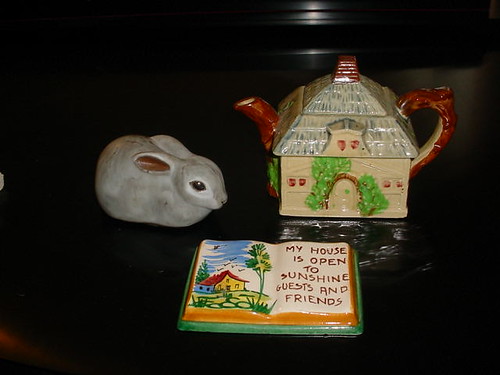
pottery stuffs

The rabbit is very pleasing in a tactile sense - about the size of your hand, and very smooth and rounded. It's going to be part of the eventual Easter decorating I do on my mantel this year.

And I decided I had to have the cottage teapot - that's another one for my collection now. I think I have five or six, if you could the little sugar-and-creamer set and the salt and pepper shakers in that form. That will probably be my summer mantel.

And I liked the little plaque. On the back it's stamped "Hand painted in Italy," so I don't know if it's a piece of souvenirware or if it was made there and imported over here. But I like it. I haven't decided where to put it up just yet but it will match just about anywhere in my house.

I did eat lunch at Churchill's - it was an an interesting and rather atmospheric place. (The real bar, I guess, is upstairs...they also broadcast European soccer matches up there. In the restaurant proper, where I ate, it was a lot quieter). They had a lot of Queen Elizabeth II memorabilia up on the walls, and the ceiling was dark and low, with beams. I chose one of the high tables that had tall stools at them; there was also a sort of banquette along one wall with several tables, and a big family-style table in the middle of the room.

I ordered something called the Sir Winston Churchill club sandwich - ham, turkey, lettuce, tomato, bacon, and a hard-boiled egg cut up on it. I would not have thought to put a hard-boiled egg in a meat sandwich, but it was good. The sandwich also had a lemon mayonnaise on it (not too much, either, which was good) and the whole combination was just good to eat. I also ate most of the fries (or, I should call them, "chips") that came with it because they had malt vinegar out on the tables. (I prefer malt vinegar on fried potatoes to catsup. I guess vinegar used to be a more common condiment; I remember one of the early, early Nero Wolfe novels has Archie make a disparaging comment about how Fred Durkin put vinegar on all his food... in a later book, that changed to catsup.)

After that, I did a bunch more shopping. Loco Cowpoke yielded a birthday present (various hot sauces and a chili mix) for my brother. (He can be hard to buy for, but as I said once before, I think that some kind of "specialty" food that you know the recipient will enjoy makes an excellent gift, because (a) they can use it up and don't have to find a place to put it and (b) if they really decide they DON'T want it, they can usually re-gift it to someone.)

I also bought some books.
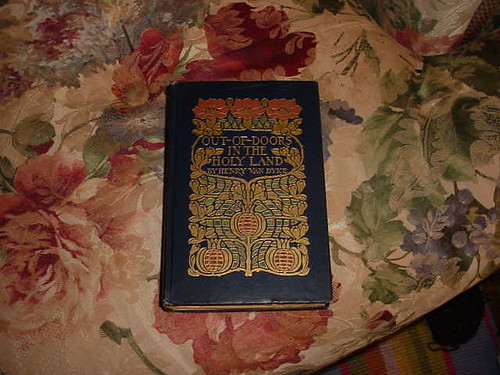
Out of Doors in the Holy Land

I've read some of van Dyke's essays (He's probably best known today for the story, "The Fourth Wise Man,") and this looked pretty fascinating - a trip through the Holy Land in an era before hotels, before easy transportation, even really before cars. (The copyright date in the book is 1908. More than 100 years old, which amazes me a little. And yet - it's in fantastically good shape. I will say I find a lot of pre-1920s books seem to have lasted better than more recent books; I think it has something to do with the formulation of the paper. I think the paper back then was more prone to be "acid free," and then for a period starting around WWII, the paper was more acidic (I have some WWII era paper backs that are crumbling to dust), and now, just recently, many publishers have realized the importance of acid-free paper again. A lot of the scholarly books I buy have a little note in them to that effect - some even somewhat smugly state, "This is a *permanent* book")

It's actually an ex-library book, apparently: it's stamped "Nellie Davis Library" and has a small pocket that could have held a check-out card. But it's in remarkably good shape so if it circulated, it must have been taken very good care of.

Besides wanting to read it, I find it just an incredibly beautiful book. I love that cover decoration.

More old books:
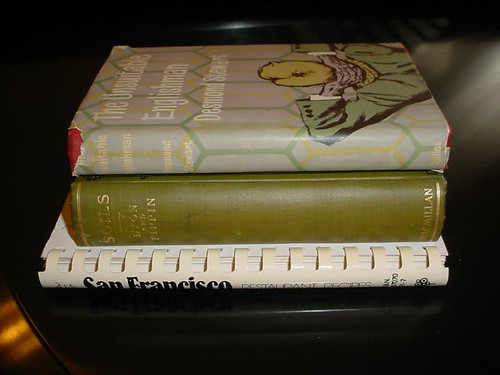
new old books

The one on the bottom is recipes, ostensibly from some of San Francisco's famous restaurants. A lot of them are ethnic recipes (I think there's a Kibbe recipe in there, and a yakisoba.) One or two I might want to try, but a lot of times the cookbooks I buy are more for the fun of looking at them than from actually cooking from them.

The soil book is almost 100 years old - it's copyright 1913. (And again: in excellent shape). I bought it, in part, because I wanted to see how much had changed between now and then in the teaching of soils. (A quick thumb-through suggests: not as much as I had thought.) Another interesting thing about the book: it belonged to J. W. Allen, who gives his (I presume) address as K. S. A. C. Box 498. I'm assuming that's Kansas State Agricultural College.

Also, the book is of a series edited by Liberty Hyde Bailey. I'm familiar with that name - he was a fairly well-known botanist in the first half of the 20th century. He was the first to talk about "cultivars" of plants, and he was instrumental in re-introducing Mendel's work on genetics.

But I know him best for the jocular name my mother said students of her generation (which was, actually, a generation of botany students after his death, but his textbooks were still used) referred to him as: "Free Skin Bailey."

Because of "Liberty Hyde," get it? (I suspect the nickname was found funny because it sounded a bit like something more ribald than it actually was...)

The top book on the stack just looked interesting to me. It was $3, so I figured even though I'd never heard of the author, it was worth a try. It's about a young British man who winds up in a (fictional) Middle Eastern country ("Media") and apparently winds up working for an oil concern. It just looked kind of intriguing. (One of my dad's friends - now deceased - worked for one of the British oil companies in Libya, in the days before Gadafi. He had all kinds of interesting stories, and it's from John that I learned you NEVER show a person in an Arabic culture the bottom of your shoe or your foot, as that is seen as an extreme insult - sort of saying "You are even less than the dust below my feet" is how he presented it. Which is why you see video of protesters there beating shoes on pictures of (a few years back) Saddam Hussein, and more recently, Mubarak and Gadafi.)

It wasn't until I got the book home and started flipping through it that the really curious and interesting thing revealed itself:
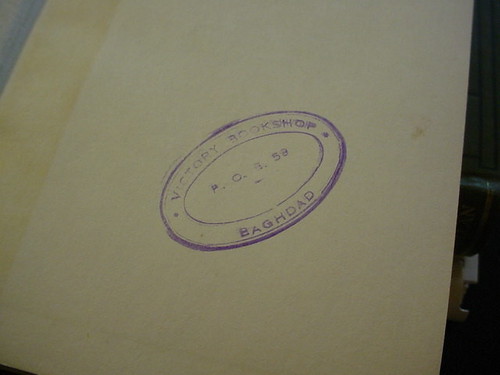
book from baghdad

Where the book was originally purchased. It was printed in the UK (The author himself was a Brit, someone living and working in Iraq), but this copy was originally purchased in Baghdad. (The copyright date is 1955. I have no idea what was going on in Iraq then but obviously there were bookstores selling British books).

This is why I love buying used books so much. To sit and imagine the path a book might have followed, the hands it might have passed through, on its way to me.

My guess - which I think is not entirely unreasonable - is that an oilman in Iraq bought it, and either he was a Texas oilman who then came back home with the book, or he was a Brit, and this is part of the library of books that the owners of Morningstar Treasures (where I bought it) purchased from the estate of a British man (if that's the case, then I have some of his other books, as well - I bought a number of the ones that the owner specifically told me had come as part of the library they bought).

But it's amazing to me to think that that book, first printed in Britain, then passed through Baghdad - and then to Texas, where the exchange of $3 put it into my hands so I can read it.

There are some other things I bought - some yarn and some fabric and one rather silly and amusing thing - but I think pictures for those will come later.

Saturday, December 18, 2010

Reading at Christmas

There are a lot of short stories and books that are either set during Christmas, or are about Christmas.

Some, like the two Miss Read Christmas stories, I like to read every year. Both of her stories show "merry little" Christmases - neither of the families involved are wealthy, and the celebrations are small. In one, a pair of spinster ladies prepare for their quiet Christmas when the boisterous family next door needs their help (The mother is going into labor with her third child, and her husband is off helping another ill family member). In the second story, a widowed woman, her widowed daughter, and her daughter's two small children prepare for a quiet Christmas when their Christmas eve is interrupted by a mouse - and by a runaway child.

In neither case is a large production made of the holiday. Oh, there are small gifts, but they are mainly "practical" gifts (new gloves, new slippers for the children). The children do get a couple of toys - small dolls and some new games - but it's a much smaller 'haul' than what an American child of my generation would probably expect. And yet, there's no sense of "is this all there is," because that's ALWAYS "all" there is, and no one wants for any more.

I think that's the thing I like, and find so touching about those stories. And also about the Little House descriptions of Christmas: how delighted the girls were to get their own tin cups to drink of (so they no longer had to share a single one). Or how exciting a piece of fancy, store-bought candy ("Made with white sugar" as is specified in the book - that would have been a big thing in those days, when maple sugar was much more common). Or an orange in the toe of the stocking.

(It's easy to forget, I think, in these days of California and Florida orange groves, and fruit shipped on planes and in refrigerated trucks, just how precious citrus used to be. And it wasn't that long ago...my dad talks about how when he was a kid, Christmastime was pretty much the only time they had oranges.)

I love those stories because it's interesting to read how other people celebrated. And it's refreshing to think of the simplicity of the celebration, and how children could be so excited by a small Dutch doll (as in the Miss Read story) or a new pair of mittens. There's something kind of touching about it, and it makes you pause and think about how much you have.

There are also a lot of stories set at Christmas that involve crime and detection. I'm sure part of this is because during the 'Golden Era' of mysteries, most magazines ran short stories, and they probably wanted one special for their "Christmas number."

I have a big compilation volume called "Murder for Christmas" (which has some funny cartoonish illustrations by Gahan Wilson in it. It is the volume that first introduced me to Inspector Alleyn ("Death on the Air" is the first Alleyn story I read). It's an enjoyable read if you like detective fiction. (There are several other volumes out there, with Christmas-themed crime fiction in them; I have one that's a Folio Press volume). Some of the stories - the more modern ones - can be a bit depressing, but many of the stories - like "The Adventure of the Christmas Pudding" (one of the later Poirot stories) - are pretty light and funny. (This is a spoiler, but: the "murder" in that story turns out not to be so.)

There are also longer Christmas-themed mysteries. "Hercule Poirot's Christmas" is one of them (In this one, there actually IS a murder). And there's a very good Hamish MacBeth outing called "A Highland Christmas." (Some might be disappointed that this outing has no murder, but I found it charming and an entertaining read. And there's a lot of discussion of the cultural celebrations of Christmas; some Scots are of a more severe strain and did not celebrate it...) And there are Nero Wolfe Christmas stories, and a couple of full-length Alleyn mysteries set at Christmas ("Tied up in Tinsel" is one of my favorite Alleyns).

And, of course, there are more serious writings on Christmas. The granddaddy of all of these is "A Christmas Carol," and I try to read it every year if I can make the time. I think a lot of our celebration of and perception of Christmas is owed to Dickens. (And there's also the wonderful Christmas at Dingley Dell chapter in Pickwick Papers).

And this year, a new one for me: Miracle and Other Christmas Stories, by Connie Willis. It's interesting to see someone I know as a science-fiction writer writing in a different genre. And obviously Connie Willis loves Christmas. Her stories, without being overly sentimental, are still funny and wonderful and celebrate the good things of Christmas.

"Miracle" (the eponymous story) is very good; it weaves in the theme of how sometimes we get what we really wanted, but weren't even wise enough to realize that we wanted it. (How many of us, I wonder, go through life thinking we want one thing, when really there's something else we want more, that's ultimately better for us, but that we've convinced ourselves we don't want, until we actually get it?)

There's another, shorter story, where a child mishears "anonymous present" as "ominous" present, which is both funny and thought provoking.

My favorite, probably, in the whole volume, though, is "Inn." Not to give too much away (but how can you not?), it involves a couple of very important visitors showing up to a church during evening choir rehearsal - but almost everyone is so blinded by their need to "get Christmas done" or by their prejudices, that they fail to see the visitors for who they really are. Except for one woman, who helps the visitors on their way, and is ultimately blessed herself. It's a fairly simple story and you can more or less guess where it's going, but there's a loveliness to it.

I also like "Epiphany," probably the longest story in there. One of the things I like about it is that it ends ambiguously - it's not all neatly wrapped up; the characters have not yet found what they are seeking when we leave them. I tend to think that stories with ambiguous endings stick more with me - that I am left thinking about the characters, wondering how their stories worked out. (It is hard for me not to imagine the characters in books I read as existing in some sort of alternate universe where they have independent lives and independent existences, and are "real" in some way. Perhaps that's why I'm so devastated when an author kills off a sympathetic character, particularly one that's been part of a long-running series: For example, I prefer to imagine Hercule Poirot in a long, quiet retirement somewhere warm - and so I will never read "Curtain," since I know what it is about.)

I wish you good reading this Christmas season.

Monday, November 08, 2010

Learning from mysteries

It's interesting how trains of thought proceed. I often get pushed to look something up, or read something, based on something else I've seen.

Last night, I was flipping through a back issue (Sept./Oct. 2010) of Piecework. This is one of those magazines that varies for me in interest from issue to issue; it seems just as I've decided after a run of one or two where the main focus is on (say) bridalwear through the ages that I'm going to drop it, then an issue comes that has an article on one of my personal areas of interest. (The most recent issue has an article on Herdwick sheep and the Beatrix Potter connection).

This issue (you can see the cover and contents here) had some interesting things - a pair of Irish-style gloves, the pattern for which could be adapted so that an actor could knit on them on stage (the gloves in question being originally developed for a production of "Dancing at Lughnasa").

(Actually, I should sit down and re-read the whole issue; I think it came at a time when I was busy and didn't really give it much attention. There's also an article on needlework in Jane Austen's time)

But what attracted my attention this time was something I had flipped past previously: the question of "What would Miss Marple knit?"

And it included a shawl pattern - actually, a reprint from Weldon's.

I had kind of bypassed it before - I bought a couple of the old Weldon's Magazine reprints when Interweave had them on a very good closeout, but never made anything from them, in fact, mainly intended to keep them just to look at. They don't work that well as pattern books for modern knitters for several reasons: first and foremost, many of the garments are styles we would not wear now, unless as part of a play or re-enactment. And second, there is no gauge specified, the needle sizes are the "old British" sizing, which is both different from modern US and metric sizing (though there are conversion charts somewhere), and there are usually only weights, and not yardages, of yarn specified. (And I think much better in terms of yardage than in weight). And of course, the yarns are all ones that haven't been made for 70-100 years, so you have to try to suss out equivalents. (Again, there are places online that can help). Finally, the terminology used in the patterns is often different than modern terminology.

I think the first time I saw the pattern I just bypassed it as "another somewhat incomprehensible old Weldon's pattern." But when I looked at the article again last night, I realized: hey, this pattern DOES make sense to me. I see how it works. It would be fun to knit.

I love "historic" patterns. One of my favorite knitting books is Nancy Bush's "Knitting Vintage Socks," because of the tie-in with Weldon. I love the feeling of reaching back over the years, and as I've said before, sort of "shaking hands" with some (usually unknown) knitter from the past who either developed the pattern, or at least wrote it down.

And then I realized: wait, that Noro Silk Garden sock yarn you have? That you don't have a pattern in mind for? It would work here. Even better, because it's a fairly simple shawl pattern (it's knit corner-to-corner, and is mainly stockinette with regularly spaced eyelet bands). And I'm guessing the original pattern was written for a sportweight, but it doesn't matter as much with a shawl, it's just a bit bigger or smaller or you block it up to the size you want.

And I liked the idea. The Weldon's pattern is ca. 1930, which would mean Miss Marple COULD have knit it (if she were, you know, a real person). I don't know that Miss Marple would have used a stripey variegated yarn (all I seem to remember reading of her knitting was that it was either "soft, cream-coloured wool" or "pale blue wool").

I also realized that most of what I knew of Miss Marple was from seeing the (admittedly excellent) PBS adaptations of the stories. And so this is where the trail begins.

I pulled my copy of "Miss Marple Stories" (I think it was free from Folio when I bought something else - maybe the Poirot short stories three-book set). And I started reading. And it started with some of the earliest appearances of Miss Marple; the "Tuesday Night Club" stories, where a group of people gather and share "unsolved" crimes (and, of course, Miss Marple figures them out).

There was one that contained two new concepts to me. One of the women in the story was described as "stout" and it was said she was "banting" to try to reduce. Well, from context, I assumed "banting" was some form of diet.

And here's where my mind went: I knew that Frederick Banting (along with Charles Best) was the discoverer of insulin, so maybe there was a diet named after him, and maybe it was a special diet for diabetics but that made other people lose weight. (My great-grandfather - my dad's mom's father - had been a diabetic late in his life and people tell me he had to eat a very restricted diet, this being the years before medications were available).

But no - it's still a very low-carbohydrate diet, sort of a Ur-Atkins plan, but it's named for a different Banting. William Banting (who actually was related to Frederick), was a formerly-fat man who lost a great deal of weight on a low carbohydrate diet, and apparently wrote a Letter to the public promoting it.

(I will observe, that the woman who was ultimately the victim in the case told her friend: "If the good Lord meant you to be stout, you should not worry about it" and proposed that banting would ruin her friend's health. I guess that's kind of how I feel: I mean, there are steps you can take to safeguard your health. But if being "slim" according to current fashion means eating egg-white omelettes and never getting to taste bread, I think I'll opt for being stout. Which is actually a more comforting descriptive term to me than "fat" is; "stout" seems to carry with it - to me at least - the connotation of robust good health, which I do, in fact, enjoy. Beatrix Potter was also described as "stout" later on in her life)

The other thing I was unfamiliar with was the concept of drinking "A bowl of corn-flour" before bed. I assume corn flour is what we in the U.S. call cornstarch - I've seen some British cookbooks note that similarity. I am guessing "a bowl of corn-flour" is kind of akin to what's called "atole" or "maizena" in Mexico: a beverage made from corn. (I've never had it so I don't know what it's like). It seems a strange thing to drink to settle an upset stomach (that was the context given), but who knows.

It surprises me how much you can learn from even a 'simple' detective story. I'm sure Christie, when she was writing it, had no intention of capturing all these small odd bits of Life Between the Wars in Britain...I suppose a lot of writers like that, especially those who wrote for the magazines (I assume that's how Christie's stories were originally published) intended for them to be largely ephemeral, a source of income for the writer and entertainment for the readers and little more. But I do find those old stories fascinating for the "background" or the settings as much as for the stories,just as I look hard at the dresses and interiors in old movies that were made during (and set in what was then "contemporary" times) the 1930s and 1940s.

So, anyway, at some point I want to knit the Weldon's shawl. I have too many other projects going to think of it now, but perhaps that will be my take-along-over-Thanksgiving-break project, as it would be fairly portable and fairly simple.

Sunday, August 22, 2010

The old river

I'm really enjoying "Up on the River" (John Madsen). He writes quite lyrically - I can picture the upper reaches of the Mississippi even though I've never seen them, from his description of how he canoed down it with his daughter.

It's the kind of book I love: he interweaves his current experiences and nature-writing about the river with history of it, with information that allows you to kind of situation what you're reading in your mind, fit it in with other stuff you know. (In a way, he's a bit like Simon Winchester, another writer I enjoy).

The book makes me happy, because in along with the new things I am learning, there are the occasional familiar names. He speaks of Henry Schoolcraft, probably the European-American with the likeliest claim on finding the river's headwaters. Schoolcraft County was one of the counties in the Upper Peninsula that we drove through to visit my grandmother. (It was the next one east of Delta County, where she lived).

And he speaks of some of the other early explorers, names I dimly remember from some of my American History classes.

But there's other information in the book - the sort of odd little facts that stick in my mind, and, if I'm lucky, there will somewhere be a time where it's appropriate for me to trot them out and then people will look at me like I'm really smart because I happen to know that.

For example: Lake Itasca, the putative head of the Mississippi? Is not named for a Native American word (Itasca does not occur in any Native language in the area), but rather, it's a contraction of veritas caput, meaning "true head" in Latin, indicating that Schoolcraft believed this was the true headwaters.

He also cites the origin of the phrase "bull pines," which is snicker-worthy, at least if you're in touch with your inner 12-year-old:

"...lofty crowns of white pines that were already a half-century old when Schoolcraft first passed them - the kind of trees called 'bull pines' by some timberjacks. (I once asked an old Swede woodman why this was so, and he roared with laughter. 'Vy? Because dey ain't never been cut yet, dat's vy!')"

(It could be that I find that funny in part, because my northern Michigan relatives - despite their British/Scots/French heritage - lived in a heavily Scandinavian area and their senses of humor were influenced by the Swedish and Finnish people living there. And Madsen's reproduction of the accent there is actually something you still do occasionally hear up that way. Or "over by dere," as we'd say. (I used to be able to mimic a Northern Michigan accent pretty well. I think it's been too long since I've been up there for me to be able to slip into it again)

Madsen is literary, in addition to having known the human and natural history of the area. In one place he speaks of being upset about something and "tarnishing the welkin" (cursing at the sky, and I only knew what "welkin" was from having read it in Shakespeare). What a great phrase that is.

He wrote that although the Lower Mississippi certainly has its beauty and interest, he prefers the upper reaches:

"[the bayou reaches of the river] are just not the same as our upper reaches where the River cuts deep into bedrock.. It is country that stands on its hind legs and shows its limestone muscles, rising sublimely over a river that flows in broad running lakes and the tangled multitude of sloughs, cuts, and side channels that wander through a fastness of wooded islands and floodplain forest"

(Now that I reread that passage, I strongly suspect that Aldo Leopold - another favorite writer of mine - had to be an influence on Madsen.)

Madsen used unusual turns of phrase - at one point, he speaks of canoeing in the uppermost reaches of the river: "an infant river that purled along happily, chuckling to itself now and then..." (Of course, as a knitter, that phrase caught my attention).

Sadly, there will be no more from John Madsen other than what is now published (He died in 1995). But he does have several other books, including "Where the Sky Began," which is about the prairie and one of those books I always meant to read but never yet got to (now that I see how Madsen writes, I will be getting to it).

I know some scientists might dislike the floweriness of his language, or his way of meandering from subject to subject. But his writing cheers and comforts me - I can picture the places where he has been (and now I kind of want to go and see the headwaters of the Mississippi, something I never even contemplated before). And his writing makes me more curious about the natural world and our history in it.

Monday, July 26, 2010

100 sci-fi books

There's a list making the rounds of "100 Sci-Fi books everyone should read."

Rather than doing the whole list, and bolding the (embarrassingly few) that I've read, I'm just going to list and comment on those I HAVE read. (you can go to either of the links for the full list, and for their comments on them)

So, here are the ones I've read:

The Martian Chronicles – Ray Bradbury (Though I can't remember if I actually finished it.)

Fahrenheit 451 – Ray Bradbury (Scary book, and one of those books, like "Brave New World," where, in my bleaker moods, I wonder if society isn't VOLUNTARILY moving towards that kind of depauperate existence)

(I've also read his "Dandelion Wine." Not really sci-fi, more of a memoir, but I remember finding it quite beautiful, the summer I read it when I was 13 or so).

The Hitchhiker’s Guide to the Galaxy – Douglas Adams (I think most geeky kids growing up in the 80s read this. Maybe even multiple times.)

1984 – George Orwell (Scary book, but I think its future is less likely than the one laid out in "Brave New World," where people voluntarily choose to infantilize themselves)

Slaughterhouse Five – Kurt Vonnegut (I know I read it but I do not remember it now. Not a single plot point. Can you count a book as "I read it" when you don't remember it? I just remember that I decided I didn't care for Vonnegut. I know people love his writing, but I just can't get into it.)

A Clockwork Orange – Anthony Burgess (Read this in high school. Another book I found scary, mainly because of the seeming soullessness of the droogs.)

A Journey to the Center of the Earth – Jules Verne (I remember LOVING this as a 12 year old or so; I tried to re-read it a couple years ago and got so hung up on the scientific inconsistencies that I couldn't enjoy it any more.)

Twenty Thousand Leagues Under the Sea – Jules Verne (Haven't ACTUALLY read it but it's on my list)

Jurassic Park – Michael Crichton (I liked it better than the movie because I think the book did a better job of raising the question "Just because we CAN do this, SHOULD we?")

Doomsday Book – Connie Wills (Oh my goodness yes. I LOVED this book. This is one of the very small number of books I push on people. It's fascinating and challenging and sad and exciting...)

Flowers for Algernon – Daniel Keyes (Another one of those that raises some important sociological questions, and the whole spectre of "If we can do this, should we?" and also "is it better to have a short period of an "ideal" life and then lose that ideal, than to never know what it was like?" Actually, this is another book that made me sad when I read it.)

Stranger in a Strange Land – Robert A. Heinlein (I found it very unsettling. Did not like Valentine Smith at all, did not like Jubal Harshaw (and did not trust any of the characters.) It was a good story but I'd run fast the other way if I met someone like Smith. Or Harshaw, for that matter.)

A Wrinkle in Time – Madeleine L’Engle (I have read this many times, first at the age of about 8, when I was probably too young to understand it. I still love it and it seems to get deeper with each re-reading. I've read most of the others in the series as well.)

Out of the Silent Planet – C. S. Lewis (Another "haven't read yet" but I have the entire trilogy on the bookshelf. Aha! Maybe I should take the first volume to read on my trip - I was trying to figure out a not-too-heavy (physically heavy) fiction book to take, and my copy is paperback)

A Fire Upon the Deep – Vernor Vinge (Started it three or four times, got lost or bored every time.)

The Handmaid’s Tale – Margaret Atwood (I don't know. I kind of felt like I was being beaten with a feminist stick for much of this book. Yeah, yeah, misunderstanding religion can make people do bad things.)

Sunday, July 25, 2010

Didn't quite finish

Despite working on them most of the weekend, I burned out a few rows before the finish of the Weasley Homestead socks. I'll probably finish them before break, just not today.

I also re-started reading "Guns of August," a highly-lauded Barbara Tuchman history of the beginning days of World War I. I started this last year and stalled out. I admit it, I have some difficulties with the history of World War I. It was not well-taught, I think, in grade school American history. I know much more about World War II, though that may be in part because one of my history teachers was a WWII buff, and also possibly it was more heavily taught. I suppose the "narrative" of WWII as a "just" war for the US to have participated in makes more sense, especially when you're teaching a grade-school crowd. And also, they may have emphasized WWII, knowing pretty well that some of the kids likely had grandparents who had served. (In my family - my parents were about 10 years older than most of my peers' parents, having chosen to start a family later, and their parents were older than many of their own peers' parents - I had a great-uncle who served in WWI (my grandfather on that side would already have been close to the upper limit for conscription) and on the other side, my grandfather had been an experimental Army Air Corps pilot, but he never saw overseas service.

(and as an aside: now how I wish I had paid better attention - or he had been more forthcoming with stories of his service. He died when I was eight and now I wish I knew more about his time as a pilot. I do think my one uncle has his diaries and is trying to put them in a more-readable narrative format, so maybe someday I will get a chance to read them)

Anyway, I knew relatively little of WWI other than some isolated facts. For example, I remember one teacher commenting on how the Germans had perfected some kind of synchronization device so they could forward-mount the guns on their planes and fire *through* the propellor blades mid-spin, rather than the rear or wing-mounts of the British planes. And I remember that was the war of the Red Baron, though frankly, the Red Baron makes me think more of Snoopy pretending to be a WWI flying ace than anything.

And I knew that it was trench warfare, and from the sense I got from the history classes it was mostly brutal and miserable, and it seemed a lot of the men didn't really understand what they were fighting for and why - it seemed that it was more a war for the glory of the officers than anything. (Though perhaps in any war, a lot of the enlisted men get to the point where they either don't know or have forgotten what they're fighting for, and it just becomes a matter of marking off days until the next leave or until they can muster out).

And I remember hearing about the poison gas, how inhumane it was, how much suffering it caused.

(And on a more humane side: I've read of the Christmas Truce, when German and British troops briefly ceased hostilities to celebrate the holiday - a game of soccer was played, and carols sung....and yet, the next day, they went back to shooting each other.)

And I read a lot of the poetry - WWI produced a lot of poetry, most of what is in the anthologies today seems to underlie the idea that the ordinary fighting man didn't really understand - the Irish Airman foreseeing his death, for example, or that Wilfred Owen poem that ends with a mention of "...that old lie: Dulce et decorum est pro patria mori" (And of course, many of the poets saw service themselves; some, like Owen, never actually returned.)

And I read "All Quiet on the Western Front" in high school, and saw the old movie (I think it was called "Grand Illusion"?) about the two deserters. And the interesting thing is, in none of those cases do you really come to understand - or at least, did I really come to understand - the reason why the war was fought.

And I think the way a lot of history is taught in the schools maybe affects this. It's hard - or maybe educators just think it's hard, and so don't try - to teach nuance to schoolkids. I always remember that "WWI started with the assassination of Archduke Ferdinand" but it seems much more - from what I've read of the Tuchman book - to be the Germans wanting too expand, and violating Belgium's neutrality on their way to try marching into Paris.

(I think of the old episode of the Simpsons, where Apu was trying to earn US citizenship. He had very nearly passed the test when the examiner asked him about the cause of the Civil War. He started into a discussion of states' rights, and the bored examiner looks at him and says, "Say 'slavery.'" That's also kind of how it's taught in the schools...)

So anyway, I'm trying to fill in that gap in my education. I admit it is slow and sometimes difficult going - almost none of the names are familiar (the way the names from WWII would be) and also, there are names that sound German but are actually of French generals or other officers, and likewise, French-sounding names of Germans.

But because I'm maybe too good at trying to see the connections between things, I feel the need to go on - to understand. Because it's the war my Great-Uncle Burt (even though I never met him) was an infantryman in (and he was one of the lucky ones; he got to come home) and was the war my grandfather was training for, even if it ended before he saw service.

And also, though I understand that I really CAN'T learn everything, still, I'd like to try. So I'm trying to set aside goodly chunks of time to read on the book (it seems to get more traction on my brain that way), and I'm going to take it with me on break and try to actually finish it this time.

Wednesday, July 21, 2010

Walloon -in-law

More genealogy stuff, this time on my dad's side. Apparently the second wife of my great-great-great grandfather was a woman from Belgium (or of Belgian heritage) living in Prussia; she kept a diary which my uncle is having translated. He sent on the first part and it talks about them being able to go to church again after the Walloons were "expelled from the church" due to "unrest from the war" (this would have been sometime between 1790 and 1810. I don't know what war is referred to for sure, apparently it was between Prussians and French). She also apparently had a very unhappy first marriage.

She makes the comment: "The legal proceedings were skewed by bribes but I still won through the strictest justice and a majority. Additionally, he and his son will not escape God....."

So apparently, she managed to get a divorce and remarry (apparently Walloons were a Protestant group, so divorce would have been possible at that time, even if it was very likely frowned upon). (Or perhaps her first husband died while they were separated; I have only the first few pages and they're a pretty rough translation in spots. I'm not totally sure of the language it's written in; it looks German but also not quite: perhaps it's a dialect, or perhaps, like some women of her time, her education did not extend all that far and her spelling and syntax are not perfect. Also the translation makes me think that the person who translated it doesn't have a good grasp of the idiom of the language; there are some things that appear to be literally translated but that do not make good sense.)

I say she's an "in-law," because I don't know if her children were the ones in my direct line, or if it was from my great-great-great-grandfather's first wife (I THINK he had a first wife who died...) who were.

But still, it's interesting. (And a little bit sad, that she had to flee her first husband, apparently. There's also an entry where it talks about her brother fighting her husband.)

Stuff like this makes me curious about those bits and pieces of European history that I know little about. I kind of knew who the Walloons were but I had to look up to be sure. I have a number of books of European history - mostly from the Middle Ages and early Renaissance, because that time period interests me - and I really should make up some kind of plan for reading them.

I want to read (or actually, re-start) Barbara Tuchman's "A Distant Mirror" which is in that time period. (And I should really try to finish "The Guns of August" - which is about WWI but is partially set in Walloon territory - the Sambre and Meuse valleys being where the Walloons were centered, and where a lot of early fighting of that war took place)

***

Right now, though, I'm reading a book that alternately fascinates me and makes me want to throw it across the room. It's called "A is for Ox" by Barry Sanders. It's about oral culture versus literate culture, and while I am really interested in what he has to say about the idea of how cultures changed (in the Middle Ages, right at the end) from being primarily oral to primarily literate - and how our way of thinking is different when we are literate (He also talks about the transitions children go through, from being unable to read to being able to read), I find his constant drumbeat of "we are killing ourselves as a culture with the world wide web" very tiresome.

I don't know how much of his arguments to accept or discount. He does have footnotes and all, and some of the data he provides seem solid. And I agree with his premise that children who spend their early childhood plunked in front of a tv screen all the time instead of having parents who talk with them and take them to the zoo and read the labels of the cereal boxes to them in the grocery store have a much more difficult time managing in life than children who do, I think he's searching for a single big answer to the problems plaguing some inner cities, when it's really a lot of problems.

He basically is making the claim, as I understand it, that violence is rising in cities because kids who don't grow up in a culture where they're spoken to and learn the intricacies of language - and later on, become readers - don't develop a sense of self the way kids who are read to and talked to and all that do. And as a result, they're more likely to become sociopaths who kill other people, because human life means less to them. And I find that very hard to swallow, somehow. Like, it's too simple of a solution for a big complex problem. And at the same time, it's a very pessimistic view - that these kids are essentially unsaveable, because they have passed through the critical stage without experiencing something.

I don't know. On the one hand, he seems to be celebrating some of the pre-literate cultures, where people were "engulfed in orality" and at the same time, he's roundly criticizing (mostly) urban, inner-city families and schools for not properly socializing their children into literacy. (And part of me wants to say: when the family's worried about whether they're living in a safe place, and if there will be enough to eat, probably making sure the kids have access to books is low down on the scale of priorities).

He also, somewhere, makes the comment that "10% of the population reads 70% of the books." If that's true, then there must be a lot of socioeconomic/profession skew to that number, because far, far more than 10% of the people I know are avid readers.

So I don't know. I wish he stuck to exploring (a) how oral and literate cultures differ (b) the history of literacy and possibly, (c) the best ways to teach disadvantaged kids to read (he argues that it's NOT plunking them in front of a computer - yet another screen - with a reading tutorial, that what they really require is interaction with real live people, and I do agree with that point) and would back off on the OH NOES WE ARE ALL DOOMED! screediness.

There is another book - a Folio Press book, I forget the author - by the same name (A is for Ox) that is about the history of the alphabet. I should probably be reading it instead; I'm sure I'd find it much more restful. (I find I greatly prefer to read books about the clever things cultures have done, rather than how the cultures destroyed themselves.)

Tuesday, April 06, 2010

Wow, I can't believe my allergies this week. This has been almost like a cold. It finally let up a little this morning (great, just in time for me to start sorting the moldy old soil again). I had absolutely no energy last night - I knit a bit on the two pairs of "simple socks" but really had a hard time concentrating.

(And in case anyone's wondering: I told my chair about the student attempting to pick the lock and I am going to e-mail his departmental chair (he is from a different department) today. I don't want to get the guy in big big trouble over what was probably one of those "hey, look what I can do" Stupid Human Tricks, but I do think he might benefit from being talked to by someone scarier than I am)

So I'm going to talk a little about the other book I completed over Spring Break but never wrote about here. This was a book sent as a gift from a reader. It's really fascinating: "Women's work: the first 20,000 years" by Elizabeth Weyland Barber.

The book does talk some about ancient Greece and Egypt, but there's also lots of what you might call Proto-Indo-European stuff - that sort of dawn-of-civilization, we-still-don't-know-much-about-it-and-could-be-totally-wrong-after-all-look-at-what-Macauley-did-with-Motel-of-the-Mysteries stuff.

I find the really early stuff deeply interesting - it's partly the roots of who we are, but it's also so different. And yet, sometimes, it's possible to trace (or to try to trace, and recognize that the links are really tenuous) how some of those old beliefs and rituals came down to present day. One example is the idea of the "string skirt." Some of the early Venus statues were naked, except for a "skirt" of knotted string. And Bronze Age remains of a woman were found - again, she was (apparently) naked when laid to rest, save for a skirt of knotted string. Barber interprets these as fertility symbols: that a woman donned them when she had reached menarche but had not yet been "married off" (whatever form "marriage" took in those societies). Essentially, it was advertising: Hey, boys, I'm ready.

The thing is: some "recent" European folk costumes (particularly from places like Wallachia and Macedonia) feature heavily fringed aprons for the women. And Barber interprets that as a modern day survival of the old string skirt - maybe people would say that it meant something different now, or maybe the wearers of the dress wouldn't even be aware of the old meaning. But somehow, the thing survived, and was passed down, and maybe changed a bit in meaning over the years.

(This seems to be not-uncommon. From what I've read of some of the Morris dances in England, they are holdovers from old festivals in the spring - for the fertility of the earth - but now all the old ideas have been largely forgotten. And in Lark Rise to Candleford, they talk about the May Day festivities, which include carrying around a huge bouquet of flowers, with a china doll attached, called The Lady - and Flora Thompson speculates that The Lady was once (in earlier times) "Our Lady" (meaning Mary), and that she was a replacement of an earlier pagan goddess).

Barber also talks about the "hooked lonzenge" geometric figure that shows up again and again: it's another fertility symbol, or to put it politely, a "female" symbol (in that it resembles, very roughly, female genitalia).

(Fertility being much more important, I guess, to ancient societies than it is to ours. Or maybe we still have that stuff going around - all the subliminal sex in advertising - but we're just blind to it).

The book is mainly about spinning and weaving (knitting comes later,  and crochet comes MUCH later). One thing I found interesting were the different loom set-ups: in Egypt, they often used a flat loom that was low to the ground, where women would sit on the ground to weave. This worked because they could set it up in a courtyard and pretty well trust that it would not be rained upon. In wetter northern Europe, vertical looms were used (they were also apparently used in Greece), where the warp ran vertically and was held straight with clay weights (in some cases, it's only the weights that remain to attest that people wove in a particular habitation). She also notes that Penelope's fabled loom was probably more like a tapestry loom - weaving a tapestry, or pictured-cloth, is probably the only way she could have justified all the time it was taking (when she was ripping back at night, to avoid having to choose one of the "suitors," knowing her Odysseus would return).

One thing Barber notes is that doing an archaeology of things like spinning and weaving can be difficult. For one thing, fiber does not generally preserve well. For another, at least in earlier archeological days, some of the findings were discarded (loom weights can look like rather indistinct lumps of clay). One thing she used - which I found interesting, as I've taken some linguistics classes, back in my undergrad days - is using comparative linguistics to see how "old" words are for different spinning or weaving processes: are they similar across all Indo-European languages, suggesting a common origin (what biologists would call "homology"), or do they differ and represent a later development ("analogy"). Another thing she did - and this is the opener for the book - is that in some cases she (or other researchers she writes about) actually TRIED OUT the methods they were contemplating: trying to spin flax, for example, or, as in Barber's case, trying to weave a small piece of plaid cloth to match one fount in the Halstatt salt mines. And she talks of what she learned from that process.

And that seems to make a lot of sense to me: learning how people did something by trying to do it yourself. Seeing what mistakes you make (Barber mis-warped the loom; she used the weft pattern for the warp). Seeing if there is an "easier" way of getting to the desired end. And then, of course, the idea that you are kind of "feeling" what someone felt hundreds (or, in Barber's case, thousands) of years ago.

Actually, that's one reason why I knit and crochet and quilt: I've said it before. I like that idea of a connection with the past. (And also, I suppose, playing the piano could count too: how many people, over the past couple hundred years, have picked out Beethoven's "Ecossaise in G" as part of their instruction? How many young ladies in households played that to entertain themselves - or someone else?)

Anyway: it's a really interesting book. It's written in such a way that it moves fast, it kept me engaged in it. And it's full of interesting small facts about spinning, weaving, and ancient cultures. I really enjoyed it.

Monday, March 29, 2010

One of the books I read over break was Georges, by Alexandre Dumas ("pere," as they say...).

It was an interesting novel. I was mistaken about it in two ways: first, it was NOT set in the Caribbean. Rather, it was set on Mauritius - in some ways, a more exotic and certainly a more distant locale. Mauritius is known in the book (mostly) as Ile de France, the name it bore during French colonial times. (First the Dutch had it. Then the French. Then the British. The Dutch named it Mauritius and the British, when they took over, renamed it that).

Also, Georges, the hero of the piece, is not noticeably of African descent. Oh, when people on the island (which is in many ways like a small town) hear his last name (Munier), they know he is "the son of the mulatto*)

(*I don't even know if it's "OK" to use that word any more, or if it's considered derogatory. The translator of the novel uses it, though).

Georges is able to "pass" as European, though once people know his heritage, they assume things about him. This leads to a certain degree of bitterness on Georges' part. We first see him as a boy - during, in fact, the battle between the French colonial forces (and the "native" troops siding with them) and the English, who wish to (and ultimately do) take over the island. Georges is impressed by his father's bravery, and upset by the way one of the French colonialist planters treats him after the battle.

Georges' father (presumably, their mother is dead) sends him and his older brother Jacques away, to France, to be educated, and for their safety. While there, Georges works at developing a nearly super-human self- control...and has the one goal of returning home and "showing them," whatever form that may take.

Georges is an interesting novel in two senses: first, as a nineteenth-century commentary on race, slavery, and colonialism. And I learned something about Dumas that I did not know before: he had some African heritage. (one of his grandmothers - I believe it was - was Afro-Caribbean). Reading the novel, at one point, I thought, "This author has some rather progressive ideas for a 19th century French novelist." Well, apparently, Dumas' own treatment - or the way he saw others of his heritage being treated - factored in to that.

That's not to say his attitudes are totally "modern." He frequently refers to the slaves (Black Africans and also Muslims from South Asia) as "poor savages" and similar. And he does not seem to see too much wrong with the ownership of slaves (even Pierre Munier owns slaves), provided they are well-taken-care-of. And Jacques Munier has become a slave trader, though he doesn't "hunt" slaves; he rather buys them off of other tribes...reminding us that in some African countries in that day, slavery of captured enemies was a common thing. (And it still exists, though for different reasons, in the Sudan today).

Still, it's an interesting viewpoint, and I suppose in its day it was revolutionary that a man of mixed race could be the hero of a novel, and perhaps even more so that a Black African slave (Laiza) could be a man of great honor and courage.

Apparently, Dumas suffered some prejudice and rudeness as a result of his heritage. A quotation from him, in response to someone who insulted him about his background:

"My father was a mulatto, my grandfather was a Negro, and my great-grandfather a monkey. You see, Sir, my family starts where yours ends."
 Heh. I'm assuming he also accepted biological evolution by that statement, though technically "we came from monkeys" is not exactly correct.

But totally beside all of the commentary that one could make, it's a rollicking good story. It's exciting, and moving, and romantic (and not in the icky way). It's set in an exotic place - Dumas talks about some of the plants, and several times he mentions the tenrecs, which are pretty much unique to that area. The culture is somewhat exotic, too - with both Europeans and "Creoles" ("Creoles" here being people of European heritage, but born on the island) as well as the people of mixed race, the Lascars (a Muslim group from India), Chinese traders, and so on. You can imagine the heat and languidness of the summer days as you read the book.

It also has many of the elements of nineteenth-century novels that I love: there is a ball (though it's not as happy an occasion as it could be). There are characters finding their true loves. There are rides through the countryside. There's a dramatic rescue of a damsel in distress.

And then there are other events: there's a hurricane. And a slave uprising. And battles at sea.

The book moves very fast, it's an exciting story (or at least I found it to be so). It has a lot of plot twists, especially as the end of the book approaches. In fact, the book ends not how I expected it would end. (But it ended how I had HOPED it would end).

The version I read was the "new" translation (the Modern Library translation) by Tina Kovers. I am sure that the quality of the translation in part makes the quality of the experience for the reader who cannot (or, in my case, doesn't care to) read the novel in its original language. I do know back in high school I tried to read The Count of Monte Cristo and either I had a poor translation or wasn't mature enough to cope with a denser book, but I remember it as being very slow and very dry and giving up a few chapters in.

I'm thinking, now, though, that I might chase down other of Dumas' work and read it, particularly if I can find translations similar in quality to the translation of Georges.  (Perhaps the Modern Library editions - which I love anyway, because they are nicely made books and appeal to the book-snob side of me - would be a place to start). I think I would like to read The Three Musketeers first, simply because the story is most familiar, and it seems like it would be similar (perhaps) to Georges in degree of "romance" (in the sense of being a good story, with lots of plot twists....I know a "romance novel" means something very different from a "novel written during the Romantic Period" and I have to admit, while I like Romantic Period novels, my few tries at "romances" have left me uninterested).

A synopsis (warning: big big spoiler for the end of the novel) is available here.

And I do highly recommend Georges if you enjoy novels, particularly ones set in exotic locales and with lots of action.

Sunday, October 25, 2009

I finished reading "The Tempest" last night. I enjoyed it very much (I know I have never seen it produced, but Prospero's summoning of the spirits towards the end is very familiar - I'm sure I've heard that recited somewhere). It still does not QUITE displace "Twelfth Night" as my favorite Shakespeare play, but it comes very close. (Perhaps seeing a production of it would change my opinion.)

I was casting about for what to read next. I had originally planned on reading "Hamlet," seeing as not very many weeks ago I saw a production of it on campus. But now I see by the calendar that today is St. Crispin's day...which tells me that perhaps Henry V should be the next one to read.

(I know very little of the play aside from the famous speech:
"This day is call'd the feast of Crispian.
He that outlives this day, and comes safe home,
Will stand a tip-toe when this day is nam'd,
And rouse him at the name of Crispian.
He that shall live this day, and see old age,
Will yearly on the vigil feast his neighbours,
And say 'To-morrow is Saint Crispian.'
Then will he strip his sleeve and show his scars,
And say 'These wounds I had on Crispian's day.'
Old men forget; yet all shall be forgot,
But he'll remember, with advantages,
What feats he did that day. Then shall our names,
Familiar in his mouth as household words-
Harry the King, Bedford and Exeter,
Warwick and Talbot, Salisbury and Gloucester-
Be in their flowing cups freshly rememb'red.
This story shall the good man teach his son;
And Crispin Crispian shall ne'er go by,
From this day to the ending of the world,
But we in it shall be remembered-
We few, we happy few, we band of brothers...
)

So it seems apropos. Also, I think I am more in the mood right now to read of heroism and sacrifice* than I am to read of what is (essentially) a dysfunctional family with a broody, indecisive main character.

(*Yes, I know: one reading of the play is as an anti-war allegory. I'll make up my mind when I actually read it.)

(I'm sure there's a considerable body count in Henry V, but somehow it's different when someone "dies in battle" in a play, than when they're all sprawled dead because of family dysfunctionality (stabbed or poisoned or both) across the stage at the very end. Or at least I tend to think so.)

And once I finish the two "non fiction" works I am reading, I am going to begin reading that book I bought over my break, about the real-life storm that apparently inspired "The Tempest."

The two books are "The Victorian Internet," which is VERY good and is far more interestingly written than "Jacquard's Loom," and "We Took to the Woods," which is Louise Dickinson Rich's account of her family's WWII era stint living in a cabin in the Maine woods...I admit that running away to a cabin in the woods is a fantasy of mine, but I know intellectually that I would probably go mad were I that isolated (living in a cabin alone). Rich talks about the real risk of going "woods queer" - a sort of stir-craziness that comes from spending too much time alone and not getting Outside, "Outside" being the larger world of shops and towns. I do think I'd be at risk of going "woods queer" - I know if I spend even a couple days - like during a school break - by myself too much I tend to brood and focus inappropriately on small things (Rich cites an example in herself, where she became overly agitated by the loss of a particular pencil she favored). The other thing that would stay my hand from running off to the woods is what I might call the running-water issue. In the Rich's home, there was no running water: drinking water had to be hauled from a well, people bathed using water heated on the stove (I tried that in 2007 when my hot water heater went out; it's a rather unpleasant effort). And they used an outhouse.

That in itself is enough to keep me in town. I have commented here before that I don't camp. Part of that is I sleep badly away from my own bed, even if I am staying in a halfway-decent hotel. But sleeping in a sleeping bag, on the ground, surrounded by allergens and (as has always been the case the few times I tried camping) with a cold rock that shows up under my sleeping bag somewhere in the vicinity of the small of my back in the middle of the night. The other reason I don't like to camp is the bathroom issue. Unless I deliberately starve myself of fluids after 4 pm, I will have to get up at least once during the night. And if you're having to trot off to a pit toilet (or worse, a latrine you yourself had to dig), well...

I know, that sounds picky and excessively "soft" and that as an ecologist, I should not be bothered by the discomforts of camping. But I am. I prefer to sleep in a nice bed, with a toilet a few steps down the hall AND hot water in which to wash my face the next morning.

So anyway: cabin in the woods, nice thing to dream about, but most likely not ever going to happen.

Tuesday, October 06, 2009

I've decided to make this a short-office day. I teach but one class, and my office hours are over before that class. I do have to grab some soil (between downpours) for tomorrow afternoon's lab, but other than that, the only requirements on my time (well, other than 5 pm piano lesson) are self-imposed.

I can read journal articles just as well at home. Better, in fact, as I don't have a computer that's linked up to the Internet right in front of me tempting me to take breaks and surf.

****

I finished reading "Jacquard's Web" Sunday night. The second half of the book was not, I think, as interesting as the first. I don't know if that's because I already knew some of the history of "modern" computing (making it less novel to me) or if the author was less expert/less interested in that section.

That said, it's interesting, some of the 'vestigial organs' or 'suboptimal solutions' we see in modern computing that are remnants of the old card-feeding days. The author mentioned the 80 column limit of a DOS prompt box - that was the size limit of a card. And I know another one. On the "old" (non-menu-driven) versions of SAS (a stats program), you would write a program to do what data analysis and then the last line had to be "CARDS;" - a throwback to the punched-card days (Or so we were told. There were a lot of capricious things about the version of SAS I learned on. Heh. I remember there was some divide between proponents of SPSS and SAS in my graduate department. The (rather Severus Snape-like, now that I think of it) Stats prof was known to comment that "SPSS was written BY idiots, FOR idiots" but I knew at least one other person whose response to that (not to the prof's face) was that "SAS was written BY a**holes, FOR a**holes.")

I never actually used punched cards - they went out before my time - but I have worked with a mainframe stats package (the mainframe version of SPSS). Where you write the program for your analysis run, send it in, walk over to the computer center, pick up the big big stack of pale green and white striped paper, start reading through the output, find the place where you made a mistake in your program and it terminated early, and then cry or swear (depending on frame of mind), go back to the office, fix the error, re-run the program, go pick up the next big stack of paper, find the next error, lather, rinse, repeat.

It strikes me that the main characteristic for success in graduate school is not so much intelligence as it is a bulldog-like tenaciousness.

The author of Jacquard's Web did also talk about some of the early programming. I did not learn much programming (even though you could allegedly get "foreign language credit" for a programming language; by the time I went through, the requirement was down to one language and my French was more than sufficient to fulfill that.

So the only programming I remember is a tiny bit of BASIC that I learned in school and from noodling around on my family's TI-44A (I think that was the model). All I remember now is writing GOTO loops to print something rude on the screen multiple times. (Given the kind of kid I was, the "rudest" word I think I ever used was "fart." And I remember being doubled over with laughter at just how "bad" I was for making a program that repeated "fart" on the screen 50 times.)

****

I also finished the first Gervase Fen mystery. This is yet another Golden Age mystery series. Fen is an Oxford don.

I'm sorry to report, but I don't think I like Fen very much. He seems awfully vague, and yet at the same time bent on proving himself smarter than everyone else. And I think the author of the series "cheats" a bit given the "rules" of Golden Age Mysteries - he DOESN'T supply us with the information that Fen has; stuff is held back.

Oh, I'll try reading a later one - this was, after all, the first ("The Case of the Gilded Fly") and I would not have liked Albert Campion much if the first thing I read of him was "The Crime at Black Dudley."

But Fen seems to lack a lot of the appeal of most series detectives. And darn it, if I'm going to read a series of books featuring a certain character, there has to be some appeal to them.

Fen does not have the suavity and gentlemanliness of Inspector Alleyn. Nor does he have the amusing, upper-middle-class twit charm of Campion. He doesn't have the fussy propriety of Poirot. He doesn't even have the broody intelligence of Nero Wolfe.

(And upon re-reading some of the Wolfe stories, I've come to the conclusion that Archie would irritate me a bit after a while - I mean, if they were real people I interacted with in real life - but that I'd rather like Wolfe. And I like to fancy [does anyone else do things like this] that though Archie probably wouldn't have the slightest interest in me (my age, for one thing*, and the fact that I don't dance, and I think I'm probably not his "type" anyway), Wolfe just might, seeing as I am intelligent, not given to emotional outbursts even in difficult situations, AND I know the difference between "imply" and "infer." And that I'm not one of those tiresome women who "can't" eat certain things or "can't" enjoy them out of worry about her figure.)

(*It's odd and a little sad to realize that I am now "too old for" Archie Goodwin. I've been reading the novels since I was 18 or so.)

Yes, that's the extent of my crushes these days. Characters in novels that are so old that, were they real people, they'd be long-dead. (If I were a more histrionic sort, I'd insert a "**sob**" right there).

***

So, having finished a couple things I was working on (I'm still reading "The Tempest," I'm about halfway through it), I started reading "The Victorian Internet" last night.

It promises to be really interesting. (It's currently out of print for some reason. It is a ten-year-old book so maybe they're doing an update, I don't know. I found a used copy from Powell's.)

The central idea is that the "Information superhighway" (Do we still call it that?) is nothing really new; the telegraph in the Victorian era was a precursor. I don't have the exact quotation (the book is at home and I am at work), but the author notes in the introduction that the telegraph changed the way news was reported, caused people to fall in love long-distance, and also led to new types of crime.

So far I've read the first 30 pages or so, where the Standridge (the author) talks about the earliest form of telegraphy: an optical telegraph that was kind of like a semaphore system. It was a series of poles with movable arms, and the positions of the arms indicated what letter - they were controlled by pulleys.

I never knew this existed. Never. It amazes me how there is a lot of stuff in history that was never even mentioned when I learned it in school. And I had pretty good history classes. And I've read a lot of history. Apparently these telegraphs were used during the Napoleonic wars and such. And I never knew about them.

(None of the towers still exist; Standridge observes that the only memory of them is in several places being named "Telegraph Hill" after the location of the towers).

Oh, and another reason why I like buying used books: there was an inscription in this one. On one side of the flyleaf it said, "Nothing is really new!" and on the other "Happy Birthday, '99 style! Love, Mark and Carla."

****

Incidentally, I noticed while reading last night (I take my glasses off when I read in bed - in fact, I often take them off whenever I'm reading for an extended period of time - I didn't have the "short arms" issue - I could hold the book as close as I ever did and still read fine. So I wonder if it could be that my glasses prescription has changed, maybe in regards the astigmatism? My eye doctor once commented that my left eye had "gotten better," so apparently it is possible for one's eyes to become less bad. Maybe that's what's happening, I don't know.

I suppose my current glasses (which I have not changed in a number of years as my prescription has changed only minimally) might now be a bit strong as regards astigmatism, and that could be the problem.

Or I could pull my other leg.

Thursday, September 24, 2009

I was mostly-felled last night by a bad sinus headache. (It happens every fall. It seems that my sinuses, like temperate-region lakes, need to experience a seasonal turnover every fall and spring.

(And it shows hints of redeveloping this morning. Even though I decided not to do my usual workout lest it bring on the headache)

I was still feeling well enough to read, though. I'm working my way through Matthew Crawford's "Shop Class as Soulcraft," a book which apparently grew from this essay.

It's an interesting book. I do think in some cases the author maybe overstates his point a bit - the anti-consumerist ideas, for example.

(And it also brings home an idea I've contemplated for a while: that the traditional labels of "conservative" and "liberal," in re politics or general worldview, are probably no longer useful and should be replaced...or perhaps that labeling is itself useless. Crawford is (I am guessing from some of the things he said) conservative-leaning politically, but some of his comments on "modern consumer society" sound like things a more left-leaning professorial type would say. I suspect he's actually what's sometimes known as a "Crunchy Con," or a "granola conservative," which in and of themselves are not useful or helpful labels. But whatever. Still, I think the idea of labeling someone based on their political ideology seems kind of useless; I have spoken, for example, with 'social conservatives' who want as many restrictions on behavior as some of the most statist liberals I've spoken with (though which behaviors should be restricted, and how, differ between the two groups.)

Anyway. Politics makes people hateful, in my experience, which is why I generally listen far more than I talk when political ideas are being tossed about.)

Anyway. Part of his hypothesis is that the consumer-driven society is alienating people from actually "doing" stuff - that, because it's so much easier to pop a CD into the player than it is, say, to pick up a guitar and learn how to play it, people content themselves with doing the "simple" thing, and the advertisers make it seem as if they are actually "doing" something. (I am not saying this very well).

He gives the example of the Toyota "Scion" line, with the various trick-out options that people can purchase, and presents it as an example of the modern, "debased," individuality - in contrast with the old-time shade-tree mechanics who knew what they were doing, who cared about making the engines work right and stuff.

And while I'm not sure I want to return to a world where I'm designing and making my own clothes, and changing my own oil (which I can do in theory but prefer to pay the nice men at my mechanic's shop to do for me), I kind of sort of see the basis of his point.

It makes more sense when he talks about work. He gives the example from Pirsig's "Zen and the art of motorcycle maintenance" where Pirsig brings his bike into a shop because it is making a strange noise (it turns out that an oil pin has sheared off and is lodged in an intake). The "mechanics" - who are mostly cavorting around being non-serious - barely look at it before one declares that it must be the tappets. And then he proceeds to butcher the bike, ruining several parts on it in his drive to get to the tappets. Crawford concludes that these are employees who do not care about their job, have not been taught to care.

He argues that a lot of the sort of traditional "diagnostic" work - he uses engine repair (which he has done himself) and medicine as examples; I can think of a couple others I'll mention in a minute - are a very high level sort of thought process; you can't reduce diagnosing a patient to a checklist, you can't do a phone consult to find out what's wrong with an engine.

(This is part of his larger argument that the manual trades should be more promoted - for one thing, you can't outsource plumbing to India).

But he argues that the kind of careful attention being a good diagnostician at whatever it is you do it not taught, not promoted in the schools - instead, there's a lot of sort of fuzzy, "We're training them to be knowledge workers!" attitude, and, he claims, a disdain for the traditional trades.

And you know, I think I can kind of buy that. (And I wonder how much of the push to get students "achieving" on standardized tests is displacing the old traditional habits of attentiveness to things, of focusing deeply on single concepts or subjects, and is replaced by a sort of surficial knowledge)

I see some of the attitudes he talks about in some of my students - the idea of "OK, I've seen that plant, now it's time to move on." I have horrible frustrations in labs where students need to examine things on slides, or where they have to learn to identify plants, or when I ask them to make sketches of soil invertebrates. Because they want to rush through. Twenty seconds is not long enough to understand what's going on with a cross-section of a corn root.

The point of drawing "stuff" to learn about it is not to make artistic drawings. It is to pay attention to it for long enough to come to see the detail. I always have students protest that they 'can't draw' or that they "don't know how to draw" and such. I tell them the point is not to make art; the point is for them to observe. By and large, a lot of them rush through the drawings (sometimes even doing them in ballpoint), the drawings lack nuance, in a few cases I've caught people trying to copy the line drawings from the identification book rather than drawing the actual critter in front of them.

However, I have to say, I have sympathy for them. I remember a grass and graminoid identification class I took in grad school where the prof would bring in the flowering heads of grasses, hand us each three or four, point us to a dissecting microscope and tell us to spend a minimum of fifteen minutes drawing each grass. At first I protested, with the same protests my students now use. But my professor, sighing a bit, said, "Just look at them. Spend more time looking at them than you do drawing them at first. Try to pick out the detail. Think about what you would want to know in order to identify this thing in the field."

And then one day, it was sort of like something clicked: I could draw the grasses! It made sense to me! And my drawings were actually pretty good, in the sense of actually looking like the model.

(In his book, Crawford describes being asked - as part of his mechanic's training, as a way to learn to "look at things" - to draw a skeleton, and the poor job he did at first, because he let the "cartoon" concept he had in his mind get in the way of seeing the actual model skeleton set up before him).

And learning to identify plants is learning a sort of diagnostic process. It takes patience. It takes a certain humility, too - being willing to be wrong, being willing to admit you don't know something. A very common mistake people make (and I know I made) when first learning to identify plants is that when you know a small handful of things, you want to shoehorn stuff you see into those different categories - I remember, for example, before I knew what Iva annua was, I was trying to call it ragweed, even though somewhere in the back of my head I KNEW the leaves were wrong (the flowering parts do look somewhat similar). I think most people beginning to identify plants make this mistake - there is an arrogant part of the brain that wants to declare "I KNOW this" and move on, instead of going, "Wait a minute...this doesn't fit with what I know."

Actually, as I got better at identifying plants, I realized that a lot of the time there is stuff I didn't know. And that it's OK to say, Well, this is "Unknown #3" and I'm going to take a sample of it and take it back to the lab and key it out, or find someone more knowledgeable than me to tell me.

And now, I'm fairly good at identifying plants. And there's a certain joy in that, just like the joy Crawford describes in finally figuring out the problem with an engine and knowing how to fix it. It's a joy even beyond knowing you're doing the job you're paid to do, even beyond being able to impress students. There's a joy in knowing how to do it, in applying that hard-won knowledge. In doing something right.

Students often ask me, when I identify a plant, "How do you KNOW?" I can't really answer that and I know I have annoyed people in the past when I simply respond, "Gestalt". But it is kind of a gestalt thing: you have to look at the whole of the plant, consider the characteristics, the leaf shape, the leaf color, match them all against the patterns in your head, and come to a conclusion. If they press me for more explanation I tell them that it's simply years of experience, years of working with the stuff, of having profs and bosses who knew the stuff and taught me the tricks of how to identify it, tricks and knowledge that I will pass on if they are just patient enough to want to receive it. (Many are not).

I think a similar process happens with people who work with computers. I've had limited experience observing it directly, but I've known a few "computer guys" in my life, and there's a certain fervor when something's wrong with a computer, a certain drive to get it fixed over and above the fact that someone will pay you when it's fixed, it's a desire to make it right, to succeed at the task. And in most cases they're "soloing" - they're not, say, opening the case, then passing it on to a guy who tests the motherboard, who passes it to some other guy who looks at the hard drive. It's one guy, one computer, and a lot of knowledge and experience.

And Crawford argues that a lot of modern education - preparing the "knowledge workers" of the future - ignores this fundamental human desire, to interact with the world and to, as he said, have "agency" in it - to have both control of and submission to the process. (You have to be willing to "listen" to the machine - or the plant - as well as draw on your own knowledge).

He also says that a lot of the dissatisfaction a lot of workers feel is because they do not have this "agency" - that their jobs are largely reduced to a script, that they feel like what they are doing doesn't have an impact, that they never see the finished product.

And I think, while again he may overstate his points, there is some truth to that. My brother used to work for a large insurance concern. He was using his math background - working out models of fire risk for areas in the Southwest (actually, it may well have included the area where I live). But he found the work unrewarding because he never wrote a WHOLE model. He did part of the number-crunching, then it got passed on to someone else. And he described it as feeling like a cog in a machine. (There were other factors - the "Office Space"-like corporate culture - that got to him as well. I think being raised by academics is perhaps a bit like being raised by wolves: you don't ever entirely fit into "normal" society). Ultimately he quit (thanks to his marrying a wife who had a decent job), went back to school, earned a divinity degree, and is now a campus representative for Intervarsity Christian Fellowship. He has a lot more autonomy, he has to use his intelligence guided by experience a lot more, and he's a lot happier.

So Crawford makes the argument that "one size fits all" education - the idea that "everyone" should go to college - is not a good idea. That trade schools should be promoted more - there are a lot of people with excellent aptitude to be mechanics, who would be bored silly (or worse) filing TPS reports. And we need mechanics. And plumbers. And electricians. But somehow, some misplaced idea of "egalitarianism" and wanting to "elevate" people above manual work has made it seem distasteful to suggest trade school to a kid - the kid has to have the drive and maturity to request it for himself, rather than be tracked along to college.

And I'm not saying someone who wants to be a plumber shouldn't GO to college if they want to. I bet business classes and maybe accounting (if they plan to keep their own books) would be tremendously helpful. Let alone the folks who just have an interest in something and want to do course work in it. (The problem being: most college is so expensive now, that unless you're an independently wealthy layabout, going to study, say, Chaucer, when your aim is not to earn your bread by being a Chaucer scholar, is seen as somehow suspect and wasteful).

I don't have any grand ideas for "fixing" education or "fixing" society. I do think more of an honoring of the "skilled trade" sort of work - and reminding kids that that's a very real option as a way to make a good living (and in fact, a good living that is more dependent, I suspect, on their own drive and their own hard work, than any cubicle or civil-service job is) - is a good place to start.

It's an interesting book. (I've not even touched on some of the stuff he's said about learning to play an instrument, which rings true for me). I'm not even 175 pages in to it and already I have all those things to say about it.

Saturday, September 05, 2009

Thanks for the suggestion, TChem. I ordered a couple more of the Folger Shakespeares (I have to say, I think they are the BEST way for someone who is not-an-expert to read Shakespeare, with the glosses and explanations on the facing pages, and they also have lots of essays and explanatory information in the beginning and at the end. And they are NOT "Cliff's Notes" versions, or Shakespeare Made Stupid or whatever - it's the real text, just explained a bit on the opposite side so you get all the jokes and so you know the words.). They were having a 4 for 3 deal so I got As You Like It, Much Ado About Nothing (I do love the comedies and I think I love them more than the histories/tragedies), Hamlet, and Henry V. (And I should rent the Olivier version of that some time to compare to the text).

So I also tossed a copy of "Will in the World" into my virtual cart, because I always like learning more about stuff that interests me.

I will say that I am finding Shakespeare Not That Hard. Once you get used to the occasionally-inverted sentence structure (and funny, but I am used to it; I find I have occasionally used similarly flexible syntax before reading Shakespeare, so it feels familiar) and recognize that words don't always mean just what they mean to us, it becomes smoother.

My new favorite word? "Welkin," meaning "sky" (Or, also used in Twelfth Night in the phrase, "'Tis out of my welkin" meaning "I don't know." Oh, how I'd love to be able to use that with a student or colleague when they ask a question that is out of my field of expertise, but I find I already get enough "Baroo?" looks in response to things I say).

I also have to say I think the contraction "'tis" is sadly underused in today's English.

More and more, I find that reading - especially reading the old, old books - is the antidote I need to what I perceive as sometimes distressing things that happen in our world. Escapism, perhaps. But at least I sleep more soundly at night after tracking my mind onto Prospero's magic or the Jarndyce and Jarndyce court case.

Friday, August 28, 2009

I'm slowly working through "Jacquard's Web" (a book on the history of computing, drawing links between the Jacquard loom - a loom that used punched cards to weave figured silk - and more modern machines, up to and including the computer).

I have to admit I like the sciency stuff and the "how these things work" part better than the gossip about the inventor's lives.

(Did you know Ada Lovelace - Lord Byron's daughter and a fairly bright woman [though, according to this book's author, not the super-genius she is made out to be by the Steampunkers] was fond of sex? Trufax: "And there was the physical side of marriage. Ada took to it with relish. Several letters she wrote to [her husband]...make clear how much she enjoyed love-making." Um, yeah. I think I could do without knowing THAT.)

Right now I'm about 2/3 of the way through, reading about the early days of IBM (and its precursor. I would LOVE to be able to see a Hollerith Tabulator - used to compile information in the 1890 census - yes, there was a mechanical computer of sorts used that early - in action, because it sounds both beautiful and fascinating.

And then there's Thomas John Watson, one of the early leaders of IBM. I knew nothing about the man. He is presented as a master salesman, and comes across at first as perhaps the original Pointy-Haired Boss:

"Hollerith [the originator of the tabulating machine] regarded engineers as backroom boys who worked best when they were left alone. Watson, on the other hand, was quick to take engineers out of the laboratory and into customers' offices to find out precisely what functions and features customers needed...Watson chased his engineers back into customers' premises again to deal with any problems the customer might be having..."

I dunno, but based on the (small number of) engineers I have known, many of them went into that field precisely to reduce interactions-with-customers.

Watson also ran C-T-R (a precursor to IBM) in a way that is eerily reminiscent of some of the "modern" corporate stuff that I am so eager to avoid by being in academe:

"There were company flags, endless group photographs of everybody being cheerful together, a daily company newspaper, banquets at horseshoe tables, and even company songs" (emphasis mine)

AAAAAAAAAGGGGGGGHHHHHHH! Jean-Paul Sartre, I may have just found an alternate version of Hell for you to write about.

(Watson also required all employees to have the word "THINK" posted on placards in their offices. The Think System?)

But, just as I'm hating him for being pointy-haired, he redeems himself: In the Great Depression, rather than releasing all his engineers and salesmen and others to the bread lines as many other corporations did, he chose to keep them working and on the payroll. They kept building machines because of Watson's belief that things would turn around. (And when they did, he was one of the few equipped to provide customers - including the US government - with tabulating machines). Perhaps this is in part the origin of the much-lauded and now-long-gone "loyalty" of companies to their workers. (It wasn't so much an altruistic decision - at least not how the book's author presents it - as a canny gamble that paid off very well. But still).

But my favorite parts of the book remain the descriptions of the machines and how they worked. There were electromechanical calculators and computers before there were electronic ones! There were things like adding machines where you set cogs to the values you were inputting and then turned a crank to make it work the arithmetic! There was a thing called an arithmometer, and another called a comptometer! It's such a vanished time - one you never hear about in a "typical" history class, and yet it was not so long ago. And what if electronics had not been discovered? Would we be accessing the internet on room-sized machines that we had to (maybe) power with foot-treadles like old-time sewing machines? It boggles the mind.

There's a book out there called something like "The Victorian Internet" (I think it's about the telegraph). I want to read that some time. I find the history of modern technology pretty fascinating.

Thursday, June 11, 2009

Matthew Crawford, who wrote the interesting essay Shop Class as Soulcraft (which I linked to way back when) has a whole book on the topic out. (Yes, I ordered a copy).

He also has a short interview promoting the book up at Popular Mechanics.

One of the arguments he makes - which others also make (including my beloved Mike Rowe, whom I love even more after hearing his talk - someone who is classically educated, but who takes on all kinds of manual labor, and who likes and respects the people who do it*), is that not everyone needs to go to college.

(*If you're a real animal-activist type you might not want to watch the video - or, rather, you might want to watch it with an unclosed mind because Rowe talks about how the supposedly more-humane method of castrating sheep seemed to traumatize them more than the quick and more-violent-seeming traditional method)

That, as a society, we need to promote alternative career paths.

And I agree with that. Even as a college teacher. You'd think someone who teaches at the college level for a living would be all about pushing more and more people to go (job security!), but I've seen too many people who were unhappy and were going to college because of family pressures. Or because someone told them they'd never amount to anything if they didn't. Or because they didn't know what they wanted to do, and their high school counselor pushed them to go to college.

I even once had a student who admitted to me that he was trying to fail out so that he could just go back home and get a job. Because that was all he really wanted.

At the same time, there ARE people who are very geared to go to college - I know I was - I loved the whole idea, I was excited to be going, I even enjoyed (on some level) the hard work and long hours of study. I was motivated to do it for its own sake, or for the internal satisfaction of knowing I had completed it. But I know not everyone is the same way.

And so I do think that trade schools, and apprenticeships of a sort, and learning-on-the-job is very important. And we need people who can do stuff - who can plumb well, or fix a car (in the Popular Mechanics article, he talks about how some places are having a hard time finding decent mechanics. And I know where I take my car to be fixed, the average age of mechanics working there seems to be close to 50).

And I think also - as the original article said - people should care about doing something well for its own sake. For some (like me) that was writing a good research paper (and now, teaching stuff so people can understand). For others that may be rewiring a house the right way, or building cabinets, or cooking food, or playing the violin. (And of course, in my away-from-work life, a lot of the satisfaction I feel comes from knitting clothing, or making quilts, or playing the piano, or even baking bread).

But I don't know. In our culture lately we've become conditioned to wanting the fastest and cheapest, and I wonder if there's still much of a market for hand-built furniture, or real bakery bread, or if most people would rather have something that's not quite so good but is cheaper (and therefore, they can have more of it: my mother talks about how people have more clothes now than she did growing up, because clothing is on average a smaller percentage of a person's paycheck - true, a lot of it is much more poorly made, and a lot of it may come from places with questionable labor practices - but it's cheaper, and so someone can have five pairs of jeans instead of two. And you don't have to worry so much about taking care of stuff. I know I'm kind of an anomaly because I still wear clothing I had 10 or more years ago - but I take care of stuff; I'm careful how I wash it, I mend problems as they come up, and I try not to be hard on my "good" clothes)

I mean, emotionally and spiritually I LIKE the idea of us turning into a nation of craftspeople, where there is care and love that goes into making commercial goods (and things are made here, or at the very least, are made by people who have decent working conditions and are making a decent wage). But practically speaking (especially in this economy), I wonder if it could work, if we could go back to that more agrarian-nation ideal.

But at any rate. I await the book to see how Crawford has expanded on his original ideas. I admit that sometimes these more pie-in-the-sky type idealist books frustrate me (I read one, called "The Bones of the Earth" over break that had me really irritated - one of the author's premises seemed to be that we should go back to small individual stores - grocers and butchers and such - rather than the big "super store" type set up. And my response to that was pure irritation: that kind of thing might have worked a treat in the 1950s when more women were at home. But in my household, I am BOTH breadwinner and bonne femme, and so having to shop at five or six little stores - some of which would doubtless open from 8 until 3, the exact hours I am in class - would be largely impossible for me. And there were a few other things the author said that made me think he was someone who had only ever lived in high density settings - where you don't need a car, for instance - and had never been in the emptier middle of the country where long drives for things are the norm and there's really nothing to be done about it.)

And for that matter, could we not have both? I have earlier alluded to my dream society - a place with plumbers who read Shakespeare because it interests them, or officeworkers who keep a volume of short stories in their desk drawer for odd moments. Or homemakers who study calculus. Or, I suppose, college professors with the quixotic goal of learning to play the piano well, even if they are almost 40 before they start learning...a society where no one is defined solely by how they earn their livings.