The filmed version of the Royal Shakespeare "Hamlet" was really good. I found the surveillance-camera idea to be particularly striking - especially from the beginning, where the ghost of the dead King (he is never named, is he?) shows up in the "real life" shots, but the shots from the "surveillance camera" showed the soldiers interacting with thin air. (And of course, Hamlet ripping down the camera and declaring that he was now alone).
The mirrors were also a good theme to include; they sort of continue the idea of surveillance, the fact that people can see other people without directly looking at them. And the broken mirrors throughout! I was struck at the point when Claudius was preparing to have Hamlet sent to England, he was washing his hands and speaking to a broken mirror - you'd think, I thought, in a castle, the home of the leader of a country, something like that would be repaired? But then again, it looked like a very 'backstairs' sort of place, almost like a mop room.
(And a thought: is it a tradition that the same actor plays Claudius and the ghost of Hamlet's father? This production did that, and the one I saw last year on campus did that. It makes sense - partly because they're supposed to be brothers, but also - in the "real world" - the Ghost is such a small role).
Tennant played up the madness more - acted goofier - than the actor in the stage production I saw. I will say I liked the trope of him filming the "play" to gauge his uncle's reaction, to try to (in Hamlet's disordered mind) find proof of his uncle's guilt.
Polonius was a much older man in this version than he was in the stage version I saw. The stage Polonius almost seemed more threatening - he was a tall man, and the actor was bald but wore a small mustache.
The "making of" feature at the very end was also interesting to me - I always find it fascinating how things are decided upon for stage productions or movies - they talked about how it was difficult to think about filming all the soliloquies because there are seven in the play, and it would get very repetitive to do them all as straight-on, stage-style settings. So they had the one with Hamlet crouching in his grief on the floor (which itself is mirrorlike - a very high gloss black floor), the most famous one with him filmed close-up and in half-darkness, Claudius speaking to the broken mirror, Hamlet filming himself as he prepares to return home to exact his "revenge"...
(I also have to say it's interesting to hear what I assume is the "natural" voice of the actor, when they talk about the production. Tennant's Scots accent becomes prominent when he's not in character. [And it's an endearing accent, or so I think]. I find it fascinating how actors can learn to speak with different accents - I wonder what kind of training that takes. I know a lot is made of how Hugh Laurie almost perfectly does an American accent in "House, MD" and I admit, knowing him mainly from that, it's surprising to see him in other things where he is speaking more "naturally" for himself).
(I'm actually surprised - looking at Tennant's bio - to find he's only a couple years younger than me. I had never watched him as The Doctor - never got into that show - and the photos I had seen of him made me assume he was somewhere in his mid 20s.)
I can also completely see that Patrick Stewart's real life ambition was to be a Shakespearean actor rather than a Starfleet Captain. He made a pretty remarkable Claudius and I'd like to see more productions of things he was in. (I seem to remember reading he was Malvolio in a production of Twelfth Night, which would have been truly wonderful to see).
More of this, please, PBS.
Showing posts with label shakespeare. Show all posts
Showing posts with label shakespeare. Show all posts
Thursday, April 29, 2010

Thursday, March 11, 2010
I also finished reading "Henry V" last night. (My original geeky thought would be to finish it on St. David's Day - March 1 - seeing as I started it on St. Crispan/Crispian's day...both those figures are mentioned in the play. But I got distracted by other things).
I enjoyed it. Not my favorite ever (that still belongs to Twelfth Night), but very interesting all the same.
One thing that strikes me about the play is that even in the middle of very serious action (the fact that people are going to be killed, it is warfare), there are some extremely comic moments (with Nym and Pistol and Bardolph...two of whom are no longer alive at the end of the play).
The portrayals of the representatives of the different countries (Wales, Scotland, Ireland) are interesting if a bit uncomfortable. (That said, I still like Fluellen a lot; he is what C.S. Lewis would probably refer to as a "brick.") I'm sure those characters were a bit of English jingoism inserted for the audience's benefit. (Makes you wonder about the portrayals of people from other countries in movies and such today).
I also was struck by the fact that the speech to the delegation from France (at the very end) starts out with this extremely formal language filled with honorifics and such, and then, after the French king and queen have left, and Henry is 'wooing' Katherine, the speech between him and his nobles devolves very quickly into double entendres.
I also found the Chorus an interesting feature, always going on about "We know we can't adequately capture the scope of what really happens on the battlefield on stage; please forgive us and use your imaginations." Makes me wonder who was the first playwright to break the fourth wall; surely Shakespeare was not the first? Maybe some of the Greek dramatists did so as well? (Would Shakespeare have known anything of the Greek dramatists?)
I don't feel quite knowledgeable enough to comment on either the whole issue of history and how it is used (essentially the topic of the "modern" essay at the back of the edition I had) or to determine if the play is a celebration or a condemnation of war. (I think in some respects, it is both...)
Probably Henry V is one of the top five or top ten plays in terms of being quoted regularly. There are others that are less commonly quoted. (I was not even aware, until reading the final essay in my little Folger edition of this play, that there was a Henry VI. I knew of Henry IV...in fact, a copy is on my bookshelf...but not Henry VI.)
I still think I like the idea of making it a life plan to read all of Shakespeare. ALL. Not just the plays I previously knew the existence of.
But, I think the next one is going to be Merchant of Venice, because that's on the top of the stack. And it's supposed to be more of a comedy, even though I've been roundly warned by various commentators that the treatment of Shylock in the play (who is Jewish) is not at all nice, especially by modern standards.
I enjoyed it. Not my favorite ever (that still belongs to Twelfth Night), but very interesting all the same.
One thing that strikes me about the play is that even in the middle of very serious action (the fact that people are going to be killed, it is warfare), there are some extremely comic moments (with Nym and Pistol and Bardolph...two of whom are no longer alive at the end of the play).
The portrayals of the representatives of the different countries (Wales, Scotland, Ireland) are interesting if a bit uncomfortable. (That said, I still like Fluellen a lot; he is what C.S. Lewis would probably refer to as a "brick.") I'm sure those characters were a bit of English jingoism inserted for the audience's benefit. (Makes you wonder about the portrayals of people from other countries in movies and such today).
I also was struck by the fact that the speech to the delegation from France (at the very end) starts out with this extremely formal language filled with honorifics and such, and then, after the French king and queen have left, and Henry is 'wooing' Katherine, the speech between him and his nobles devolves very quickly into double entendres.
I also found the Chorus an interesting feature, always going on about "We know we can't adequately capture the scope of what really happens on the battlefield on stage; please forgive us and use your imaginations." Makes me wonder who was the first playwright to break the fourth wall; surely Shakespeare was not the first? Maybe some of the Greek dramatists did so as well? (Would Shakespeare have known anything of the Greek dramatists?)
I don't feel quite knowledgeable enough to comment on either the whole issue of history and how it is used (essentially the topic of the "modern" essay at the back of the edition I had) or to determine if the play is a celebration or a condemnation of war. (I think in some respects, it is both...)
Probably Henry V is one of the top five or top ten plays in terms of being quoted regularly. There are others that are less commonly quoted. (I was not even aware, until reading the final essay in my little Folger edition of this play, that there was a Henry VI. I knew of Henry IV...in fact, a copy is on my bookshelf...but not Henry VI.)
I still think I like the idea of making it a life plan to read all of Shakespeare. ALL. Not just the plays I previously knew the existence of.
But, I think the next one is going to be Merchant of Venice, because that's on the top of the stack. And it's supposed to be more of a comedy, even though I've been roundly warned by various commentators that the treatment of Shylock in the play (who is Jewish) is not at all nice, especially by modern standards.
Sunday, October 25, 2009
I finished reading "The Tempest" last night. I enjoyed it very much (I know I have never seen it produced, but Prospero's summoning of the spirits towards the end is very familiar - I'm sure I've heard that recited somewhere). It still does not QUITE displace "Twelfth Night" as my favorite Shakespeare play, but it comes very close. (Perhaps seeing a production of it would change my opinion.)
I was casting about for what to read next. I had originally planned on reading "Hamlet," seeing as not very many weeks ago I saw a production of it on campus. But now I see by the calendar that today is St. Crispin's day...which tells me that perhaps Henry V should be the next one to read.
(I know very little of the play aside from the famous speech:
So it seems apropos. Also, I think I am more in the mood right now to read of heroism and sacrifice* than I am to read of what is (essentially) a dysfunctional family with a broody, indecisive main character.
(*Yes, I know: one reading of the play is as an anti-war allegory. I'll make up my mind when I actually read it.)
(I'm sure there's a considerable body count in Henry V, but somehow it's different when someone "dies in battle" in a play, than when they're all sprawled dead because of family dysfunctionality (stabbed or poisoned or both) across the stage at the very end. Or at least I tend to think so.)
And once I finish the two "non fiction" works I am reading, I am going to begin reading that book I bought over my break, about the real-life storm that apparently inspired "The Tempest."
The two books are "The Victorian Internet," which is VERY good and is far more interestingly written than "Jacquard's Loom," and "We Took to the Woods," which is Louise Dickinson Rich's account of her family's WWII era stint living in a cabin in the Maine woods...I admit that running away to a cabin in the woods is a fantasy of mine, but I know intellectually that I would probably go mad were I that isolated (living in a cabin alone). Rich talks about the real risk of going "woods queer" - a sort of stir-craziness that comes from spending too much time alone and not getting Outside, "Outside" being the larger world of shops and towns. I do think I'd be at risk of going "woods queer" - I know if I spend even a couple days - like during a school break - by myself too much I tend to brood and focus inappropriately on small things (Rich cites an example in herself, where she became overly agitated by the loss of a particular pencil she favored). The other thing that would stay my hand from running off to the woods is what I might call the running-water issue. In the Rich's home, there was no running water: drinking water had to be hauled from a well, people bathed using water heated on the stove (I tried that in 2007 when my hot water heater went out; it's a rather unpleasant effort). And they used an outhouse.
That in itself is enough to keep me in town. I have commented here before that I don't camp. Part of that is I sleep badly away from my own bed, even if I am staying in a halfway-decent hotel. But sleeping in a sleeping bag, on the ground, surrounded by allergens and (as has always been the case the few times I tried camping) with a cold rock that shows up under my sleeping bag somewhere in the vicinity of the small of my back in the middle of the night. The other reason I don't like to camp is the bathroom issue. Unless I deliberately starve myself of fluids after 4 pm, I will have to get up at least once during the night. And if you're having to trot off to a pit toilet (or worse, a latrine you yourself had to dig), well...
I know, that sounds picky and excessively "soft" and that as an ecologist, I should not be bothered by the discomforts of camping. But I am. I prefer to sleep in a nice bed, with a toilet a few steps down the hall AND hot water in which to wash my face the next morning.
So anyway: cabin in the woods, nice thing to dream about, but most likely not ever going to happen.
I was casting about for what to read next. I had originally planned on reading "Hamlet," seeing as not very many weeks ago I saw a production of it on campus. But now I see by the calendar that today is St. Crispin's day...which tells me that perhaps Henry V should be the next one to read.
(I know very little of the play aside from the famous speech:
"This day is call'd the feast of Crispian.)
He that outlives this day, and comes safe home,
Will stand a tip-toe when this day is nam'd,
And rouse him at the name of Crispian.
He that shall live this day, and see old age,
Will yearly on the vigil feast his neighbours,
And say 'To-morrow is Saint Crispian.'
Then will he strip his sleeve and show his scars,
And say 'These wounds I had on Crispian's day.'
Old men forget; yet all shall be forgot,
But he'll remember, with advantages,
What feats he did that day. Then shall our names,
Familiar in his mouth as household words-
Harry the King, Bedford and Exeter,
Warwick and Talbot, Salisbury and Gloucester-
Be in their flowing cups freshly rememb'red.
This story shall the good man teach his son;
And Crispin Crispian shall ne'er go by,
From this day to the ending of the world,
But we in it shall be remembered-
We few, we happy few, we band of brothers...
So it seems apropos. Also, I think I am more in the mood right now to read of heroism and sacrifice* than I am to read of what is (essentially) a dysfunctional family with a broody, indecisive main character.
(*Yes, I know: one reading of the play is as an anti-war allegory. I'll make up my mind when I actually read it.)
(I'm sure there's a considerable body count in Henry V, but somehow it's different when someone "dies in battle" in a play, than when they're all sprawled dead because of family dysfunctionality (stabbed or poisoned or both) across the stage at the very end. Or at least I tend to think so.)
And once I finish the two "non fiction" works I am reading, I am going to begin reading that book I bought over my break, about the real-life storm that apparently inspired "The Tempest."
The two books are "The Victorian Internet," which is VERY good and is far more interestingly written than "Jacquard's Loom," and "We Took to the Woods," which is Louise Dickinson Rich's account of her family's WWII era stint living in a cabin in the Maine woods...I admit that running away to a cabin in the woods is a fantasy of mine, but I know intellectually that I would probably go mad were I that isolated (living in a cabin alone). Rich talks about the real risk of going "woods queer" - a sort of stir-craziness that comes from spending too much time alone and not getting Outside, "Outside" being the larger world of shops and towns. I do think I'd be at risk of going "woods queer" - I know if I spend even a couple days - like during a school break - by myself too much I tend to brood and focus inappropriately on small things (Rich cites an example in herself, where she became overly agitated by the loss of a particular pencil she favored). The other thing that would stay my hand from running off to the woods is what I might call the running-water issue. In the Rich's home, there was no running water: drinking water had to be hauled from a well, people bathed using water heated on the stove (I tried that in 2007 when my hot water heater went out; it's a rather unpleasant effort). And they used an outhouse.
That in itself is enough to keep me in town. I have commented here before that I don't camp. Part of that is I sleep badly away from my own bed, even if I am staying in a halfway-decent hotel. But sleeping in a sleeping bag, on the ground, surrounded by allergens and (as has always been the case the few times I tried camping) with a cold rock that shows up under my sleeping bag somewhere in the vicinity of the small of my back in the middle of the night. The other reason I don't like to camp is the bathroom issue. Unless I deliberately starve myself of fluids after 4 pm, I will have to get up at least once during the night. And if you're having to trot off to a pit toilet (or worse, a latrine you yourself had to dig), well...
I know, that sounds picky and excessively "soft" and that as an ecologist, I should not be bothered by the discomforts of camping. But I am. I prefer to sleep in a nice bed, with a toilet a few steps down the hall AND hot water in which to wash my face the next morning.
So anyway: cabin in the woods, nice thing to dream about, but most likely not ever going to happen.
Saturday, October 10, 2009
The sore throat went away. It was very likely allergies; I found out later in the day that the heavy rains had flooded our storeroom, conference room, and my department chair's office (all on the south side of the first floor; my office is on the north side of the second floor). It could have been mold or just the general dampness.
I did take a Claritin last night even though I don't like to take them at night because they give me dry mouth and vivid dreams. But at least I am reasonably certain I am not going to get sick. (I've had a lot of students out sick, and a couple of the guys in the back of the Ecology class were talking before class about "how high a fever do you have to have before staying home is justified?" So I'm a little spooked about all the germs.)
I think what I meant by the "petty things" was being unhappy about the prospect of being sick over my break - which, actually, if I HAD to get sick, would logically be the "best" time in terms of not missing class. (But hopefully that is a moot point now)
We have hand sanitizer dispensers around the building but I don't use them because (a) Does an antibacterial product even WORK on viruses? and (b) I don't want to kill off my commensal skin bacteria and (c) the stuff is really hard on your hands, and it contains phenol, which I have sensitivity to. I have been more diligent with washing with soap and water before eating, after class, etc.
I'm hoping that the combination of eating yogurt, getting lots of exercise, getting enough sleep, washing hands, and eating enough fruits and vegetables will help keep me well. I do most of the things they recommend to rev up the immune system (short of taking the supplements they sell).
****
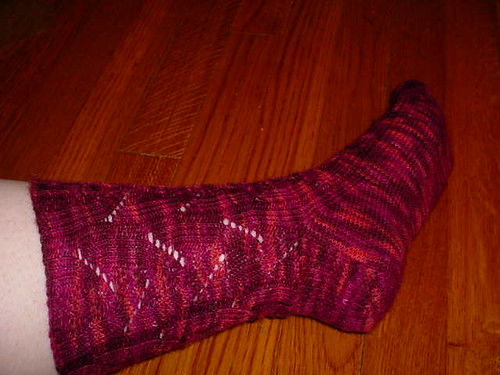
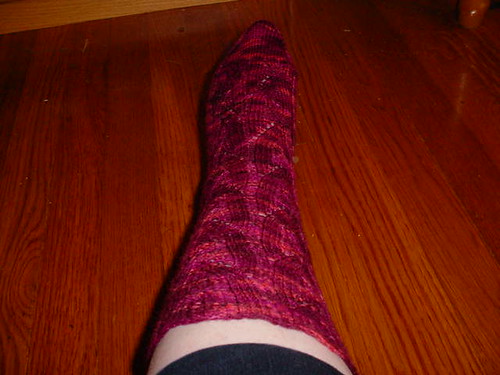
I finished the first Angee sock last night. I really like these! It's a fun pattern to knit, not hard but not boring either. I also like the yarn - it's a Fibra Natura 100% wool sock yarn, and to continue my discussion of yesterday, it's very tightly spun and has almost a "hard" finish to it, which I think will make it hold up well. (And also leads to it having nice stitch definition).
It's hard to photograph the sock, though, as it's a dark mottled color that doesn't seem to show up well:
****
I didn't mention that I bought a ticket for an on-campus production of Hamlet last night. It was very well done - it was our Theater department's entry in some contest that eventually goes to the national level.
They re-set it in "modern day or thereabouts" but other than that seem to have changed little (I say "seem" as I've never read the play. But I will, sometime in the future).
The play was well-done. I think the body count (six, not considering old king Hamlet) is a bit high for one to actually say they ENJOYED the play, but it was enlightening.
A couple of observations, and again with the caveat that I am NOT a Shakespeare scholar and so these may sound very obvious and naive to people who know more than I do:
- It seems to me that many of S.'s tragedies (at least the four with which I am now familiar) seem to center on misplaced or improper ambition: Macbeth wanted to be king. Lear's daughters wanted their inheritance. Brutus and Cassius wanted to rule Rome rather than Caesar, whom Cassius felt was unfit. And in Hamlet, Claudius wanted to be king (and perhaps also wanted Gertrude?). And I guess, in Shakespeare's day, How Ambition Ruins Everything would have been a popular book.
- The modern reset, I think, served to underline the whole "court intrigue" angle. Claudius was almost pompous, very sure of himself, believing he had done the right thing (well, until the chapel scene) - or at least that's the image he presented. The lords and ladies of the court had become sort of a circle of "advisors" that were really the king's handpicked yes-men and -women. When he spoke, they stood in a sort of half-circle around him and applauded his every pronouncement, which was very creepy and also I think a nice touch - it put one in mind of some of the tinpot dictators one reads about, where they kill off the smart people and put their cronies in to bow and scrape to them.
- I think also the modern reset allowed more "clothing semiotics" that the audience would recognize. Gertrude, in particular: they had her in these severe, tailored suits most of the time: feminine and brightly colored, but still severe. It made me think a bit of Eva Peron, at least as she was portrayed in Evita, and I wonder if maybe that was the intention of the costumer.
Also, the "adult" generation dressed very formally: full suits on the men, skirted-suits or severe dresses on the women. Hamlet and his cohort dressed more casually, sort of in 'student' mode (though they dressed better than most of our students; I mean the men wore collarless shirts and Ophelia was a bit less tailored than the "adult" women).
- The lighting was extremely well done. Very atmospheric. The stage set was very simple (after all, it is a Danish Modern reset). The stage was very simple: a long ramp with some steps to one side (and a place where the throne (actually a bench) could be set). As Hamlet is going up, at the middle of Act III, to speak with Gertrude, he is walking stage left up the ramp. The stage lights come down but a strong orange directional spot is on him (shining from stage left), and you can't really see him on stage - but his shadow is thrown onto the opposite wall by the spot, and it grows ominously larger and larger as he walks. It was very creepy and very effective.
(There was also a screen on stage where different things were projected: a dead tree for the first scene where they encounter the ghost, stained glass windows for the chapel scene....)
- I guess they eliminated Fortinbras. At the end of the play, they closed with Hamlet dying in his friend Horatio's arms, and I walked out going, "Okay, so who would rule Denmark now? Everyone in the royal family is dead." Apparently in some productions there's a last scene where Fortinbras comes on and Horatio recounts what happened.
- They made Rosencrantz and Guidenstern female. I suppose this was to allow for more female roles in the play (some of the "lords" were also female). But it added an interesting extra layer of comic relief - they were dressed as very trashy women, in a sort of 1980s Madonna mode (Rosencrantz - or maybe it was Guildenstern - had high ratted blonde hair, tight jeans with a sparkly top, and high heels, and the other wore a short tight skirt and low blouse). And they flirted shamelessly with Hamlet while trying to get information from him.
- The graveyard scene was very effective, thanks to a "pit" in the middle of the stage. The gravediggers, though they had but small parts, were good - again, comic relief. (I suspect they're almost always played as country-bumpkin types?).
I will admit I was fighting tears at Ophelia's funeral, even though I was completely aware I was watching a play. It was very effectively done - starting out subdued and somber (one of the "traveling players" - a woman with a good singing voice - was suited up in the procession and she quietly sang "Amazing Grace" - which can make me tear up a bit at the best of times - as the procession processed). And then it became wild and unhinged as Laertes and then Hamlet leapt down into the grave, and then they had to be held back from each other, as the mourners stood, stunned and shocked.
***
I want to rent the Branagh version sometime now and see it. (And huh. Wikipedia says the "Lion King" is a loose adaptation. I guess I never realized that but now it kind of, sort of makes sense. (Except, obviously, the body count is must needs much lower).
Another thing: even though I'd never read the play, I recognized large chunks of dialog (not just the famous Hamlet soliloquy or the Yorick scene - also Polonius' advice to Laertes) and also lots of quotations. I'd be willing to agree that this is the most widely-quoted of the Shakespeare plays. I also think there are three or four book or movie titles that came from quotations ("And Be a Villain," "Murder Most Foul," "What Dreams May Come," and "The Undiscovered Country," which is actually a subtitle of one of the Star Trek movies...) I'm sure there are more. (There is also a Thursday Next novel featuring Hamlet but I've not read it yet)
I did take a Claritin last night even though I don't like to take them at night because they give me dry mouth and vivid dreams. But at least I am reasonably certain I am not going to get sick. (I've had a lot of students out sick, and a couple of the guys in the back of the Ecology class were talking before class about "how high a fever do you have to have before staying home is justified?" So I'm a little spooked about all the germs.)
I think what I meant by the "petty things" was being unhappy about the prospect of being sick over my break - which, actually, if I HAD to get sick, would logically be the "best" time in terms of not missing class. (But hopefully that is a moot point now)
We have hand sanitizer dispensers around the building but I don't use them because (a) Does an antibacterial product even WORK on viruses? and (b) I don't want to kill off my commensal skin bacteria and (c) the stuff is really hard on your hands, and it contains phenol, which I have sensitivity to. I have been more diligent with washing with soap and water before eating, after class, etc.
I'm hoping that the combination of eating yogurt, getting lots of exercise, getting enough sleep, washing hands, and eating enough fruits and vegetables will help keep me well. I do most of the things they recommend to rev up the immune system (short of taking the supplements they sell).
****
I finished the first Angee sock last night. I really like these! It's a fun pattern to knit, not hard but not boring either. I also like the yarn - it's a Fibra Natura 100% wool sock yarn, and to continue my discussion of yesterday, it's very tightly spun and has almost a "hard" finish to it, which I think will make it hold up well. (And also leads to it having nice stitch definition).
It's hard to photograph the sock, though, as it's a dark mottled color that doesn't seem to show up well:
****
I didn't mention that I bought a ticket for an on-campus production of Hamlet last night. It was very well done - it was our Theater department's entry in some contest that eventually goes to the national level.
They re-set it in "modern day or thereabouts" but other than that seem to have changed little (I say "seem" as I've never read the play. But I will, sometime in the future).
The play was well-done. I think the body count (six, not considering old king Hamlet) is a bit high for one to actually say they ENJOYED the play, but it was enlightening.
A couple of observations, and again with the caveat that I am NOT a Shakespeare scholar and so these may sound very obvious and naive to people who know more than I do:
- It seems to me that many of S.'s tragedies (at least the four with which I am now familiar) seem to center on misplaced or improper ambition: Macbeth wanted to be king. Lear's daughters wanted their inheritance. Brutus and Cassius wanted to rule Rome rather than Caesar, whom Cassius felt was unfit. And in Hamlet, Claudius wanted to be king (and perhaps also wanted Gertrude?). And I guess, in Shakespeare's day, How Ambition Ruins Everything would have been a popular book.
- The modern reset, I think, served to underline the whole "court intrigue" angle. Claudius was almost pompous, very sure of himself, believing he had done the right thing (well, until the chapel scene) - or at least that's the image he presented. The lords and ladies of the court had become sort of a circle of "advisors" that were really the king's handpicked yes-men and -women. When he spoke, they stood in a sort of half-circle around him and applauded his every pronouncement, which was very creepy and also I think a nice touch - it put one in mind of some of the tinpot dictators one reads about, where they kill off the smart people and put their cronies in to bow and scrape to them.
- I think also the modern reset allowed more "clothing semiotics" that the audience would recognize. Gertrude, in particular: they had her in these severe, tailored suits most of the time: feminine and brightly colored, but still severe. It made me think a bit of Eva Peron, at least as she was portrayed in Evita, and I wonder if maybe that was the intention of the costumer.
Also, the "adult" generation dressed very formally: full suits on the men, skirted-suits or severe dresses on the women. Hamlet and his cohort dressed more casually, sort of in 'student' mode (though they dressed better than most of our students; I mean the men wore collarless shirts and Ophelia was a bit less tailored than the "adult" women).
- The lighting was extremely well done. Very atmospheric. The stage set was very simple (after all, it is a Danish Modern reset). The stage was very simple: a long ramp with some steps to one side (and a place where the throne (actually a bench) could be set). As Hamlet is going up, at the middle of Act III, to speak with Gertrude, he is walking stage left up the ramp. The stage lights come down but a strong orange directional spot is on him (shining from stage left), and you can't really see him on stage - but his shadow is thrown onto the opposite wall by the spot, and it grows ominously larger and larger as he walks. It was very creepy and very effective.
(There was also a screen on stage where different things were projected: a dead tree for the first scene where they encounter the ghost, stained glass windows for the chapel scene....)
- I guess they eliminated Fortinbras. At the end of the play, they closed with Hamlet dying in his friend Horatio's arms, and I walked out going, "Okay, so who would rule Denmark now? Everyone in the royal family is dead." Apparently in some productions there's a last scene where Fortinbras comes on and Horatio recounts what happened.
- They made Rosencrantz and Guidenstern female. I suppose this was to allow for more female roles in the play (some of the "lords" were also female). But it added an interesting extra layer of comic relief - they were dressed as very trashy women, in a sort of 1980s Madonna mode (Rosencrantz - or maybe it was Guildenstern - had high ratted blonde hair, tight jeans with a sparkly top, and high heels, and the other wore a short tight skirt and low blouse). And they flirted shamelessly with Hamlet while trying to get information from him.
- The graveyard scene was very effective, thanks to a "pit" in the middle of the stage. The gravediggers, though they had but small parts, were good - again, comic relief. (I suspect they're almost always played as country-bumpkin types?).
I will admit I was fighting tears at Ophelia's funeral, even though I was completely aware I was watching a play. It was very effectively done - starting out subdued and somber (one of the "traveling players" - a woman with a good singing voice - was suited up in the procession and she quietly sang "Amazing Grace" - which can make me tear up a bit at the best of times - as the procession processed). And then it became wild and unhinged as Laertes and then Hamlet leapt down into the grave, and then they had to be held back from each other, as the mourners stood, stunned and shocked.
***
I want to rent the Branagh version sometime now and see it. (And huh. Wikipedia says the "Lion King" is a loose adaptation. I guess I never realized that but now it kind of, sort of makes sense. (Except, obviously, the body count is must needs much lower).
Another thing: even though I'd never read the play, I recognized large chunks of dialog (not just the famous Hamlet soliloquy or the Yorick scene - also Polonius' advice to Laertes) and also lots of quotations. I'd be willing to agree that this is the most widely-quoted of the Shakespeare plays. I also think there are three or four book or movie titles that came from quotations ("And Be a Villain," "Murder Most Foul," "What Dreams May Come," and "The Undiscovered Country," which is actually a subtitle of one of the Star Trek movies...) I'm sure there are more. (There is also a Thursday Next novel featuring Hamlet but I've not read it yet)
Saturday, September 05, 2009
Thanks for the suggestion, TChem. I ordered a couple more of the Folger Shakespeares (I have to say, I think they are the BEST way for someone who is not-an-expert to read Shakespeare, with the glosses and explanations on the facing pages, and they also have lots of essays and explanatory information in the beginning and at the end. And they are NOT "Cliff's Notes" versions, or Shakespeare Made Stupid or whatever - it's the real text, just explained a bit on the opposite side so you get all the jokes and so you know the words.). They were having a 4 for 3 deal so I got As You Like It, Much Ado About Nothing (I do love the comedies and I think I love them more than the histories/tragedies), Hamlet, and Henry V. (And I should rent the Olivier version of that some time to compare to the text).
So I also tossed a copy of "Will in the World" into my virtual cart, because I always like learning more about stuff that interests me.
I will say that I am finding Shakespeare Not That Hard. Once you get used to the occasionally-inverted sentence structure (and funny, but I am used to it; I find I have occasionally used similarly flexible syntax before reading Shakespeare, so it feels familiar) and recognize that words don't always mean just what they mean to us, it becomes smoother.
My new favorite word? "Welkin," meaning "sky" (Or, also used in Twelfth Night in the phrase, "'Tis out of my welkin" meaning "I don't know." Oh, how I'd love to be able to use that with a student or colleague when they ask a question that is out of my field of expertise, but I find I already get enough "Baroo?" looks in response to things I say).
I also have to say I think the contraction "'tis" is sadly underused in today's English.
More and more, I find that reading - especially reading the old, old books - is the antidote I need to what I perceive as sometimes distressing things that happen in our world. Escapism, perhaps. But at least I sleep more soundly at night after tracking my mind onto Prospero's magic or the Jarndyce and Jarndyce court case.
So I also tossed a copy of "Will in the World" into my virtual cart, because I always like learning more about stuff that interests me.
I will say that I am finding Shakespeare Not That Hard. Once you get used to the occasionally-inverted sentence structure (and funny, but I am used to it; I find I have occasionally used similarly flexible syntax before reading Shakespeare, so it feels familiar) and recognize that words don't always mean just what they mean to us, it becomes smoother.
My new favorite word? "Welkin," meaning "sky" (Or, also used in Twelfth Night in the phrase, "'Tis out of my welkin" meaning "I don't know." Oh, how I'd love to be able to use that with a student or colleague when they ask a question that is out of my field of expertise, but I find I already get enough "Baroo?" looks in response to things I say).
I also have to say I think the contraction "'tis" is sadly underused in today's English.
More and more, I find that reading - especially reading the old, old books - is the antidote I need to what I perceive as sometimes distressing things that happen in our world. Escapism, perhaps. But at least I sleep more soundly at night after tracking my mind onto Prospero's magic or the Jarndyce and Jarndyce court case.
Saturday, August 01, 2009
I also finished reading "Twelfth Night" last night.
I think this is my favorite of the (five) Shakespeare plays I have read (in my life: I read three in high school, then "Julius Caesar" earlier this summer).
I do prefer the comedies to the histories/tragedies I have read. I think part of it is a general distaste for "stories where people die" (my love of detective novels notwithstanding). But mainly, in the comedies, Shakespeare's wordplay (puns, extended metaphors, saucy comparisons) comes to the fore, and that's really why I like Shakespeare's writing.
True, "Twelfth Night," is, as one character notes (in an early instance of "breaking the fourth wall") a rather unbelievable plot (I'm searching for the exact quote now...it was something along the lines of, "If I saw this acted out on stage, I'd laugh at it as being totally impossible...")
Ah, here it is: Act 3, scene 4, Fabian, after seeing Malvolio fall for the fake letter, and show up "in yellow stockings and cross-gartered*":
"If this were played upon a stage now, I could condemn it as an improbable fiction."
The whole play is just fun. It comes out happily at the end for everyone (well, save for poor Malvolio, and at least he is released from the asylum). There are some enjoyable instances of wordplay, and a few Shakespeare-bawdy jokes (I may be a prude about some things, but those kind of bawdy jokes do make me laugh and appreciate them). And I feel smarter after having read it - I think it does make a person's brain work in good ways to read something like Shakespeare. And I find reading Shakespeare satisfying - because they are plays, they are shorter than the average novel I read, and so I can finish one in a matter of a few weeks rather than a few months.
I think I enjoyed "Twelfth Night" more also because the version of it I had was a Folger Library paperback - I think these were the versions we used in high school when we read Shakespeare - where the right-hand pages are the play, and the left-hand pages are a gloss with references - so you can immediately check an unfamiliar word (though I will say with some pride that most of the words they provided a gloss for, I either already knew or already had seen in the "alternate" usage as Shakespeare used them - like "wanton" meaning "changeable" as well as "unchaste"). And it's easy to pick up references that, as a modern person, you would not get - the reference to song lines in particular.
I'm sure my enjoyment of the play was enhanced by having seen a good version of it beforehand, so I could "hear" the proper inflections of certain words, and probably my catching the double-meaning words was perhaps because I had heard them on stage first.
But at any rate: I do like Twelfth Night. As I said, I think it's my favorite of the Shakespeare plays I have read.
I'm going to read "The Tempest" next; in fact, I'm going to take it with me on break. I have a Folger Library paperback of it as well. (As much as I may love the "atmosphere" of the little old 1890s hardbacks I have that once belonged to Charles Goulder, I have to say the Folger editions are definitely preferable to study from and to feel that you are actually learning about the play. In the older editions I'd have to flip to the back for the gloss, which was inconvenient, and also, it was less complete and did not have all of the allusions noted).
(*And it strikes me that a really wonderful "geeky" sock pattern could be made up based on that line: long socks (like knee socks) to be made of bright yellow yarn, with cables on them designed to capture the "cross gartering" effect. Or maybe welts on them to look like the garters. I don't know. The little woodcut showing "cross gartering" in my copy of the play is not sufficiently clear for me to exactly figure out what it looks like - if I even felt like designing a pattern for knee length socks - but I think it would be a clever idea. They could be called "Malvolio's stockings" or some such.)
I think this is my favorite of the (five) Shakespeare plays I have read (in my life: I read three in high school, then "Julius Caesar" earlier this summer).
I do prefer the comedies to the histories/tragedies I have read. I think part of it is a general distaste for "stories where people die" (my love of detective novels notwithstanding). But mainly, in the comedies, Shakespeare's wordplay (puns, extended metaphors, saucy comparisons) comes to the fore, and that's really why I like Shakespeare's writing.
True, "Twelfth Night," is, as one character notes (in an early instance of "breaking the fourth wall") a rather unbelievable plot (I'm searching for the exact quote now...it was something along the lines of, "If I saw this acted out on stage, I'd laugh at it as being totally impossible...")
Ah, here it is: Act 3, scene 4, Fabian, after seeing Malvolio fall for the fake letter, and show up "in yellow stockings and cross-gartered*":
"If this were played upon a stage now, I could condemn it as an improbable fiction."
The whole play is just fun. It comes out happily at the end for everyone (well, save for poor Malvolio, and at least he is released from the asylum). There are some enjoyable instances of wordplay, and a few Shakespeare-bawdy jokes (I may be a prude about some things, but those kind of bawdy jokes do make me laugh and appreciate them). And I feel smarter after having read it - I think it does make a person's brain work in good ways to read something like Shakespeare. And I find reading Shakespeare satisfying - because they are plays, they are shorter than the average novel I read, and so I can finish one in a matter of a few weeks rather than a few months.
I think I enjoyed "Twelfth Night" more also because the version of it I had was a Folger Library paperback - I think these were the versions we used in high school when we read Shakespeare - where the right-hand pages are the play, and the left-hand pages are a gloss with references - so you can immediately check an unfamiliar word (though I will say with some pride that most of the words they provided a gloss for, I either already knew or already had seen in the "alternate" usage as Shakespeare used them - like "wanton" meaning "changeable" as well as "unchaste"). And it's easy to pick up references that, as a modern person, you would not get - the reference to song lines in particular.
I'm sure my enjoyment of the play was enhanced by having seen a good version of it beforehand, so I could "hear" the proper inflections of certain words, and probably my catching the double-meaning words was perhaps because I had heard them on stage first.
But at any rate: I do like Twelfth Night. As I said, I think it's my favorite of the Shakespeare plays I have read.
I'm going to read "The Tempest" next; in fact, I'm going to take it with me on break. I have a Folger Library paperback of it as well. (As much as I may love the "atmosphere" of the little old 1890s hardbacks I have that once belonged to Charles Goulder, I have to say the Folger editions are definitely preferable to study from and to feel that you are actually learning about the play. In the older editions I'd have to flip to the back for the gloss, which was inconvenient, and also, it was less complete and did not have all of the allusions noted).
(*And it strikes me that a really wonderful "geeky" sock pattern could be made up based on that line: long socks (like knee socks) to be made of bright yellow yarn, with cables on them designed to capture the "cross gartering" effect. Or maybe welts on them to look like the garters. I don't know. The little woodcut showing "cross gartering" in my copy of the play is not sufficiently clear for me to exactly figure out what it looks like - if I even felt like designing a pattern for knee length socks - but I think it would be a clever idea. They could be called "Malvolio's stockings" or some such.)
Saturday, July 18, 2009
So, you might ask: How does it work, resetting "Twelfth Night" to late 1800s Louisiana?
Quite brilliantly, in fact.
The play was very good. (I don't know how all Shakespeare festivals are, but for ours, we have some "outside talent" come in - I don't think our theater department would be large enough to sustain four or five plays, done on tight rotation, anyway. There are a number of actors who come back year after year - the man playing Malviolo last night was the lugubrious cop in last year's "Guys and Dolls).
I may have seen Twelfth Night years ago - the girl-dressed-as-boy theme is familiar, as is how the whole thing is unravelled at the end - but that version was clearly not as good as this version.
Ilyria has become "Ilyria Parish." The lovesick count (who was played wonderfully well by the actor doing him) was sort of a nouveau-riche shipping magnate (that's how Antonio's arrest could be worked in). The Fool was a Yankee (I believe the actor playing him was from New York; he let some of what may have been his natural way of speaking shine through, and a number of the characters referred derisively to him as "Yankee.") Olivia, for much of the play (well, until she started to fall in love with "Cesario") wore the old-timey full mourning that a woman in the South of that era would have worn. Viola and Sebastian, while they did not look greatly alike (the actor and actress playing them), were dressed the same (in top boots, dark pants, cap, and a blue sailor's jacket) and they spoke much the same (they, in contrast to most of the other actors, spoke with a "neutral Midwestern" sort of accent - actually, rather like I talk. Except I do not talk in blank verse.)
Accents were used to great effect in this play. I once said here that in England, you could guess someone's social class by their accent, but not so much in America. I rescind that statement; I see now how the Louisiana accents were used (from the almost-impenetrable argot of Captain to the better-enunciated (but still clearly South Louisiana) speech of the Count). Several of the actors in the production actually WERE from Louisiana, so perhaps they had heard the accents more frequently and they were certainly good at doing them, they rang very true. (I am assuming the actors do not normally speak Cajun-style.)
There were clear differences between how the servants spoke and how the upper-class spoke (well, except for Malviolo, who seemed to put on airs and sounded like a Louisianan trying to sound British).
Incidental music was provided by a three man Cajun band (guitar, squeezebox, and that plastron-thing that fills the role of a washboard). They stood over to one side of the stage, under a "gaslamp" near Orsino's balcony...the whole play was done without changing sets; one half the stage was Orsino's balcony and porch, the other half was Olivia's house (balcony and veranda), but it also played the role of the tree that the "conspirators" hid in to watch their prank on Malviolo begin.
(O poor Malviolo!)
All of the actors were good, though I found that the love-struck Count Orsino (who got the chance to chew the scenery just a little bit (but not enough to not seem right)), and Sir Toby Belch (Fat, drunken, lecherous, joking old planter-type), and Malviolo were particularly good.
Oh, and the Fool was good as well. When he played "Sir Topas" (pronounced "Topaz" at least for this production) he did a very fine parody of an old-timey Gospel preacher. (Malviolo, rather than being in an asylum, was sitting out "on the dock of the bay" in the dark and fog (they actually used a fog machine), which was a rather effective change from the original play).
He also played the guitar and sang. Rather than the songs in the original play, he used some traditional songs: "House of New Orleans" made it in there, and at the very end, "Jambalaya" was used as the ending music. (in that case, the three-man Cajun band played along with him)
There were a few little changes here and there - mostly of proper names ("Boudreaux' bedchamber," for example) and the scene before Sebastian and Olivia plight their troth was rewritten to imply they had spent the night together (and all that includes). (And Sebastian was given Mardi Gras beads instead of a pearl). And the priest was given a few lines, something about shriving Sebastian, I think?
Two of the male roles (Valentine and Fabian) were given to women: Valentine was a maid, and Fabian was - well, I'm not sure what SHE was, she hung around with Toby and didn't seem very respectful of Olivia if Olivia was in fact her mistress and employer. (Those switches may have partly have been to give enough "partners" for the dancing at the very end - everyone out on stage (the two couples, all the servants, Belch, and Aguecheek) went into the traditional zydeco-style dancing to end the play)
My only complaint, if I may have one? The accents, wonderful as they were, at times made it harder for me to understand what was being said. I know I missed some of the wordplay because I was distracted by the odd-to-me way that bayou people have of pronouncing some of their vowels (to my ear it sounds like they start out doing one - say, an "a" - and it ends up as another, say an "o"). But that's a minor quibble, and I can certainly read the play to catch what I missed.
In fact, I do think it will be my next Shakespeare read.
Quite brilliantly, in fact.
The play was very good. (I don't know how all Shakespeare festivals are, but for ours, we have some "outside talent" come in - I don't think our theater department would be large enough to sustain four or five plays, done on tight rotation, anyway. There are a number of actors who come back year after year - the man playing Malviolo last night was the lugubrious cop in last year's "Guys and Dolls).
I may have seen Twelfth Night years ago - the girl-dressed-as-boy theme is familiar, as is how the whole thing is unravelled at the end - but that version was clearly not as good as this version.
Ilyria has become "Ilyria Parish." The lovesick count (who was played wonderfully well by the actor doing him) was sort of a nouveau-riche shipping magnate (that's how Antonio's arrest could be worked in). The Fool was a Yankee (I believe the actor playing him was from New York; he let some of what may have been his natural way of speaking shine through, and a number of the characters referred derisively to him as "Yankee.") Olivia, for much of the play (well, until she started to fall in love with "Cesario") wore the old-timey full mourning that a woman in the South of that era would have worn. Viola and Sebastian, while they did not look greatly alike (the actor and actress playing them), were dressed the same (in top boots, dark pants, cap, and a blue sailor's jacket) and they spoke much the same (they, in contrast to most of the other actors, spoke with a "neutral Midwestern" sort of accent - actually, rather like I talk. Except I do not talk in blank verse.)
Accents were used to great effect in this play. I once said here that in England, you could guess someone's social class by their accent, but not so much in America. I rescind that statement; I see now how the Louisiana accents were used (from the almost-impenetrable argot of Captain to the better-enunciated (but still clearly South Louisiana) speech of the Count). Several of the actors in the production actually WERE from Louisiana, so perhaps they had heard the accents more frequently and they were certainly good at doing them, they rang very true. (I am assuming the actors do not normally speak Cajun-style.)
There were clear differences between how the servants spoke and how the upper-class spoke (well, except for Malviolo, who seemed to put on airs and sounded like a Louisianan trying to sound British).
Incidental music was provided by a three man Cajun band (guitar, squeezebox, and that plastron-thing that fills the role of a washboard). They stood over to one side of the stage, under a "gaslamp" near Orsino's balcony...the whole play was done without changing sets; one half the stage was Orsino's balcony and porch, the other half was Olivia's house (balcony and veranda), but it also played the role of the tree that the "conspirators" hid in to watch their prank on Malviolo begin.
(O poor Malviolo!)
All of the actors were good, though I found that the love-struck Count Orsino (who got the chance to chew the scenery just a little bit (but not enough to not seem right)), and Sir Toby Belch (Fat, drunken, lecherous, joking old planter-type), and Malviolo were particularly good.
Oh, and the Fool was good as well. When he played "Sir Topas" (pronounced "Topaz" at least for this production) he did a very fine parody of an old-timey Gospel preacher. (Malviolo, rather than being in an asylum, was sitting out "on the dock of the bay" in the dark and fog (they actually used a fog machine), which was a rather effective change from the original play).
He also played the guitar and sang. Rather than the songs in the original play, he used some traditional songs: "House of New Orleans" made it in there, and at the very end, "Jambalaya" was used as the ending music. (in that case, the three-man Cajun band played along with him)
There were a few little changes here and there - mostly of proper names ("Boudreaux' bedchamber," for example) and the scene before Sebastian and Olivia plight their troth was rewritten to imply they had spent the night together (and all that includes). (And Sebastian was given Mardi Gras beads instead of a pearl). And the priest was given a few lines, something about shriving Sebastian, I think?
Two of the male roles (Valentine and Fabian) were given to women: Valentine was a maid, and Fabian was - well, I'm not sure what SHE was, she hung around with Toby and didn't seem very respectful of Olivia if Olivia was in fact her mistress and employer. (Those switches may have partly have been to give enough "partners" for the dancing at the very end - everyone out on stage (the two couples, all the servants, Belch, and Aguecheek) went into the traditional zydeco-style dancing to end the play)
My only complaint, if I may have one? The accents, wonderful as they were, at times made it harder for me to understand what was being said. I know I missed some of the wordplay because I was distracted by the odd-to-me way that bayou people have of pronouncing some of their vowels (to my ear it sounds like they start out doing one - say, an "a" - and it ends up as another, say an "o"). But that's a minor quibble, and I can certainly read the play to catch what I missed.
In fact, I do think it will be my next Shakespeare read.
Subscribe to:
Posts (Atom)