I packed last night. Most of my "lightweight" summer clothes are dresses now, so I took several dresses in case it gets terribly hot again up where I'm going. (For various reasons I don't wear shorts. Especially not out of the house).
I also have lots of projects - the Ropes and Picots cardigan, the Oscilloscope shawl, the Miss Marple shawl (which I really, really hope to finish soon - I'm on repeat 6 of 10 "decrease" repeats, and then have a little while to go to finish it off). Some socks. And books.
I said I was looking for a new non-fiction book to read, and I think I found it. Some years back I bought a book on the pre-history of the eastern U.S. (it may even been from the late, lamented A Common Reader* catalog). It's called The Moundbuilders. It's one of those "educated layperson" books on archaeology - it's by George Milner. I started reading it last night (I like to read a few pages of anything I'm taking with me to read, to be sure it won't be one of those books I want to throw across the room).
(*There's been some talk lately online about Borders' books having apparently run itself into the ground because of bad management and a bad business model, though in the press it's largely being spun as "E-books killed the bookstore star" thing. I think A Common Reader is an earlier case of this - they had a FANTASTIC catalog, I loved ordering from them...and then they were gone. And apparently it was again a case of problems with the business plan and how the business was run. Which is really sad.)
It's very engagingly written. In some ways, it reminds me a bit of a book I read quite a few years ago now on Roman-occupied Britain. It's a similar style. I can't quite pin-point it, I think of it as a "British" style of writing - sort of anecdotes tied together thing (but I believe Milner is an American). It's also, I guess I'd say, it feels like the author of the book is sitting down with you over tea to tell you about his research - it's more of a general-overview than a "here is a catalog of the objects found in this mound. Now here is another catalog from another mound." I guess I'm saying it's not dry. And Milner is kind of operating on two levels of history in his writing - first, there is the actual historical time of the Moundbuilders, what the just-barely-postglacial world was like. But he's also discussing some of the early archaeological work done and some of the early ideas (Jefferson knew of mounds - and he believed the Moundbuilders where the ancestors of current Native Americans. Which is pretty much the accepted idea NOW, though there was a period time when apparently the prevailing belief was that the Moundbuilders were some kind of Golden-Era people who were in no way related to the "savages" who came after them and drove them out. (As Milner points out: it's easier for a culture to justify its mistreatment of the Native people if they see them as "savages" who destroyed some flourishing earlier culture.))
I also find it interesting - and I originally bought the book - because, having grown up in Ohio, I learned about the mounds and Moundbuilders in some of my history classes. (The Hopewell and, um....I'm drawing a blank on the second group we studied. Adena. I had to look that up. I have no idea if this information is accurate in line with what we now know/believe about these people, but this is the kind of thing I learned about.)
As a kid, I found the history of where I lived interesting. (I've already talked about my fascination with Deep Lock Quarry and the few remnants of the Ohio and Erie canal that were in the Metroparks). It was strange to stand there, out in the forest in the fall (for some reason, the fall always made me think more of the passage of time and of history), and consider that there were people who lived here, not only a hundred or so years before I was born, but even maybe a thousand years before I was born. It was interesting and in a strange way, slightly creepy (but creepy in a GOOD way - maybe, as an adult having read C.S. Lewis, I'd use the term "numinous" instead) to think about that, that there had been all these people who had lived and died, hoped and feared and loved, cooked food and made pottery, long before I was ever on the scene - and that they would never really fathom what would exist long after they were gone, and that I could just barely know some of the basic facts of how they lived, but never really know what they were REALLY like. So I'm looking forward to reading it, both to learn more about these early cultures, but also to recapture a bit of that sense of wonder of being 10 years old standing out in one of the Metroparks and thinking about what it would be like to be one of those prehistoric people catching fish and building shelters and raising their children...so different from the way people lived in my time, but maybe, in some ways, the same.
I'll be back in a couple weeks.
Wednesday, July 27, 2011

Tuesday, July 26, 2011
Twisted stitch knitting
This is a poor photograph of the back of Ropes and Picots.
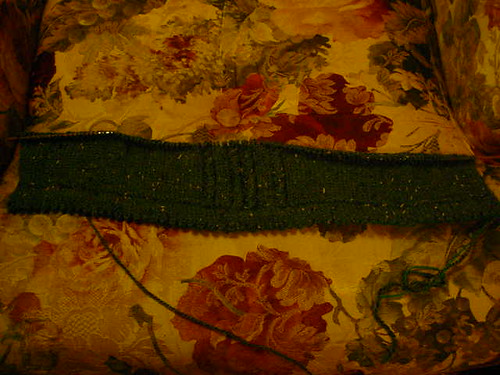
The color isn't even very true, at least not on my monitor. (It's a greenish blue - more blue than teal). Also, even though I played with the camera settings to try to be able to get a shot without flash (which always washes out the texture of stitches), you can't really see the "ropes" there.
The ropes are sort of like mini-cables, but they're made by twisting stitches - that is, knitting the stitches out of order (you don't need a cable needle to do them).
I was flipping through my copy of "Around the World in Knitted Socks." One thing that strikes me is how certain techniques seem to be typical of certain areas. Twisted and traveling stitches, for example, seem to be an Alpine thing - southern Germany, Switzerland, Austria. Brightly-colored patterned knitting, for example the iconic eight-pointed star, seems to have originated or at least flourished in Scandinavia. The British Isles have cables/aran patterns, and the northern parts (the Shetlands) have very specific lace patterns. (And France and Spain also had certain lace patterns).
You see this to some extent in quilting, too, though I think quilting/patchwork had its greatest flourishing in the U.S. Within the U.S. there are subgroups - the Amish are very known for their particular style (And interestingly, when I look at photographs of some of the Welsh quilts I've seen - the color combinations and heavy use of large pieces of solid-colored dark fabric - recall the Amish quilts. (However, the quilting designs are different - the Welsh tend to use rather elaborate, almost Celtic looking quilting designs). The African-American quilts of the Carolinas have their own distinctive style. And there is Seminole patchwork (which apparently developed in the 1920s, after missionaries brought them sewing machines...however, I have seen some of the Choctaw fancy-dress outfits that have similar designs - though in different colors, the Choctaw tend to use one solid color, often red, plus white, whereas the Seminole use many solid colors together)
And quilting has become popular in Japan and Holland (among other places) and I expect we'll see distinctive styles developing there as well. (Even with the widespread nature of quilt magazines and the Internet, I still think a person's culture often informs what they design and create).
I suppose treatises may have been written on the regional styles of things like knitting and quilting, and I've just not seen them, but I think it would be interesting to read. And I wonder how and why a particular technique developed and flourished in a certain area. I've read that cabled knitting was used in part because certain ways of handspinning yarn leaves it with "energy" (a tendency to twist) that can cause plain knit fabric to bias, and that cables stabilize the fabric more. But I also wonder if perhaps there was some element of competition that got going - say, some knitter in an Alpine village somewhere figured out a fancy pattern on his/her* own using traveling stitches. Other knitters saw it, were maybe a bit jealous of the person's skill, and figured, "I'll show them" and figured out something even more complex. (I can see that happening. You see that happening in some quilt guilds. Which is actually why I prefer not to consider submitting my quilts to shows or competitions - what I like is very simple and rather plain, and I don't like the whole, "I'll best her design even if it kills me" attitude).\
(* In the really early days, like Medieval eras, most of the knitters were men. Or at least, the people who could knit for money were men - there were knitter's guilds and membership was only available to men. We tend to forget that know, with knitting having been largely thought of as a female occupation since, I don't know, 1600 or so)
In a lot of cases, the patterns are more complex than they need to be. (The story about being able to identify a drowned Aran-isles fisherman from the particular knitted pattern in his sweater is pretty much myth). And I can't help but think that someone charged with knitting stockings for themselves and their family wouldn't want, necessarily, to do something far more complex and elaborate that takes more time. (Then again, maybe that's why the complex and elaborate stockings have survived in museums and such: they were knit "for good" or for fancy-dress occasions, and the plain everyday socks got worn out.)
I also wonder about trade routes and travelers and if certain styles or methods of doing something got spread that way - I know there's a divide somewhere in the Balkans between toe-up socks (more of a Turkish/Eastern European style) and cuff-down socks (more of a Western European style). Makes me wonder if there were people in, I don't know, France or somewhere who had traveled in the Balkans or emigrated from there who still insisted on doing toe-up socks. (Though I suppose prior to 1800 or so, there was a lot less travel than there is now, and perhaps there was less of that sort of emigration.)
It's interesting, though, to have books like the Socks around the World book and to compare the different styles side-by-side, and to wonder how historically accurate it is to suggest that traveling stitches are mainly an Alpine phenomenon, and to look at the different types of colorwork from Estonia vs. Denmark, etc.
The color isn't even very true, at least not on my monitor. (It's a greenish blue - more blue than teal). Also, even though I played with the camera settings to try to be able to get a shot without flash (which always washes out the texture of stitches), you can't really see the "ropes" there.
The ropes are sort of like mini-cables, but they're made by twisting stitches - that is, knitting the stitches out of order (you don't need a cable needle to do them).
I was flipping through my copy of "Around the World in Knitted Socks." One thing that strikes me is how certain techniques seem to be typical of certain areas. Twisted and traveling stitches, for example, seem to be an Alpine thing - southern Germany, Switzerland, Austria. Brightly-colored patterned knitting, for example the iconic eight-pointed star, seems to have originated or at least flourished in Scandinavia. The British Isles have cables/aran patterns, and the northern parts (the Shetlands) have very specific lace patterns. (And France and Spain also had certain lace patterns).
You see this to some extent in quilting, too, though I think quilting/patchwork had its greatest flourishing in the U.S. Within the U.S. there are subgroups - the Amish are very known for their particular style (And interestingly, when I look at photographs of some of the Welsh quilts I've seen - the color combinations and heavy use of large pieces of solid-colored dark fabric - recall the Amish quilts. (However, the quilting designs are different - the Welsh tend to use rather elaborate, almost Celtic looking quilting designs). The African-American quilts of the Carolinas have their own distinctive style. And there is Seminole patchwork (which apparently developed in the 1920s, after missionaries brought them sewing machines...however, I have seen some of the Choctaw fancy-dress outfits that have similar designs - though in different colors, the Choctaw tend to use one solid color, often red, plus white, whereas the Seminole use many solid colors together)
And quilting has become popular in Japan and Holland (among other places) and I expect we'll see distinctive styles developing there as well. (Even with the widespread nature of quilt magazines and the Internet, I still think a person's culture often informs what they design and create).
I suppose treatises may have been written on the regional styles of things like knitting and quilting, and I've just not seen them, but I think it would be interesting to read. And I wonder how and why a particular technique developed and flourished in a certain area. I've read that cabled knitting was used in part because certain ways of handspinning yarn leaves it with "energy" (a tendency to twist) that can cause plain knit fabric to bias, and that cables stabilize the fabric more. But I also wonder if perhaps there was some element of competition that got going - say, some knitter in an Alpine village somewhere figured out a fancy pattern on his/her* own using traveling stitches. Other knitters saw it, were maybe a bit jealous of the person's skill, and figured, "I'll show them" and figured out something even more complex. (I can see that happening. You see that happening in some quilt guilds. Which is actually why I prefer not to consider submitting my quilts to shows or competitions - what I like is very simple and rather plain, and I don't like the whole, "I'll best her design even if it kills me" attitude).\
(* In the really early days, like Medieval eras, most of the knitters were men. Or at least, the people who could knit for money were men - there were knitter's guilds and membership was only available to men. We tend to forget that know, with knitting having been largely thought of as a female occupation since, I don't know, 1600 or so)
In a lot of cases, the patterns are more complex than they need to be. (The story about being able to identify a drowned Aran-isles fisherman from the particular knitted pattern in his sweater is pretty much myth). And I can't help but think that someone charged with knitting stockings for themselves and their family wouldn't want, necessarily, to do something far more complex and elaborate that takes more time. (Then again, maybe that's why the complex and elaborate stockings have survived in museums and such: they were knit "for good" or for fancy-dress occasions, and the plain everyday socks got worn out.)
I also wonder about trade routes and travelers and if certain styles or methods of doing something got spread that way - I know there's a divide somewhere in the Balkans between toe-up socks (more of a Turkish/Eastern European style) and cuff-down socks (more of a Western European style). Makes me wonder if there were people in, I don't know, France or somewhere who had traveled in the Balkans or emigrated from there who still insisted on doing toe-up socks. (Though I suppose prior to 1800 or so, there was a lot less travel than there is now, and perhaps there was less of that sort of emigration.)
It's interesting, though, to have books like the Socks around the World book and to compare the different styles side-by-side, and to wonder how historically accurate it is to suggest that traveling stitches are mainly an Alpine phenomenon, and to look at the different types of colorwork from Estonia vs. Denmark, etc.
Monday, July 25, 2011
the summer doldrums
As I've abundantly whined about discussed here, I do not like heat and humidity. It's been the hottest summer yet since I lived here (They tell me 1980 was worse; I was in Northeast Ohio at the time and I was also 11, and I think pre-pubescent girls, by and large, are more tolerant of heat than mature women are. Or at least, I was more tolerant of the heat. That's probably PARTLY because I was in what would have been a "normal to possibly just barely underweight" BMI category as a pre-teen, and I'm, well, in a considerably-more-alarming category now)
But anyway. There are a couple of things that I have to admit just feel like insult added to injury:
- In the wintertime, I wash my hair every second or third day. That's all it needs and any more than that and it starts to get brittle. But in the summer, if I don't wash it DAILY, it gets limp and rank-looking (even though it still smells of the fruity shampoo I use).
- Of course, while I'm in the shower waiting for the conditioner to do its work, I have time to shave my legs. Which I have to do every day in the summer. It's a combination of going bare-legged under my dresses, and having VERY fair (think a trout's belly and you're not too far off) skin and dark hair means I get stubble. (I also think hair grows faster in the summer; I know I need to get my bangs trimmed more often). And yeah, yeah, I know some of my sisters would say I'm giving in to the patriarchy by shaving my legs, but here's the thing: I prefer the way they look and feel shaved. And while I know some women who choose not to shave at all, and most women I know do depilate in one way or another, midway between the two (stubble) just looks untidy and careless to me - you're not making a statement nor are you being mainstream. (And yes, I know, there are other methods of removing hair, but I burned myself experimenting with hot wax, I'm too cheap to go to a salon every few weeks, and I don't like the way depilatories smell).
(I wonder what women did back when my grandmother was young, before safety razors. Did they just not worry about it? Or did they have some other method of removal? I know one of my aunts - of whom I am very jealous - has never had to shave her legs because she has very fine, very blonde hair - and the hair on her legs DOES NOT SHOW. But surely there were enough fair skin + dark hair women back in the day that hair on the legs would have been an issue. Or did they just always wear thick stockings and so many layers of undergarments that it didn't matter? What did the flappers do? I don't think the safety razor existed in the 1920s...)
- The biggest thing that gets me down, though? The pipes that carry the water in this town are fairly shallowly buried. And the soil here has heated up to, I don't know, 90 degrees or somewhere near (heat + drought - dry soil heats faster than wet soil because there's no water - with its high specific heat - to absorb the energy. Heh, soils class in action). And the water coming out of the COLD tap is lukewarm. Which I just find disgusting. I normally don't put ice in water when I drink it, but I have to in the summer. (And yes, I know, that's very much a first-world problem. And yes, I'm grateful to have clean safe water coming out of my tap. And yes, I'm grateful I'm not in Ada where they had several water main breaks the other day. But still...it would be nice to get cold water out of the tap.)
I'll be really, really glad when it finally cools down. The first day I can draw a glass of water from the tap and have it be cool is always a big day in the fall. (I don't know why that bugs me so much but it does. I think that's probably because all through my growing-up years I was spoiled - my grandmother had a deep well with cold water and even in the warm summers, the water at my parents' house - which was city water but which came from wells - was cold out of the tap).
But anyway. There are a couple of things that I have to admit just feel like insult added to injury:
- In the wintertime, I wash my hair every second or third day. That's all it needs and any more than that and it starts to get brittle. But in the summer, if I don't wash it DAILY, it gets limp and rank-looking (even though it still smells of the fruity shampoo I use).
- Of course, while I'm in the shower waiting for the conditioner to do its work, I have time to shave my legs. Which I have to do every day in the summer. It's a combination of going bare-legged under my dresses, and having VERY fair (think a trout's belly and you're not too far off) skin and dark hair means I get stubble. (I also think hair grows faster in the summer; I know I need to get my bangs trimmed more often). And yeah, yeah, I know some of my sisters would say I'm giving in to the patriarchy by shaving my legs, but here's the thing: I prefer the way they look and feel shaved. And while I know some women who choose not to shave at all, and most women I know do depilate in one way or another, midway between the two (stubble) just looks untidy and careless to me - you're not making a statement nor are you being mainstream. (And yes, I know, there are other methods of removing hair, but I burned myself experimenting with hot wax, I'm too cheap to go to a salon every few weeks, and I don't like the way depilatories smell).
(I wonder what women did back when my grandmother was young, before safety razors. Did they just not worry about it? Or did they have some other method of removal? I know one of my aunts - of whom I am very jealous - has never had to shave her legs because she has very fine, very blonde hair - and the hair on her legs DOES NOT SHOW. But surely there were enough fair skin + dark hair women back in the day that hair on the legs would have been an issue. Or did they just always wear thick stockings and so many layers of undergarments that it didn't matter? What did the flappers do? I don't think the safety razor existed in the 1920s...)
- The biggest thing that gets me down, though? The pipes that carry the water in this town are fairly shallowly buried. And the soil here has heated up to, I don't know, 90 degrees or somewhere near (heat + drought - dry soil heats faster than wet soil because there's no water - with its high specific heat - to absorb the energy. Heh, soils class in action). And the water coming out of the COLD tap is lukewarm. Which I just find disgusting. I normally don't put ice in water when I drink it, but I have to in the summer. (And yes, I know, that's very much a first-world problem. And yes, I'm grateful to have clean safe water coming out of my tap. And yes, I'm grateful I'm not in Ada where they had several water main breaks the other day. But still...it would be nice to get cold water out of the tap.)
I'll be really, really glad when it finally cools down. The first day I can draw a glass of water from the tap and have it be cool is always a big day in the fall. (I don't know why that bugs me so much but it does. I think that's probably because all through my growing-up years I was spoiled - my grandmother had a deep well with cold water and even in the warm summers, the water at my parents' house - which was city water but which came from wells - was cold out of the tap).
Sunday, July 24, 2011
Scarf, thus far
Toasty Twisty is a nice scarf pattern. There's a good rhythm to it, it's fast to knit up, the fact that it's reversible (always an issue with scarves) is pleasing. It looks cabled but you don't have to use a cable needle as it uses twisted stitches instead.
It also makes a thick, "scrunchy" fabric that I think will be nice for a warm scarf. I may wind up doing another one of these later, for myself, out of some of the yarn I have stockpiled in my "ooh, that's pretty, I want a scarf of that someday" box.
It's hard to photograph though.
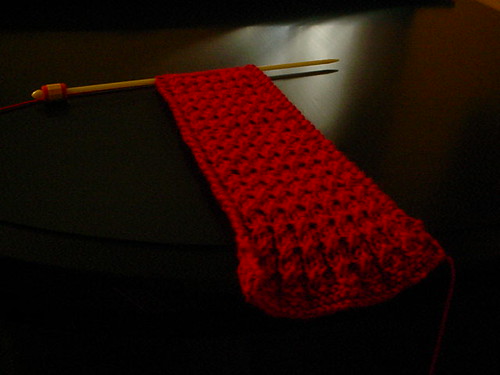
I would have gotten farther on this but I realized the middle of this afternoon that if I were going to do house cleaning before I went on break (which I really prefer to do if at all possible), today would have to be the day. So I put the knitting aside and cleaned house. And now I'm glad I did it.
I also did do a bit more on the back of the Ropes and Picots cardigan; I think it will be a work-on-it-on-break project. I may post a picture of that tomorrow if I get any further on it - I just started the "rope" pattern (which is another use of the twisted-stitch.)
I also finished reading "A Distant Mirror" last night. I think my main reaction is that the 14th century is nice to read about, but I wouldn't want to live there. It seems that the way wars were fought were really stupid - and the wars were over stupid things some of the times. And the "companies" were scary - basically, groups of armed brigands with fungible loyalties who might come into a town or city and mess it up and steal things and kidnap people. And, as I said before, except for a VERY few women (like Christine de Pisan and that anatomist, I forget her name now), life pretty much stunk if you were female. (Well, it stunk too if you were male, but I think it stunk a little more for females, at least females in the nobility as compared to males in the nobility). And there was a great deal of corruption...I can see now that there were a lot of threads and streams that led up to the Reformation, it wasn't just Luther finally deciding he had had it and nailing his theses to the church door. (There was Wyclif, and Jan Hus, and others, before Luther, that, if they weren't actually Protestant, were certainly anti-Church-hierarchy. And anti-the-corruption-they-saw-among-some-priests-and-bishops.)
Not sure what non-fiction I'm going to pick to read next. I'm not sure I'm ready for another sweeping book of history, especially one highlighting so much human selfishness and stupidity.
It also makes a thick, "scrunchy" fabric that I think will be nice for a warm scarf. I may wind up doing another one of these later, for myself, out of some of the yarn I have stockpiled in my "ooh, that's pretty, I want a scarf of that someday" box.
It's hard to photograph though.
I would have gotten farther on this but I realized the middle of this afternoon that if I were going to do house cleaning before I went on break (which I really prefer to do if at all possible), today would have to be the day. So I put the knitting aside and cleaned house. And now I'm glad I did it.
I also did do a bit more on the back of the Ropes and Picots cardigan; I think it will be a work-on-it-on-break project. I may post a picture of that tomorrow if I get any further on it - I just started the "rope" pattern (which is another use of the twisted-stitch.)
I also finished reading "A Distant Mirror" last night. I think my main reaction is that the 14th century is nice to read about, but I wouldn't want to live there. It seems that the way wars were fought were really stupid - and the wars were over stupid things some of the times. And the "companies" were scary - basically, groups of armed brigands with fungible loyalties who might come into a town or city and mess it up and steal things and kidnap people. And, as I said before, except for a VERY few women (like Christine de Pisan and that anatomist, I forget her name now), life pretty much stunk if you were female. (Well, it stunk too if you were male, but I think it stunk a little more for females, at least females in the nobility as compared to males in the nobility). And there was a great deal of corruption...I can see now that there were a lot of threads and streams that led up to the Reformation, it wasn't just Luther finally deciding he had had it and nailing his theses to the church door. (There was Wyclif, and Jan Hus, and others, before Luther, that, if they weren't actually Protestant, were certainly anti-Church-hierarchy. And anti-the-corruption-they-saw-among-some-priests-and-bishops.)
Not sure what non-fiction I'm going to pick to read next. I'm not sure I'm ready for another sweeping book of history, especially one highlighting so much human selfishness and stupidity.
Saturday, July 23, 2011
...with hope & confidence
The world is a scary place. Or maybe, some people make this world a scary place.
Like a lot of people, I watched the news with considerable dismay yesterday - first a bombing in Oslo, then a shooting at a youth camp.
Honestly, I don't care about the politics, opinions, motives, whatever of the individuals involved. If I were God, right now, I'd be saying, "I don't CARE who started it. I just want it to STOP NOW." (Oddly, in my mind, God sometimes sounds rather like an irritated mother.)
I think I said something this morning on Twitter about how I wished everyone would just shut up for a while. And how if I didn't hate camping - and if it weren't deadly hot here - I'd be strapping on my backpack and picking up my tent and running off to the forest for a few days to be away from people.
But then, as I was sitting at my microscope working, a thought hit me: "You should knit a scarf for the Red Scarf Project." Because I tend to believe that every loving act - even if it's just an anonymous one - adds to the balance of love in the universe, and that somehow, maybe, there will be enough kind and loving acts to somehow balance the hateful ones. (There's an old Jewish saying I read once, which I cannot find a text of online (which I find maddening: I can find just about anything else). It goes something like, "For every small act of kindness, God says, 'For this, I do not destroy the world.'")
I had to run some errands (and I also bribed myself with the promise of a trip to the bookstore if I finished the two samples I needed to finish). I also ran to the Hobby Lobby where I found, as if it were just waiting for me, three skeins of bright-red (they call it "Geranium") Bamboo Ewe on clearance. So it came home with me, and I cast on for the Toasty Twisty Scarf, because I was envisioning some kind of mock-cable pattern. (This is a pattern that will work for either a man or a woman.)
It soothes me considerably to be working on it. I'm going to see how much I can get done tonight and tomorrow, will probably post a picture of the progress Monday.
I do this not out of a purely altruistic feeling; it's also something that keeps me from totally flipping out, from writing off the human race, from deciding people are irredeemably bad, because I think about the college student (whom I will never know) that will receive this scarf and think, maybe, hopefully, they will turn out to be someone who does good in the world.
And also, I don't know, as I said I tend to believe that every loving act adds to the balance of love in the world. I NEED to believe that; if I didn't I think I'd be a much unhappier and more cynical person. And sometimes I need to very concretely remind myself of this fact.
I have until December to complete the scarf; December 1 is, I believe, the first day you send them in. It may even become my carry-it-around project this fall, so as I sit at the campus nurse's office or other places, if people ask me about what I'm knitting, I can explain to them...
I can't do much in this world, but I can do SOMETHING.
Like a lot of people, I watched the news with considerable dismay yesterday - first a bombing in Oslo, then a shooting at a youth camp.
Honestly, I don't care about the politics, opinions, motives, whatever of the individuals involved. If I were God, right now, I'd be saying, "I don't CARE who started it. I just want it to STOP NOW." (Oddly, in my mind, God sometimes sounds rather like an irritated mother.)
I think I said something this morning on Twitter about how I wished everyone would just shut up for a while. And how if I didn't hate camping - and if it weren't deadly hot here - I'd be strapping on my backpack and picking up my tent and running off to the forest for a few days to be away from people.
But then, as I was sitting at my microscope working, a thought hit me: "You should knit a scarf for the Red Scarf Project." Because I tend to believe that every loving act - even if it's just an anonymous one - adds to the balance of love in the universe, and that somehow, maybe, there will be enough kind and loving acts to somehow balance the hateful ones. (There's an old Jewish saying I read once, which I cannot find a text of online (which I find maddening: I can find just about anything else). It goes something like, "For every small act of kindness, God says, 'For this, I do not destroy the world.'")
I had to run some errands (and I also bribed myself with the promise of a trip to the bookstore if I finished the two samples I needed to finish). I also ran to the Hobby Lobby where I found, as if it were just waiting for me, three skeins of bright-red (they call it "Geranium") Bamboo Ewe on clearance. So it came home with me, and I cast on for the Toasty Twisty Scarf, because I was envisioning some kind of mock-cable pattern. (This is a pattern that will work for either a man or a woman.)
It soothes me considerably to be working on it. I'm going to see how much I can get done tonight and tomorrow, will probably post a picture of the progress Monday.
I do this not out of a purely altruistic feeling; it's also something that keeps me from totally flipping out, from writing off the human race, from deciding people are irredeemably bad, because I think about the college student (whom I will never know) that will receive this scarf and think, maybe, hopefully, they will turn out to be someone who does good in the world.
And also, I don't know, as I said I tend to believe that every loving act adds to the balance of love in the world. I NEED to believe that; if I didn't I think I'd be a much unhappier and more cynical person. And sometimes I need to very concretely remind myself of this fact.
I have until December to complete the scarf; December 1 is, I believe, the first day you send them in. It may even become my carry-it-around project this fall, so as I sit at the campus nurse's office or other places, if people ask me about what I'm knitting, I can explain to them...
I can't do much in this world, but I can do SOMETHING.
This is...interesting
Trying to get through my last two samples of inverts from today. Ran across this. I'm pretty sure it's a mite. It might have even been a gravid mite ("pregnant"). There are two small objects in its abdomen...not sure what else they could be (mite droppings are not that large).


Friday, July 22, 2011
This is brilliant
I don't remember where I came across this in my surfing, but this is one of those things I just love.
The man is an impressionist, and he goes through Clarence's Speech (from Richard III) in the style of various famous people. The ones that he utterly nails (I think his Christopher Walken is a bit weak), he has not just the voice, but the expression and gestures down (Garrison Keillor, for example)
The man is an impressionist, and he goes through Clarence's Speech (from Richard III) in the style of various famous people. The ones that he utterly nails (I think his Christopher Walken is a bit weak), he has not just the voice, but the expression and gestures down (Garrison Keillor, for example)
Fifteen pound book
So, I decided I really needed to start thinking about Principles I, seeing as in three weeks or so I will be teaching it. I have the "topics that must be covered" (this is one of those gen-ed classes, and it's also a "hurdle" class for the other classes in the department).
So I started the first chapter, got most of a lecture done on that. Hauled the book home to read more.
I think this is a more-recent edition the book that, several years ago, when we were "vetting" books for the new class, I took it home to look at it and dropped it on my toe, and figured that I had broken my toe. (I just taped the toe to the one next to it until it stopped hurting; I didn't have the time or energy to go to Urgent Care and then pay a bunch of money for someone to tape my toes together and tell me to be careful about what shoes I wore for a while).
Yeah, the book feels like it weighs fifteen pounds.
I think this is one of the more-compelling arguments for e-books. I don't particularly NEED a Kindle, and I sure as shooting wouldn't throw out my entire library just to replace it with digital versions of the books (for one thing, I suspect many of the books I own don't exist in digital form, even once you get past the "what if you drop the Kindle and it breaks?" or "Do you REALLY own the digital version of a book?" questions)
Part of it is that it's a giant hardback book. And part of it is that it's full of illustrations. But it's also just really DENSE. I think they used special high-density paper or something. (The soils textbook I use is the same size, maybe somewhat thinner, and it doesn't weigh anywhere near as much).
I tried to read ahead and knit on the sleeve for Potter.
I didn't get very far. It's hard to read this book and knit, because it uses that accursed shiny paper (I suppose, the better to get the illustration ink to work). Which means it's hard to position it anywhere that's not right up close to my face and be able to read it without a glare from the light.
So I finally gave up on knitting, right after attaching the new ball of yarn (10" of sleeve from what was left from the first ball - so that means the back, both fronts, and about 1/2 of a sleeve from one ball of yarn).
After getting kind of tired of holding up the heavy textbook I switched over to reading another book, one I bought to help me review some of the details of genetics and cell biology. It's called "The Manga Guide to Cellular Biology" (or something very close to that. There's a whole series of these; I first bought the one for Calculus, thinking I could maybe, finally, get a little bit of calculus to make a dent on my brain. (I don't know what it is. I understand the purposes of derivatives and of integration, but I couldn't do either operation to save my life. And this is after taking calculus twice - I earned a 3 on the AP calculus exam, enough to get me out of basic calculus, but I re-took it in college because I thought I didn't know enough. And then in grad school I spent part of one summer reading a calculus text and taking extensive notes...and still, it escapes me. And part of it is stubbornness, but part of it is also a weird fascination: is this REALLY where the limit of my intelligence/ability to learn lies? Why do the calculations of derivatives and integrals remain such a black box to me?)
***
I'm really trying to have sympathy for all of y'all on the East Coast who are hot right now. But seeing as we're closing in on, I think, 25 days in a row where it's been 95 or above, it's not rained in two months, and we've been asked to conserve water (and yet, my "perfect" neighbor down the street had the sprinkler out on her lawn this morning as I left the house... if she gripes at me about my lawn being "ugly" she will get a piece of my mind)...well, I admit I'm having a little trouble.
I know, I know: a lot of people up north don't have air conditioning and that makes it crazy awful. But still. I'm beyond ready for this heat to be done with.
So I started the first chapter, got most of a lecture done on that. Hauled the book home to read more.
I think this is a more-recent edition the book that, several years ago, when we were "vetting" books for the new class, I took it home to look at it and dropped it on my toe, and figured that I had broken my toe. (I just taped the toe to the one next to it until it stopped hurting; I didn't have the time or energy to go to Urgent Care and then pay a bunch of money for someone to tape my toes together and tell me to be careful about what shoes I wore for a while).
Yeah, the book feels like it weighs fifteen pounds.
I think this is one of the more-compelling arguments for e-books. I don't particularly NEED a Kindle, and I sure as shooting wouldn't throw out my entire library just to replace it with digital versions of the books (for one thing, I suspect many of the books I own don't exist in digital form, even once you get past the "what if you drop the Kindle and it breaks?" or "Do you REALLY own the digital version of a book?" questions)
Part of it is that it's a giant hardback book. And part of it is that it's full of illustrations. But it's also just really DENSE. I think they used special high-density paper or something. (The soils textbook I use is the same size, maybe somewhat thinner, and it doesn't weigh anywhere near as much).
I tried to read ahead and knit on the sleeve for Potter.
I didn't get very far. It's hard to read this book and knit, because it uses that accursed shiny paper (I suppose, the better to get the illustration ink to work). Which means it's hard to position it anywhere that's not right up close to my face and be able to read it without a glare from the light.
So I finally gave up on knitting, right after attaching the new ball of yarn (10" of sleeve from what was left from the first ball - so that means the back, both fronts, and about 1/2 of a sleeve from one ball of yarn).
After getting kind of tired of holding up the heavy textbook I switched over to reading another book, one I bought to help me review some of the details of genetics and cell biology. It's called "The Manga Guide to Cellular Biology" (or something very close to that. There's a whole series of these; I first bought the one for Calculus, thinking I could maybe, finally, get a little bit of calculus to make a dent on my brain. (I don't know what it is. I understand the purposes of derivatives and of integration, but I couldn't do either operation to save my life. And this is after taking calculus twice - I earned a 3 on the AP calculus exam, enough to get me out of basic calculus, but I re-took it in college because I thought I didn't know enough. And then in grad school I spent part of one summer reading a calculus text and taking extensive notes...and still, it escapes me. And part of it is stubbornness, but part of it is also a weird fascination: is this REALLY where the limit of my intelligence/ability to learn lies? Why do the calculations of derivatives and integrals remain such a black box to me?)
***
I'm really trying to have sympathy for all of y'all on the East Coast who are hot right now. But seeing as we're closing in on, I think, 25 days in a row where it's been 95 or above, it's not rained in two months, and we've been asked to conserve water (and yet, my "perfect" neighbor down the street had the sprinkler out on her lawn this morning as I left the house... if she gripes at me about my lawn being "ugly" she will get a piece of my mind)...well, I admit I'm having a little trouble.
I know, I know: a lot of people up north don't have air conditioning and that makes it crazy awful. But still. I'm beyond ready for this heat to be done with.
Thursday, July 21, 2011
Somethng new learned.
(Spike, it turns out to "share" the channel, I need an e-mail address. Gah. I didn't check to see how one went about sharing; I thought it was by Pandora ID, which seemed only logical to me. Also The Anonymous Channel isn't really lyric-less, but most of the lyrics are in languages I do not speak - I find I can't concentrate on other things if I can understand the words of music.)
Anyway. Last night I did (just barely) start the Ropes and Picots cardigan. Because I wanted something different to work on. (If I don't get the sleeves done - or close to done - for Potter this weekend, it'll be a toss-up whether I take this or Potter as my "big project" for over break).
And I learned something new. Because the sweater has a picot edge, you cannot merely cast on and start knitting ("One does not merely cast on into Mordor."?). With a picot edge, the standard way of doing it is that you cast on, knit a few rows, then do the picot row (a row of yarn-overs and knit-two-togethers - when it's folded like it's supposed to be, it makes a row of tiny points), then you knit a few more rows. And then you fold the knitting to make the picots.
One way of getting the fold to say is to sew the cast-on edge to the appropriate row further downstream (and I admit I've done that on things like hats), but it's a little messy and inelegant.
A better way is to do a provisional cast-on (one that you can take out later on and expose "live" stitches that you can knit to), and then knit those stitches together with the stitches they are to be joined to.
I have done a provisional cast on a few times, and always as the crochet method (you crochet a chain, use that to work off of, and then unpick the crocheted chain).
But this pattern recommended the "invisible provisional" cast-on (say that three times fast). You cast on over a strand of waste yarn, and the idea is, you can pull that out later and get "live stitches."
They had tiny drawings in the back of the Interweave issue as to how to do it, but...as much as I love Interweave Press for many things...their instructions on how to do new-to-you techniques often leave something to be desired. (Or, I don't know, maybe I need more explicit instructions).
I dug out my copy of the most recent book in the Stitch and Bitch line (I think it's "Superstar knitting"?) As much as I'm put off a bit by the name, and by the whole attitude that you need to be a Knitting Rockstar, the tutorials in the books are solid and the illustrations are more helpful than most.
So I managed to get the invisible provisional cast on done. It's tricky to do - you're having to weave your hands around in all kinds of strange ways, and I wound up taking several tries before I got stitches that held. My final result was not pretty, but as long as I can unpick it when I need to and knit those stitches with the other stitches, it will be fine.
(There's YouTube video tutorial (actually, there's more than one), but they do it differently than the way in my book. (And they call the waste yarn "auxiliary yarn," which I suppose is the "politically correct" term as you don't want to label a yarn a "waste"? But I find it more confusing).
(I'm thinking now, in the future, if I need an "invisible provisional" cast-on, I'm just going to cast on with waste yarn, knit a few rows with it, and then join on the yarn I need to have cast on provisionally - and just not anchor it. Then I can snip the cast on of the waste yarn, unzip the rows of waste yarn I knit, and get live stitches that way. A lot more straightforward to my brain, and it doesn't require any kind of hand-jive to make it work.)
(So does it still count as learning something new if you later on decide that there's a more straightforward-to-you way, so you won't do that method again?)
Anyway. Last night I did (just barely) start the Ropes and Picots cardigan. Because I wanted something different to work on. (If I don't get the sleeves done - or close to done - for Potter this weekend, it'll be a toss-up whether I take this or Potter as my "big project" for over break).
And I learned something new. Because the sweater has a picot edge, you cannot merely cast on and start knitting ("One does not merely cast on into Mordor."?). With a picot edge, the standard way of doing it is that you cast on, knit a few rows, then do the picot row (a row of yarn-overs and knit-two-togethers - when it's folded like it's supposed to be, it makes a row of tiny points), then you knit a few more rows. And then you fold the knitting to make the picots.
One way of getting the fold to say is to sew the cast-on edge to the appropriate row further downstream (and I admit I've done that on things like hats), but it's a little messy and inelegant.
A better way is to do a provisional cast-on (one that you can take out later on and expose "live" stitches that you can knit to), and then knit those stitches together with the stitches they are to be joined to.
I have done a provisional cast on a few times, and always as the crochet method (you crochet a chain, use that to work off of, and then unpick the crocheted chain).
But this pattern recommended the "invisible provisional" cast-on (say that three times fast). You cast on over a strand of waste yarn, and the idea is, you can pull that out later and get "live stitches."
They had tiny drawings in the back of the Interweave issue as to how to do it, but...as much as I love Interweave Press for many things...their instructions on how to do new-to-you techniques often leave something to be desired. (Or, I don't know, maybe I need more explicit instructions).
I dug out my copy of the most recent book in the Stitch and Bitch line (I think it's "Superstar knitting"?) As much as I'm put off a bit by the name, and by the whole attitude that you need to be a Knitting Rockstar, the tutorials in the books are solid and the illustrations are more helpful than most.
So I managed to get the invisible provisional cast on done. It's tricky to do - you're having to weave your hands around in all kinds of strange ways, and I wound up taking several tries before I got stitches that held. My final result was not pretty, but as long as I can unpick it when I need to and knit those stitches with the other stitches, it will be fine.
(There's YouTube video tutorial (actually, there's more than one), but they do it differently than the way in my book. (And they call the waste yarn "auxiliary yarn," which I suppose is the "politically correct" term as you don't want to label a yarn a "waste"? But I find it more confusing).
(I'm thinking now, in the future, if I need an "invisible provisional" cast-on, I'm just going to cast on with waste yarn, knit a few rows with it, and then join on the yarn I need to have cast on provisionally - and just not anchor it. Then I can snip the cast on of the waste yarn, unzip the rows of waste yarn I knit, and get live stitches that way. A lot more straightforward to my brain, and it doesn't require any kind of hand-jive to make it work.)
(So does it still count as learning something new if you later on decide that there's a more straightforward-to-you way, so you won't do that method again?)
Wednesday, July 20, 2011
Not gonna explain
If you don't know the two things involved, it's probably too obscure. But:
two things I love, all mashed together
It's really, really warm and sticky in my office again. My "mystery hives" (which I'm fully convinced is some kind of cholinergic urticaria/cholinergic dermatitis) are back. I have my syllabi done for fall but that's ALL I've done today. I have to go home and bake brownies for a party tonight - an OUTDOOR party. I'm not looking forward to it at all, but I can't not go.
So I'm trying to find things to make me happy.
two things I love, all mashed together
It's really, really warm and sticky in my office again. My "mystery hives" (which I'm fully convinced is some kind of cholinergic urticaria/cholinergic dermatitis) are back. I have my syllabi done for fall but that's ALL I've done today. I have to go home and bake brownies for a party tonight - an OUTDOOR party. I'm not looking forward to it at all, but I can't not go.
So I'm trying to find things to make me happy.
Some life lessons
Once again, I've seen a lot of low-level drama swirling around. At work, in the volunteer work I do, other places. I'm never directly involved in the drama but it seems that I suffer from the effects anyway. (I don't know. Maybe I just am surrounded by people with a need for drama/tragically thin skins/I don't know what, or maybe I'm just more sensitive than some people to what I see as drama-mongering.)
Anyway, I got to thinking last night about things I've learned over the years, things that I remind myself of, that help keep me out of drama - or at least help me shrug and accept that "life is messy and people are weird." I actually tried to catalog them:
1. The only person whose behavior you control is you. I remind myself of this regularly. I don't always succeed - when I have a bunch of people melted down in tears and yelling at each other around me, it's hard for me not to melt down in tears, too, just because I'm SO FRUSTRATED with them and I hate dissention. But on a bigger level, I remind myself of this and I'm proud of myself for knowing it because:
2. There are certain things - call them ethics, morals, integrity, your reputation, whatever - that you just have to stick to, no matter what the consequences. When I (mentally) square my shoulders and say, "I don't care if X is slacking off and it means I have to pick up some of X's tasks, those tasks still have to be done" instead of being kind of "poor me" about it, just saying to myself, "You are a responsible person and this is the kind of thing responsible people do." Or, likewise, something I said in Ivory Tower Fiber Freaks - we were discussing a (now deleted, but it's there in Google Cache) blogpost by a professor at a B-school who essentially said, "I busted a bunch of students for plagiarizing. While my administration praised me for it, I got the lowest merit pay raise of my career the following year, and I think it's because my busting of the plagiarists made my evaluation scores go down...so I'm not going to bust plagiarists any more." After first voicing dismay about the whole situation, then I decided: sometimes you just have to accept certain things as (no pun intended) the cost of doing business. If I were in a similar situation, I'd take my lower pay raise and shrug and say, "But what I'm doing is more important." Because:
3. It's (usually) not about you. There are really two interpretations to this that I use. First: there are some things in life that are more important than how you feel about a situation, or your emotions. I learned this the really, really hard way when I was leading the teenaged youth group. I'd get complaints about stuff - some of it petty, some of it potentially serious. And don't get me wrong, those complaints HURT. I went home a few times and cried. But I also realized that being there for those kids was more important than how I felt, more important than whatever blows my 'self esteem' took from people who didn't like smudges on the Fellowship Hall floor or lights inadvertently left on in bathrooms. Again, you just square your shoulders and tell yourself that the only person getting no complaints is often the person doing nothing of import, and you go on. (And you do listen to the complaints seriously enough to learn if there's anything you need to change).
But secondly: It's not about you when people talk. Sometimes people say stuff - sometimes quite hurtful stuff - when they are hurting themselves. And while there have been times I've said (or wanted to say) "And what do you mean by THAT?" a lot of the time I can write off what they said to the fact that they're hurting. I hurt too, sometimes. And sometimes I say stupid stuff I shouldn't because I'm hurting. (I do try to apologize when I do, but I don't always manage to. Saying you're sorry is sometimes the hardest thing to say). I remember reading somewhere the phrase: "Small input, big reaction: there's something else going on in the reactor" and I try to keep that in mind.
4. Sometimes people say stuff they don't really mean. This is kind of a tough lesson for me because I came from a family where people didn't say crazy stuff out of anger or hurt or threaten things they weren't going to follow through on. (But likewise: praise was not empty or unearned). A tough lesson I've had to learn as an adult is that some people just need to blow of steam verbally, and in some cases you have to learn to discount what a person says by a certain amount. Again, I think this is where I think a lot of people are "bringing the drama" compared to how I think.
5. If you don't have a "dog in the hunt," keep your mouth shut. Or, as one of my research students says: Better to keep your mouth shut and be thought a fool, than to open it and remove all doubt. But it's not just to avoid appearing foolish that I've learned not to say stuff in situations where I don't have an investment. For one thing, I've found you can learn a lot more about where interpersonal relations are going, what the underlying problems in a group are, etc., if, instead of trying to formulate what you're going to say or looking for a point where you can stick your oar in, you just stand back and keep your own counsel and watch other people. (And not least: if the people with low/no investment in a situation don't speak in a meeting, the meeting often ends earlier.)
6. Don't participate in gossip or tale-bearing. I'm generally the last one to know "the dirt" because I do this - but on the other side of things, I generally keep a higher opinion of people. And also, I find, in a lot of cases stuff that comes up as gossip around me is so often the result of miscommunication or something said in a moment of anger or pain...that the person didn't really mean what they are said to have said. Also, I find that not participating in gossip tends to make one less of a target of it.
7. Throw away your 'calculator.' This is something my dad said to my brother and me ALL THE TIME when we were growing up - because, like most siblings, we'd fight over
a. who got the bigger piece of cake
b. who had the worse chores to do
c. whose tennis shoes were nicer/more expensive
d. who got better birthday presents...
with each of us trying to find some way we'd been wronged, and deserved restitution.
And the truth of the matter is, sometimes you just have to stop worrying about "fair" and worry more about "important." It's not "fair," all the volunteer work I do, when other people seem to sit on their hands. But, much of it is work that I think is important and if I can do it - and if no one else is going to step up so it goes undone - well, what's more important is the work getting done or the service being provided, and what's really "fair" in the long run matters less. (Or, as someone else on Ravelry said: "'Fair' is a place where you go to see pigs and pies.")
8. But: sometimes you just have to say "No." And people have to be able to deal with that. I think I related how I gave up the chairship of a campus committee because it got so stressful and ugly - and how all I ever heard were complaints and people wanting me to bend the rules "just for them." I told the rest of the committee that it was making my blood pressure spike up (Well, based on my having one unusually high-for-me reading during a random check-up during that time) and I had to give it up. The committee survived, they found a new head. (But not after trying to suck me back in: seriously, they asked me to schedule the meeting for them to find a new chair. And I said no, it was partly the issues surrounding scheduling that were making me crazy). But you need to pick your battles. I figured it was easier and probably better in the long run to say "Yes" to teaching Principles I - because there are a lot of good reasons for my doing it, and other people in the department are having to bear other burdens - but I am reserving the right to say "No" to something else in the future.
9. Some stuff isn't worth fighting over. It just isn't. As long as you're not compromising your morals or integrity or whatever, sometimes, if someone is being (forgive me) a total ass about a situation, it's better to let them "win" and just walk away.
10. Some people enjoy drama and upset. You do not have to get drawn into their game and try to avoid being manipulated by them. Try to surround yourself with people who have more valuable ways of spending their time. Learn to see through the drama-mongers. (I've often said the reason I never cared for soap operas is that I had enough people around me in real life whose lives seemed to be soap operas.)
11. My "good enough" and other people's "good enough" are often two different "good enoughs." I tend to be a perfectionist and am super self-critical. For example: the pastor's wife and I are working on revitalizing the Sunday-night programs for older kids. I had some possible curricula picked out and I showed them to her, apologetically saying I hadn't looked that hard and hadn't read them in as great detail as I might have liked. But she was super enthusiastic and happy that I had thought and hunted even as much as I did for stuff. And the whole thing with the Full Professor - everyone I know tells me now they "knew" I'd get it, but I really doubted a lot of the time, I can always see how I didn't work hard enough or push enough or spend enough hours in the lab or the field or whatever. (I think in some cases it's a lot like the old saying, "familiarity breeds contempt." I "see" myself all the time, I am privy to what's going on in my head, whereas other people mainly see my actions and what I say...so they don't know about all the (in my estimation) mixed-up, stupid stuff that goes on in my brain...they don't know, for example, that I like to come home at the end of the day and put on my SpongeBob SquarePants pajamas and watch cartoons, or that if I'm really upset I will occasionally eat a couple of spoons of Nutella straight from the jar, things like that. They don't see all the weird stupid stuff about me. Of course, I also don't see all the weird stupid messed-up stuff other people do, so maybe I hold some people in higher esteem than they hold themselves...but at any rate, I often say, "Other people see things in me I fail to see in myself.")
12. Don't forget to take time for yourself. And your family. And your friends. I realized that after going out last Friday and spending part of a day hanging out with Laura. And as one of my friends who recently lost both parents told me: You will never regret taking the time to visit people you care about. And also: you are a person you should care about. One thing I want to work on this fall is giving myself permission at night to plop down and relax if there's something I really want to see on television, or if I have a very absorbing book I'm reading, or whatever. And do things like not jump up and answer the phone if it rings. Or feel obligated to go do stuff I don't need to do and don't want to do.
13. Don't forget who you are. Don't forget or shortchange the things that make you, you. This goes along with both #11 and #2 above. As I said, I feel better and stronger and more able to take whatever's thrown at me if I remind myself regularly of the important things - that I'm a responsible person, that I'm someone other people can depend on, that I'm honest, that I'm faithful, that I stop to think about whether something is right or wrong before I do it, that I'm intelligent... But I also think for me it's important to remember where I came from - I have lots of pictures of family around my house, I have certain "touchstone" memories of my parents and grandparents and growing-up time that are things I think of as things that define me as who I am. And it's also important to me to continue to do the things I value, the things that I think of as setting me apart a little bit, of (maybe even) making me kind of special - the things like the quilting and knitting and continuing to try to learn to play the piano and reading books that are outside of my main field of study but that are on topics that interest me, and so on. It's so easy when I get busy and stressed for me to begin to feel like I'm losing myself, almost like I'm starting to turn a little invisible, and hanging on to those things can help pull me back to the course I should be on.
So anyway. I think of something I read in a book once, about a woman who lived in a cabin out in the wilderness, and how another woman - who was, at that time, somewhat lost - wound up at the cabin. And after a few weeks the woman who had come to the cabin talked about how great it was, how if she could only find a place like that, she could become like a saint. And the woman in the cabin said to her something like, "It's easy to be a saint up on the mountaintop, and very hard to be one down among people. But ultimately, the place where good people are needed is down among the people." (I'm paraphrasing heavily there, and not saying it very well. I guess what I mean is that as much as I'd LIKE to withdraw from the world, and to be somewhat of a hermit...I can't, really. There are things I need to do. And maybe lessons I need to learn (still) from my fellow messy, difficult humans.)
There. Now I feel a little better. (I hope this coming fall is less stressful.)
Anyway, I got to thinking last night about things I've learned over the years, things that I remind myself of, that help keep me out of drama - or at least help me shrug and accept that "life is messy and people are weird." I actually tried to catalog them:
1. The only person whose behavior you control is you. I remind myself of this regularly. I don't always succeed - when I have a bunch of people melted down in tears and yelling at each other around me, it's hard for me not to melt down in tears, too, just because I'm SO FRUSTRATED with them and I hate dissention. But on a bigger level, I remind myself of this and I'm proud of myself for knowing it because:
2. There are certain things - call them ethics, morals, integrity, your reputation, whatever - that you just have to stick to, no matter what the consequences. When I (mentally) square my shoulders and say, "I don't care if X is slacking off and it means I have to pick up some of X's tasks, those tasks still have to be done" instead of being kind of "poor me" about it, just saying to myself, "You are a responsible person and this is the kind of thing responsible people do." Or, likewise, something I said in Ivory Tower Fiber Freaks - we were discussing a (now deleted, but it's there in Google Cache) blogpost by a professor at a B-school who essentially said, "I busted a bunch of students for plagiarizing. While my administration praised me for it, I got the lowest merit pay raise of my career the following year, and I think it's because my busting of the plagiarists made my evaluation scores go down...so I'm not going to bust plagiarists any more." After first voicing dismay about the whole situation, then I decided: sometimes you just have to accept certain things as (no pun intended) the cost of doing business. If I were in a similar situation, I'd take my lower pay raise and shrug and say, "But what I'm doing is more important." Because:
3. It's (usually) not about you. There are really two interpretations to this that I use. First: there are some things in life that are more important than how you feel about a situation, or your emotions. I learned this the really, really hard way when I was leading the teenaged youth group. I'd get complaints about stuff - some of it petty, some of it potentially serious. And don't get me wrong, those complaints HURT. I went home a few times and cried. But I also realized that being there for those kids was more important than how I felt, more important than whatever blows my 'self esteem' took from people who didn't like smudges on the Fellowship Hall floor or lights inadvertently left on in bathrooms. Again, you just square your shoulders and tell yourself that the only person getting no complaints is often the person doing nothing of import, and you go on. (And you do listen to the complaints seriously enough to learn if there's anything you need to change).
But secondly: It's not about you when people talk. Sometimes people say stuff - sometimes quite hurtful stuff - when they are hurting themselves. And while there have been times I've said (or wanted to say) "And what do you mean by THAT?" a lot of the time I can write off what they said to the fact that they're hurting. I hurt too, sometimes. And sometimes I say stupid stuff I shouldn't because I'm hurting. (I do try to apologize when I do, but I don't always manage to. Saying you're sorry is sometimes the hardest thing to say). I remember reading somewhere the phrase: "Small input, big reaction: there's something else going on in the reactor" and I try to keep that in mind.
4. Sometimes people say stuff they don't really mean. This is kind of a tough lesson for me because I came from a family where people didn't say crazy stuff out of anger or hurt or threaten things they weren't going to follow through on. (But likewise: praise was not empty or unearned). A tough lesson I've had to learn as an adult is that some people just need to blow of steam verbally, and in some cases you have to learn to discount what a person says by a certain amount. Again, I think this is where I think a lot of people are "bringing the drama" compared to how I think.
5. If you don't have a "dog in the hunt," keep your mouth shut. Or, as one of my research students says: Better to keep your mouth shut and be thought a fool, than to open it and remove all doubt. But it's not just to avoid appearing foolish that I've learned not to say stuff in situations where I don't have an investment. For one thing, I've found you can learn a lot more about where interpersonal relations are going, what the underlying problems in a group are, etc., if, instead of trying to formulate what you're going to say or looking for a point where you can stick your oar in, you just stand back and keep your own counsel and watch other people. (And not least: if the people with low/no investment in a situation don't speak in a meeting, the meeting often ends earlier.)
6. Don't participate in gossip or tale-bearing. I'm generally the last one to know "the dirt" because I do this - but on the other side of things, I generally keep a higher opinion of people. And also, I find, in a lot of cases stuff that comes up as gossip around me is so often the result of miscommunication or something said in a moment of anger or pain...that the person didn't really mean what they are said to have said. Also, I find that not participating in gossip tends to make one less of a target of it.
7. Throw away your 'calculator.' This is something my dad said to my brother and me ALL THE TIME when we were growing up - because, like most siblings, we'd fight over
a. who got the bigger piece of cake
b. who had the worse chores to do
c. whose tennis shoes were nicer/more expensive
d. who got better birthday presents...
with each of us trying to find some way we'd been wronged, and deserved restitution.
And the truth of the matter is, sometimes you just have to stop worrying about "fair" and worry more about "important." It's not "fair," all the volunteer work I do, when other people seem to sit on their hands. But, much of it is work that I think is important and if I can do it - and if no one else is going to step up so it goes undone - well, what's more important is the work getting done or the service being provided, and what's really "fair" in the long run matters less. (Or, as someone else on Ravelry said: "'Fair' is a place where you go to see pigs and pies.")
8. But: sometimes you just have to say "No." And people have to be able to deal with that. I think I related how I gave up the chairship of a campus committee because it got so stressful and ugly - and how all I ever heard were complaints and people wanting me to bend the rules "just for them." I told the rest of the committee that it was making my blood pressure spike up (Well, based on my having one unusually high-for-me reading during a random check-up during that time) and I had to give it up. The committee survived, they found a new head. (But not after trying to suck me back in: seriously, they asked me to schedule the meeting for them to find a new chair. And I said no, it was partly the issues surrounding scheduling that were making me crazy). But you need to pick your battles. I figured it was easier and probably better in the long run to say "Yes" to teaching Principles I - because there are a lot of good reasons for my doing it, and other people in the department are having to bear other burdens - but I am reserving the right to say "No" to something else in the future.
9. Some stuff isn't worth fighting over. It just isn't. As long as you're not compromising your morals or integrity or whatever, sometimes, if someone is being (forgive me) a total ass about a situation, it's better to let them "win" and just walk away.
10. Some people enjoy drama and upset. You do not have to get drawn into their game and try to avoid being manipulated by them. Try to surround yourself with people who have more valuable ways of spending their time. Learn to see through the drama-mongers. (I've often said the reason I never cared for soap operas is that I had enough people around me in real life whose lives seemed to be soap operas.)
11. My "good enough" and other people's "good enough" are often two different "good enoughs." I tend to be a perfectionist and am super self-critical. For example: the pastor's wife and I are working on revitalizing the Sunday-night programs for older kids. I had some possible curricula picked out and I showed them to her, apologetically saying I hadn't looked that hard and hadn't read them in as great detail as I might have liked. But she was super enthusiastic and happy that I had thought and hunted even as much as I did for stuff. And the whole thing with the Full Professor - everyone I know tells me now they "knew" I'd get it, but I really doubted a lot of the time, I can always see how I didn't work hard enough or push enough or spend enough hours in the lab or the field or whatever. (I think in some cases it's a lot like the old saying, "familiarity breeds contempt." I "see" myself all the time, I am privy to what's going on in my head, whereas other people mainly see my actions and what I say...so they don't know about all the (in my estimation) mixed-up, stupid stuff that goes on in my brain...they don't know, for example, that I like to come home at the end of the day and put on my SpongeBob SquarePants pajamas and watch cartoons, or that if I'm really upset I will occasionally eat a couple of spoons of Nutella straight from the jar, things like that. They don't see all the weird stupid stuff about me. Of course, I also don't see all the weird stupid messed-up stuff other people do, so maybe I hold some people in higher esteem than they hold themselves...but at any rate, I often say, "Other people see things in me I fail to see in myself.")
12. Don't forget to take time for yourself. And your family. And your friends. I realized that after going out last Friday and spending part of a day hanging out with Laura. And as one of my friends who recently lost both parents told me: You will never regret taking the time to visit people you care about. And also: you are a person you should care about. One thing I want to work on this fall is giving myself permission at night to plop down and relax if there's something I really want to see on television, or if I have a very absorbing book I'm reading, or whatever. And do things like not jump up and answer the phone if it rings. Or feel obligated to go do stuff I don't need to do and don't want to do.
13. Don't forget who you are. Don't forget or shortchange the things that make you, you. This goes along with both #11 and #2 above. As I said, I feel better and stronger and more able to take whatever's thrown at me if I remind myself regularly of the important things - that I'm a responsible person, that I'm someone other people can depend on, that I'm honest, that I'm faithful, that I stop to think about whether something is right or wrong before I do it, that I'm intelligent... But I also think for me it's important to remember where I came from - I have lots of pictures of family around my house, I have certain "touchstone" memories of my parents and grandparents and growing-up time that are things I think of as things that define me as who I am. And it's also important to me to continue to do the things I value, the things that I think of as setting me apart a little bit, of (maybe even) making me kind of special - the things like the quilting and knitting and continuing to try to learn to play the piano and reading books that are outside of my main field of study but that are on topics that interest me, and so on. It's so easy when I get busy and stressed for me to begin to feel like I'm losing myself, almost like I'm starting to turn a little invisible, and hanging on to those things can help pull me back to the course I should be on.
So anyway. I think of something I read in a book once, about a woman who lived in a cabin out in the wilderness, and how another woman - who was, at that time, somewhat lost - wound up at the cabin. And after a few weeks the woman who had come to the cabin talked about how great it was, how if she could only find a place like that, she could become like a saint. And the woman in the cabin said to her something like, "It's easy to be a saint up on the mountaintop, and very hard to be one down among people. But ultimately, the place where good people are needed is down among the people." (I'm paraphrasing heavily there, and not saying it very well. I guess what I mean is that as much as I'd LIKE to withdraw from the world, and to be somewhat of a hermit...I can't, really. There are things I need to do. And maybe lessons I need to learn (still) from my fellow messy, difficult humans.)
There. Now I feel a little better. (I hope this coming fall is less stressful.)
Tuesday, July 19, 2011
Fun with Pandora
This spring, I took out a subscription to the Pandora music service. I did this in part because I was listening to the thing so much in my office that my month of "free" Pandora would time out before the month was up. (Also, I got tired of the ads).
I needed it because (a) it's getting harder and harder to access KING-fm successfully and (b) I really need some kind of music in my office - or at least did last year, when my next-door neighbor would have loud, rather pointy phone conversations that I could hear. (That person is now gone, but that doesn't mean that who ever has that office next won't be just as pointy).
So anyway. For months and months I happily listened to the Johann Strauss waltz channel I "made" (The idea of Pandora is you tell it what you like, and it uses some kind of an algorithm to find similar music). But I guess it got bored with Strauss and Lehar waltzes (or else its repertoire of those decreased for some copyright reason; it seemed I'd get three versions of songs from The Merry Widow in a day.) And then it gave me a lot of opera. Which is kind of OK, but after I realized yesterday they had played "Nessun Dorma" three times in the several hours I'd been listening...I decided it was time to try a new channel. Or rather, revamping one I had.
I took a Ralph Vaughn Williams channel I'd not listened to in a while, and said, "Okay, add in these composers" and listed Eric Coates, David Fanshawe, Charles Williams, and Albert Ketèlbey* These are all individuals I consider British Light Music (a genre of "classical" music from the early 20th c., it also includes things like orchestral movie scores).
And I let it go.
I think that slightly more obscure list kind of overwhelmed its algorithm because it started to throw off weird stuff. First, I got bluegrass. (Okay, bluegrass originated from Scots-Irish settlers, who originally came from the British Isles...but not quite close enough). Then I got some 1960s popsinger, I forget who.
Then today, I got (urk) The Harmonicats.*
So I renamed the channel the This Is Supposed To Be British Light Music Channel and decided to just listen to it when I'm actively at the computer, so I can give the "thumbs down" on stuff I don't think fits.
*(Which came up as "Albert Ketèlbey and his orchestra," which is maybe how Pandora decided the "Harmonicats" were somehow OK)
But then I got to playing around. One of the suggestions they gave me for new music was "Anonymous Scottish" and I hatched a plan.
I now have THE ANONYMOUS CHANNEL. Which includes "anonymous antiquarian composers," "anonymous Scottish" and ditto German, French, English, Italian, and Belgian. And I think I said OK to "Anonymous French Polyphonic" as well.
So it'll be mostly old, old stuff - but that's more likely to not turn up jarringly different things, I think. And I like most of the Renaissance (and earlier) music I've heard.
I also was idly wondering a while back what Pandora would do with an odd combination - say, you told it you liked both Eartha Kitt and Lynyrd Skynyrd, what would it do? (I'm still half-tempted to try that as a channel). Then again, it may have been someone who said they liked "both Eric Coats AND the Harmonicats" that got me the strange mix on my British Light Music channel. (Or else, the algorithm just doesn't work well with the mix of composers I chose, I don't know).
Incidentally, it's possible to 'share' stations with other people on Pandora, so if you have a burning desire to "share" my ANONYMOUS CHANNEL or something, let me know your Pandora ID....
I needed it because (a) it's getting harder and harder to access KING-fm successfully and (b) I really need some kind of music in my office - or at least did last year, when my next-door neighbor would have loud, rather pointy phone conversations that I could hear. (That person is now gone, but that doesn't mean that who ever has that office next won't be just as pointy).
So anyway. For months and months I happily listened to the Johann Strauss waltz channel I "made" (The idea of Pandora is you tell it what you like, and it uses some kind of an algorithm to find similar music). But I guess it got bored with Strauss and Lehar waltzes (or else its repertoire of those decreased for some copyright reason; it seemed I'd get three versions of songs from The Merry Widow in a day.) And then it gave me a lot of opera. Which is kind of OK, but after I realized yesterday they had played "Nessun Dorma" three times in the several hours I'd been listening...I decided it was time to try a new channel. Or rather, revamping one I had.
I took a Ralph Vaughn Williams channel I'd not listened to in a while, and said, "Okay, add in these composers" and listed Eric Coates, David Fanshawe, Charles Williams, and Albert Ketèlbey* These are all individuals I consider British Light Music (a genre of "classical" music from the early 20th c., it also includes things like orchestral movie scores).
And I let it go.
I think that slightly more obscure list kind of overwhelmed its algorithm because it started to throw off weird stuff. First, I got bluegrass. (Okay, bluegrass originated from Scots-Irish settlers, who originally came from the British Isles...but not quite close enough). Then I got some 1960s popsinger, I forget who.
Then today, I got (urk) The Harmonicats.*
So I renamed the channel the This Is Supposed To Be British Light Music Channel and decided to just listen to it when I'm actively at the computer, so I can give the "thumbs down" on stuff I don't think fits.
*(Which came up as "Albert Ketèlbey and his orchestra," which is maybe how Pandora decided the "Harmonicats" were somehow OK)
But then I got to playing around. One of the suggestions they gave me for new music was "Anonymous Scottish" and I hatched a plan.
I now have THE ANONYMOUS CHANNEL. Which includes "anonymous antiquarian composers," "anonymous Scottish" and ditto German, French, English, Italian, and Belgian. And I think I said OK to "Anonymous French Polyphonic" as well.
So it'll be mostly old, old stuff - but that's more likely to not turn up jarringly different things, I think. And I like most of the Renaissance (and earlier) music I've heard.
I also was idly wondering a while back what Pandora would do with an odd combination - say, you told it you liked both Eartha Kitt and Lynyrd Skynyrd, what would it do? (I'm still half-tempted to try that as a channel). Then again, it may have been someone who said they liked "both Eric Coats AND the Harmonicats" that got me the strange mix on my British Light Music channel. (Or else, the algorithm just doesn't work well with the mix of composers I chose, I don't know).
Incidentally, it's possible to 'share' stations with other people on Pandora, so if you have a burning desire to "share" my ANONYMOUS CHANNEL or something, let me know your Pandora ID....
More sleeve done
I managed to start on identifying/counting the animalcules yesterday. I was worrying about this...it was one of those chain-of-things-needs-to-happen things:
1. When they replaced my office computer, they did not transfer over the drivers/image analysis program for the microscope camera
2. The CD for those drivers had been stored improperly and was warped.
3. The files were available online as a download, but I had no idea if the person who really owns the camera had already registered it or not.
4. He is somewhere (Colorado River, I think?) totally incommunicado until August 3 or so.
5. I tried flattening the CD under my "Britton and Brown's New Flora" but that didn't do it well enough for it to work.
So, I decided to try the last-ditch solution the computer dudes suggested: heat the thing up with a hair dryer and try to flatten it. So that meant asking around if there were a hair dryer in the department. (We do use them for things: for example, if you are trying to dry a paper chromatograph, a hair dryer is handy, because you don't want to put things like that in an oven).
Turns out my colleague the ornithologist had one, which he uses when he cleans bird specimens (the less said about that, the better). So I went and found it, remembered to gently flambe and not roast the CD, and got it to flatten sufficiently that I could re-load the drivers and start work.
I got about a quarter of the samples done yesterday and plan to do as many today. (I can knock one out in about a half-hour once I get going). I also want to try to do my syllabi today. I don't NEED them until August 12 or so, but I feel better when I have them done. (Well, I can do two of them: I still do not know what time or days of the week I'm teaching Principles I. But at least I have a sample syllabus from a colleague to work off of.)
So I decided I could relax when I got home last night.
The first sleeve of Potter is about half-done now. (And I still have a few yards of yarn left from that first ball). It makes me happy to think about having this sweater finished. (And I think the leftovers from the second ball will be used to make watchcaps or mittens, to be donated to a group that provides charity-knit items.)
I also looked at the Ropes and Picots cardigan again and I think that's going to be my next sweater. For one thing, the sweater I'm knitting now is essentially brown, and the Hampton cardigan will be essentially brown. The Ropes and Picots will be blue-green. Also, I've had the yarn in-stash longer for Ropes and Picots. And I just bought a new size 4 circular needle - for another project I'll start at another time, but still - and the pattern for Ropes and Picots calls for a 4. (Hampton calls for a 7, and my 7 is currently in use on Potter.)
So I could go ahead and at least swatch for Ropes and Picots whenever I felt like it.
In fact, I might do that this afternoon/evening...I have a follow-up meeting tonight to a meeting I went to last month where there was some...unpleasantness. Nothing involving me, nothing that I did wrong causing the unpleasantness - it was all tension between two people I thought were friends, and then it turned into a "let's Air Our Grievances" and I find that kind of thing unhappy to be a witness to. So thinking about a new project and a new sweater will be kind of like carrying a smooth stone in my pocket, something to rub my mental thumbs over if things get tense and remind myself that this meeting really doesn't matter that greatly in the Grand Scheme of Things.
Also, if I wind up taking it with me on break...well, this is yarn my parents gave me as a Christmas present a couple years ago and I kind of like the aspect of "Hey, look, I actually do knit up the yarn you give me!"
1. When they replaced my office computer, they did not transfer over the drivers/image analysis program for the microscope camera
2. The CD for those drivers had been stored improperly and was warped.
3. The files were available online as a download, but I had no idea if the person who really owns the camera had already registered it or not.
4. He is somewhere (Colorado River, I think?) totally incommunicado until August 3 or so.
5. I tried flattening the CD under my "Britton and Brown's New Flora" but that didn't do it well enough for it to work.
So, I decided to try the last-ditch solution the computer dudes suggested: heat the thing up with a hair dryer and try to flatten it. So that meant asking around if there were a hair dryer in the department. (We do use them for things: for example, if you are trying to dry a paper chromatograph, a hair dryer is handy, because you don't want to put things like that in an oven).
Turns out my colleague the ornithologist had one, which he uses when he cleans bird specimens (the less said about that, the better). So I went and found it, remembered to gently flambe and not roast the CD, and got it to flatten sufficiently that I could re-load the drivers and start work.
I got about a quarter of the samples done yesterday and plan to do as many today. (I can knock one out in about a half-hour once I get going). I also want to try to do my syllabi today. I don't NEED them until August 12 or so, but I feel better when I have them done. (Well, I can do two of them: I still do not know what time or days of the week I'm teaching Principles I. But at least I have a sample syllabus from a colleague to work off of.)
So I decided I could relax when I got home last night.
The first sleeve of Potter is about half-done now. (And I still have a few yards of yarn left from that first ball). It makes me happy to think about having this sweater finished. (And I think the leftovers from the second ball will be used to make watchcaps or mittens, to be donated to a group that provides charity-knit items.)
I also looked at the Ropes and Picots cardigan again and I think that's going to be my next sweater. For one thing, the sweater I'm knitting now is essentially brown, and the Hampton cardigan will be essentially brown. The Ropes and Picots will be blue-green. Also, I've had the yarn in-stash longer for Ropes and Picots. And I just bought a new size 4 circular needle - for another project I'll start at another time, but still - and the pattern for Ropes and Picots calls for a 4. (Hampton calls for a 7, and my 7 is currently in use on Potter.)
So I could go ahead and at least swatch for Ropes and Picots whenever I felt like it.
In fact, I might do that this afternoon/evening...I have a follow-up meeting tonight to a meeting I went to last month where there was some...unpleasantness. Nothing involving me, nothing that I did wrong causing the unpleasantness - it was all tension between two people I thought were friends, and then it turned into a "let's Air Our Grievances" and I find that kind of thing unhappy to be a witness to. So thinking about a new project and a new sweater will be kind of like carrying a smooth stone in my pocket, something to rub my mental thumbs over if things get tense and remind myself that this meeting really doesn't matter that greatly in the Grand Scheme of Things.
Also, if I wind up taking it with me on break...well, this is yarn my parents gave me as a Christmas present a couple years ago and I kind of like the aspect of "Hey, look, I actually do knit up the yarn you give me!"
Monday, July 18, 2011
neat little test.
Supposedly, this short test will estimate, based on the number of words you know "at least one meaning" for, how large your vocabulary supposedly is.
I admit with some pride that mine is supposedly 39,500 words. Which is greater than 95% percentile for English speakers.
I suspect that's for several reasons: First, I know a fair number of Latin and Greek roots, both from being in the sciences and having been a Spelling Bee Geek back in the day. Also, I read a lot as a child, and still read a fair amount as an adult, and I read things outside of my area of work. Also, as a child, I used to actually read the dictionary (And no, not to look up just the "bad" words, like everyone does in school!). (I've found as an adult that reading the dictionary as a kid isn't as weird as I thought it was: I know several people who admit to having done it.)
Also, as a kid in school, the teachers pushed us to read with a dictionary at our side and look up any words we didn't know (Though I admit at times I was lazy and just guessed the meanings from context). Or they had us write down words we didn't know and look them up later (which I think is better because it doesn't interrupt the flow of reading so much). I was also pushed a lot in school to read "difficult" stuff; I went to school in an era when "tracking" or "grouping" students was not anathema, so I always wound up in the fast-paced or advanced reading group. And my teachers let me read ahead (I have heard some stories from parents now that their kid isn't allowed to forge ahead even if he or she wants to) and if I finished the work early, I could move on to some other book.
(And before you ask: I always had good reading comprehension, I always did well on those tests, and to this day am pretty good at remembering what I've read. Not quite exact quotations but close, and certainly I remember the MEANING and facts of what I read, and I can often remember where in a book, story, or play a particular quotation was, in case I want to find it again)
We also did a LOT with vocabulary work, we had spelling lists that were generally pretty advanced words. And I enjoyed the vocabulary and spelling stuff, because very often the "learn this word" assignments involved making up a sentence or paragraph where the word fit, and I really enjoyed that kind of thing - I often actually had little stories for the entire assignment, where every sentence was part of the story.
So I think I just learned a lot of words, and fortunately my brain hung on to them over the years.
I will say on the second "tougher" list on the test, there were a number of words I didn't know: I could GUESS at oneiromancy and fuddle, but chose not to, because while I could probably get a close meaning by guessing (oneiromancy must have to do with some kind of diviniation or sorcery), it doesn't mean I actually KNOW the word. (And now I'm going to look up the ones I didn't know).
"estivation" (which I would be more likely to spell "aestivation," which is, I guess, the British spelling) was on the second list. Not only is that a word I know, it's something I wish I could be doing. (It's the summer version of hibernation. Hibernus = winter, aestas = summer)
I also ran across a word I didn't know in my reading recently - enfeoffment. (This was from the Barbara Tuchman book). Apparently it has something to do with a person pledging to serve a lord, and being given a "pledge" of land (which I take as not being the same thing as having the land deeded to them right away) in return.
It's actually fairly rare these days I run across a word I don't already know, so I tend to remember it and then look it up.
Thanks for the link to the site, Tat
I admit with some pride that mine is supposedly 39,500 words. Which is greater than 95% percentile for English speakers.
I suspect that's for several reasons: First, I know a fair number of Latin and Greek roots, both from being in the sciences and having been a Spelling Bee Geek back in the day. Also, I read a lot as a child, and still read a fair amount as an adult, and I read things outside of my area of work. Also, as a child, I used to actually read the dictionary (And no, not to look up just the "bad" words, like everyone does in school!). (I've found as an adult that reading the dictionary as a kid isn't as weird as I thought it was: I know several people who admit to having done it.)
Also, as a kid in school, the teachers pushed us to read with a dictionary at our side and look up any words we didn't know (Though I admit at times I was lazy and just guessed the meanings from context). Or they had us write down words we didn't know and look them up later (which I think is better because it doesn't interrupt the flow of reading so much). I was also pushed a lot in school to read "difficult" stuff; I went to school in an era when "tracking" or "grouping" students was not anathema, so I always wound up in the fast-paced or advanced reading group. And my teachers let me read ahead (I have heard some stories from parents now that their kid isn't allowed to forge ahead even if he or she wants to) and if I finished the work early, I could move on to some other book.
(And before you ask: I always had good reading comprehension, I always did well on those tests, and to this day am pretty good at remembering what I've read. Not quite exact quotations but close, and certainly I remember the MEANING and facts of what I read, and I can often remember where in a book, story, or play a particular quotation was, in case I want to find it again)
We also did a LOT with vocabulary work, we had spelling lists that were generally pretty advanced words. And I enjoyed the vocabulary and spelling stuff, because very often the "learn this word" assignments involved making up a sentence or paragraph where the word fit, and I really enjoyed that kind of thing - I often actually had little stories for the entire assignment, where every sentence was part of the story.
So I think I just learned a lot of words, and fortunately my brain hung on to them over the years.
I will say on the second "tougher" list on the test, there were a number of words I didn't know: I could GUESS at oneiromancy and fuddle, but chose not to, because while I could probably get a close meaning by guessing (oneiromancy must have to do with some kind of diviniation or sorcery), it doesn't mean I actually KNOW the word. (And now I'm going to look up the ones I didn't know).
"estivation" (which I would be more likely to spell "aestivation," which is, I guess, the British spelling) was on the second list. Not only is that a word I know, it's something I wish I could be doing. (It's the summer version of hibernation. Hibernus = winter, aestas = summer)
I also ran across a word I didn't know in my reading recently - enfeoffment. (This was from the Barbara Tuchman book). Apparently it has something to do with a person pledging to serve a lord, and being given a "pledge" of land (which I take as not being the same thing as having the land deeded to them right away) in return.
It's actually fairly rare these days I run across a word I don't already know, so I tend to remember it and then look it up.
Thanks for the link to the site, Tat
Sunday, July 17, 2011
862 yards: impressive
I'm closing in on using up the first (of two) balls of Stylecraft "Special" that I bought to do the Potter cardigan with.

That's the back, both fronts, and the beginning of a sleeve. And I still have a goodly bit of yarn left. (I will certainly need to dip into the second ball, however: the sleeves are fairly wide, as is typical of coat-sweaters, and then there's also a collar that gets knit on at the end).
I'm happy, though, I kind of feel like I've crossed the Rubicon on this one. (I know, I know, other knitters: don't speak of being stranded on 'sleeve island' to me). For one thing, the sleeves are super easy until the shaping of the cap - they're wide, un-shaped sleeves once I've finished the ribbing and done a few decreases, so I can just motor along until I hit the cap shaping. (One of the things that held me back from working more on the right front was that I had to remember to do the sleeve decreases AND remember to measure so I'd know where to put in the buttonholes AND THEN do the neck decreases. And that's reversing all the shaping that was laid out in detail for the left front. (Heh. It's kind of like Ginger Rogers' comment that she did everything Astaire did, just backwards and in heels)
One HUGE benefit of knitting the bits of a sweater off an enormous ball of yarn: far, far fewer ends to weave in - it'll just be the cast-on/bind-off ends, the one place where I join in the new ball, and then the ends of the yarn I use to sew up the sweater. (I may raid my sock-yarn stash and find a matching sock-yarn for sewing up: it will be less bulky.)
I'm thinking I can finish this by the end of the summer, and then look forward to a new sweater project. (The Hampton Cardigan, for which I just bought yarn, may leapfrog to the front of the line: for one thing, I'm excited about the color, and for another, the cardigan has a very different style of construction: it is knit in all one piece, from the back hem up, then there are additional stitches cast on for each sleeve, then you bind off for the neckline, then you knit down each front to the front hem. The front bands are attached later, I think. The design is such that it gives an uninterrupted flow of the vine-lace pattern. I like it because there's less seaming, and no fiddling with setting in sleeves.)
That's the back, both fronts, and the beginning of a sleeve. And I still have a goodly bit of yarn left. (I will certainly need to dip into the second ball, however: the sleeves are fairly wide, as is typical of coat-sweaters, and then there's also a collar that gets knit on at the end).
I'm happy, though, I kind of feel like I've crossed the Rubicon on this one. (I know, I know, other knitters: don't speak of being stranded on 'sleeve island' to me). For one thing, the sleeves are super easy until the shaping of the cap - they're wide, un-shaped sleeves once I've finished the ribbing and done a few decreases, so I can just motor along until I hit the cap shaping. (One of the things that held me back from working more on the right front was that I had to remember to do the sleeve decreases AND remember to measure so I'd know where to put in the buttonholes AND THEN do the neck decreases. And that's reversing all the shaping that was laid out in detail for the left front. (Heh. It's kind of like Ginger Rogers' comment that she did everything Astaire did, just backwards and in heels)
One HUGE benefit of knitting the bits of a sweater off an enormous ball of yarn: far, far fewer ends to weave in - it'll just be the cast-on/bind-off ends, the one place where I join in the new ball, and then the ends of the yarn I use to sew up the sweater. (I may raid my sock-yarn stash and find a matching sock-yarn for sewing up: it will be less bulky.)
I'm thinking I can finish this by the end of the summer, and then look forward to a new sweater project. (The Hampton Cardigan, for which I just bought yarn, may leapfrog to the front of the line: for one thing, I'm excited about the color, and for another, the cardigan has a very different style of construction: it is knit in all one piece, from the back hem up, then there are additional stitches cast on for each sleeve, then you bind off for the neckline, then you knit down each front to the front hem. The front bands are attached later, I think. The design is such that it gives an uninterrupted flow of the vine-lace pattern. I like it because there's less seaming, and no fiddling with setting in sleeves.)
Saturday, July 16, 2011
I needed that
Took the day off yesterday and went to Longview for the Stitches N Stuff July sale, also met up with my friend Laura and went out to lunch and book shopping.
More than anything - more than the fact that I got to see yarn that wasn't "just" Red Heart brand, more than the fact that I got to go to a nice bookstore, was the fact of getting OUT. Of getting away from home. Of seeing and talking to someone in a situation where nothing was really expected of me (not work, not volunteer work).
I think sometimes I let things sort of close in on me, where I get to the point of feeling like my life is shuttling between my office, home, church, and the grocery store, and it's easy to get, I don't know, kind of trapped feeling. Or cabin feverish. Or something.
At first, I was not at all sure about going - and probably, had I not had the plans with Laura, I would have not gone. For one thing, it's hot. Oh, man, has it been hot. And I got kind of freaked out because they did a big report on the local news about how the hot roads were leading to more tire blow-outs. (I tried to tell myself: "You know how they have a history of doing "free advertising" for businesses under the guide of it being a story; this is that." But, dangit, I did see more remnants of blown-out tires on my trip. (Though the tires on my car are still fairly new; they're the original tires but I only have about 8000 miles on the thing, and their treads still look good).
Also, there was horrible road construction right west of Greenville. I was hung up for a good 15-20 minutes (10 minutes waiting on the flagger; the rest of the time having to drive extra slowly on the newly-resurfaced road). I'll have to plan for that in about 10 days when I have to go down to Mineola to catch a train. Not sure if I'll try to find an alternate route (I might be able to find a detour for that section) or if I'll just leave earlier and put up with the construction delay.
(I wound up going home by a different way - took 259 up from the knit shop, to 49, to 271, and then caught 82 in Paris. So I've been to Paris now. I'm not all that impressed. And the traffic on a Friday afternoon wasn't fun. I will say the drive was nice EXCEPT for the bits around Paris.)
I wound up being - as I said - the "little pig" at the yarn shop. But it was a 20% off sale, I don't get to see fancy yarn in person like, ever, any more (now that the knit shop in my parents' town has closed), and I found a dk weight yarn that I reaaaaaallly reallllly wanted for a sweater pattern I'd been eyeing. (it's the Hampton cardigan, from New England Knits, for those that have seen the book. I bought a Louisa Harding yarn for it, in sort of a rusty-brown color. The knit shop owner - Laura knows her much better than I do - sent Laura to the "yarn closet" to find more balls of the dyelot I needed. In the end, I found a whole BAG of the dyelot, which made me happy, because my second choice - a sort of a teal - just wasn't appealing to me the way the rusty brown did.).
(Yes, I tend to operate in a small palette of colors for sweaters, mostly revolving around green, brown, or purple. Whatever. I LIKE those colors, they look good on me, and they match with the clothes I already have.)
I also wound up with a couple balls of a super-soft merino-silk blend (for yet another pair of fingerless mitts; I have a pattern already in mind - the Cupcake Mittlets, which is a free Ravelry pattern. And oh look, I'd have enough for two pair!), a ball of purple marled yarn for the Rebecca Danger hippo pattern in the most recent KnitSimple (I think that will be an over-vacation project), and two skeins of super-soft Auraucania worsted-weight for the Madeleine Shawl (Ravelry link - a picture for those not Ravelry members can be seen here). Only my yarn is a variegated brown/tan/berry color.
And now I want to KNIT ALL THE THINGS. (Can it be fall, yet? I really want it to be fall.)
But first: I must write some more on the draft of this paper. (And I want to finish at least one or two of the projects I have ongoing.)
More than anything - more than the fact that I got to see yarn that wasn't "just" Red Heart brand, more than the fact that I got to go to a nice bookstore, was the fact of getting OUT. Of getting away from home. Of seeing and talking to someone in a situation where nothing was really expected of me (not work, not volunteer work).
I think sometimes I let things sort of close in on me, where I get to the point of feeling like my life is shuttling between my office, home, church, and the grocery store, and it's easy to get, I don't know, kind of trapped feeling. Or cabin feverish. Or something.
At first, I was not at all sure about going - and probably, had I not had the plans with Laura, I would have not gone. For one thing, it's hot. Oh, man, has it been hot. And I got kind of freaked out because they did a big report on the local news about how the hot roads were leading to more tire blow-outs. (I tried to tell myself: "You know how they have a history of doing "free advertising" for businesses under the guide of it being a story; this is that." But, dangit, I did see more remnants of blown-out tires on my trip. (Though the tires on my car are still fairly new; they're the original tires but I only have about 8000 miles on the thing, and their treads still look good).
Also, there was horrible road construction right west of Greenville. I was hung up for a good 15-20 minutes (10 minutes waiting on the flagger; the rest of the time having to drive extra slowly on the newly-resurfaced road). I'll have to plan for that in about 10 days when I have to go down to Mineola to catch a train. Not sure if I'll try to find an alternate route (I might be able to find a detour for that section) or if I'll just leave earlier and put up with the construction delay.
(I wound up going home by a different way - took 259 up from the knit shop, to 49, to 271, and then caught 82 in Paris. So I've been to Paris now. I'm not all that impressed. And the traffic on a Friday afternoon wasn't fun. I will say the drive was nice EXCEPT for the bits around Paris.)
I wound up being - as I said - the "little pig" at the yarn shop. But it was a 20% off sale, I don't get to see fancy yarn in person like, ever, any more (now that the knit shop in my parents' town has closed), and I found a dk weight yarn that I reaaaaaallly reallllly wanted for a sweater pattern I'd been eyeing. (it's the Hampton cardigan, from New England Knits, for those that have seen the book. I bought a Louisa Harding yarn for it, in sort of a rusty-brown color. The knit shop owner - Laura knows her much better than I do - sent Laura to the "yarn closet" to find more balls of the dyelot I needed. In the end, I found a whole BAG of the dyelot, which made me happy, because my second choice - a sort of a teal - just wasn't appealing to me the way the rusty brown did.).
(Yes, I tend to operate in a small palette of colors for sweaters, mostly revolving around green, brown, or purple. Whatever. I LIKE those colors, they look good on me, and they match with the clothes I already have.)
I also wound up with a couple balls of a super-soft merino-silk blend (for yet another pair of fingerless mitts; I have a pattern already in mind - the Cupcake Mittlets, which is a free Ravelry pattern. And oh look, I'd have enough for two pair!), a ball of purple marled yarn for the Rebecca Danger hippo pattern in the most recent KnitSimple (I think that will be an over-vacation project), and two skeins of super-soft Auraucania worsted-weight for the Madeleine Shawl (Ravelry link - a picture for those not Ravelry members can be seen here). Only my yarn is a variegated brown/tan/berry color.
And now I want to KNIT ALL THE THINGS. (Can it be fall, yet? I really want it to be fall.)
But first: I must write some more on the draft of this paper. (And I want to finish at least one or two of the projects I have ongoing.)
Thursday, July 14, 2011
Sun-baked idea?
I did the last day's fieldwork (this was with the student who injured her ankle earlier).
Dang, it was hot. I wound up sending her into the last site (it was near enough to where we were parked so I could keep an eye from the van to be sure she was OK) to work on her own, because my asthma started to get to me (it's extremely humid here) and also I was perspiring profusely and starting to feel a bit chilled...which are early signs of heat exhaustion. (She's younger than I am, slimmer than I am, and doesn't have asthma...)
(I do feel better now.)
Before that, while we were working, we were talking about the periodical cicadas, and suddenly this idea popped into my head:

(Sorry, I so did not feel like taking the time to try to superimpose a little pair of hipster glasses onto the cicada's face, so you'll have to imagine them).
I don't see Hipster Cicada catching on as a meme, because it's basically a one-joke deal.
(Or is it?:
 )
)
Dang, it was hot. I wound up sending her into the last site (it was near enough to where we were parked so I could keep an eye from the van to be sure she was OK) to work on her own, because my asthma started to get to me (it's extremely humid here) and also I was perspiring profusely and starting to feel a bit chilled...which are early signs of heat exhaustion. (She's younger than I am, slimmer than I am, and doesn't have asthma...)
(I do feel better now.)
Before that, while we were working, we were talking about the periodical cicadas, and suddenly this idea popped into my head:
(Sorry, I so did not feel like taking the time to try to superimpose a little pair of hipster glasses onto the cicada's face, so you'll have to imagine them).
I don't see Hipster Cicada catching on as a meme, because it's basically a one-joke deal.
(Or is it?:
)
Willis' "Fire Watch"
I just needed something different to read last night. While looking for my copy of "The Two Gentlemen of Verona," I found my copy of Connie Willis' "Fire Watch" - which is a book of her short stories.
I started the first one - which is the eponymous "Fire Watch" last night.
(Warning: spoilers may follow. However - I think Willis' stories are still worth reading even if you know the outcome).
(Incidentally, a text of the story is available online.
I like Connie Willis' writing; mostly what I've read by her are her time-travel novels ("Doomsday Book" and "To Say Nothing of the Dog," which are very different in tone - "To Say Nothing..." has far more comic moments and is ultimately a "happier" book, but even "Doomsday Book," with its sad themes of Plague and good people sacrificing themselves, has a fundamentally-optimistic tone to it).
"Fire Watch" is set in that same world. Bartholomew, a History undergrad, is being sent to do his "practicum" - because, in this world, time travel is a fact of life, the sort of trial-by-fire (like a Senior Thesis on steroids) that undergrads get is to (apparently) be sent back into the past to do something.
However, there's a big slip-up right at the start. Bartholomew was preparing to travel with St. Paul (And of course, Bartholemew has Biblical significance as a name). He had learned first-century ways, learned the languages - was all prepared.
But the computer, apparently, specified that he was going to St. Paul'S - St. Paul's Cathedral, during the Blitz, his stated purpose for going is to prevent the incendiary bombs from burning it down. (Cathedrals feature prominently in Willis' work - To Say Nothing of the Dog features the rebuilding program for Coventry Cathedral).
**spoilers after here**
In the world of Fire Watch, St. Paul's has also been destroyed - but not by Nazi bombs...apparently, in the alternate universe of Willis' story, the communists became sort of a world-wide terrorist organization, either developed or got hold of something called a "pinpoint bomb" (which, thank God, has not been invented in our reality), and apparently, in 2009 in Fire Watch World, the cathedral was destroyed.
But at some points, Bartholomew thinks he's going to save the cathedral...and somehow, by saving it in 1940s time, that may save it from the pinpoint bomb later on - or that's the sense I got.
One of the atmospheric things about the story is the very jumbled, not-very-linear, stream-of-consciousness style. Because Bartholomew was, to say the least, poorly prepared for the era he was ultimately sent to (and the error was only detected two days before he had to go), he had little time to prepare - so he did some kind of brain-doping thing (which is just sketched out briefly) where apparently he is put into a drug-induced coma of sorts, and has all the stuff downloaded into his long-term memory. The problem being, accessing that stuff is very, very spotty when it's learned that way (as opposed to being learned by the traditional method of a program of hard study).
(And I like that idea. It makes me feel hopeful that they never will actually develop a working brain-microchip system, where you could, say, immediately download a knowledge of High Church Slavonic or something into your brain and be able to use it - meaning, that teachers and professors would be rendered useless and all of us who earned our knowledge the old-fashioned way would be branded the ultimate chumps)
The only way he can get at that information is to apparently intoxicate himself somehow - trying to get enough brandy to do the job is a minor complication in the plot.
However, because of the "access" problems, he doesn't know the lingo of the times (there is an early hint of this, when the man he takes for a verger asks him if he's from the "ayarpee" - the ARP, or Air Raid Precaution.) He also is confused about people's motives - Langby, his co-worker, in particular.
(One thing I'm wondering about, and none of the online reviews hint at it - Enola, the girl he meets and feels somewhat protective towards - she's described as "looking something like" Kivrin, Bartholomew's roommate, who had done her practicum (which is the plot of Doomsday Book) earlier - could Enola have been Kivrin sent back in disguise to watch over Bartholomew? I almost got that sense. However, I was also reading the story when I was tired, so I may have missed what either confirmed or contradicted that fact. Enola seems an unlikely name for a 1940s Englishwoman but I could be mistaken on that; of course the Enola Gay, the plane that dropped one of the nuclear bombs, was named for the mother of the pilot, so it was a woman's name in existence at that time. Oh, I know, there's the "printout" on Enola he's given, but that could have been faked.).
The thing I like about Willis' writing - at least, all of it that I have read - is that even in the sad stories (and sad things do happen in Fire Watch), there's a fundamental HOPEFULNESS. Or an optimism. Or something.
(I've speculated before on Willis' faith - I get the sense from her writing that she believes there is a Bigger Sense of Order out there than what we humans know, and that things will ultimately somehow be put right.)
I've said before I don't read a lot of modern novels, at least not what would be billed as modern "serious" novels (as opposed to "genre stuff" like mysteries), because I so often find them depressing. I used to belong to a book club where we read a lot of modern novels, and with the exception of "The Strange Incident of the Dog in the Night-Time," which is about a young man with autism learning how to navigate the world, and also with somewhat of an exception for "The Life of Pi" (but oh, how I preferred the story with the animals), most of them left me either disappointed in or angry with the main characters.
I mean, really. I am not a rocket scientist, I am far from an expert on relationships or understanding humanity but - if you are married to someone who is good and kind and loyal and hardworking, and you cheat on that person because you want "a bit of fun," IT WILL MESS UP YOUR LIFE. And again and again, people did just that - and then wondered, and spent many pages whining about, how their lives got messed up.
I mean, I know, I know: people are messed-up. We're all messed-up. If we weren't, there wouldn't be shows like "Dr. Drew" on television. I'm messed-up too, in specific ways. (But I'd hope that if I were married to a good man, or even a decent-if-not-exciting man, I'd be smart enough to realize I had a good thing, and remain faithful to him.)
But here's the thing: even though I acknowledge our fundamental messed-up-ness, when I am looking for the solace of a book or other entertainment (and really, a lot of times, that's what things like books or movies are to me - a solace and an escape from the world) - I don't want to READ about someone who's messed-up in such banal ways.
I see enough dysfunction around me - people I know having family problems, students with some pretty spectacular issues - that I want to run from what I deem "dysfunction" in my entertainment time.
And yes, I know, a lot of older novels address serious problems - Dickens tried to bring social issues to the fore and address them; some of the most harrowing descriptions of poverty are in Dickens. And yet...and yet, there's something different to reading it in Dickens than there is to reading it in some recent MLA grad's novel. I can't put my finger on why...I once said one of the reasons I liked the novel "Middlemarch" is that it showed people who made bad decisions with their lives (e.g., marrying the "wrong" person for them) but they tried to find ways to live with those decisions. (Perhaps "a lack of whining about the problems" is the simplest way I can contrast things like Dickens and Eliot and Trollope with modern novelists...or that those who whine about problems in the older novels are not the norm, and it's assumed they're not-entirely-desirable characters. Or something).
I think the other thing about Willis' writing that I like, is that there IS the idea that there's something larger out there than individuals and their problems...that going up on the roof of St. Paul's to dump sand on incendiary bombs that may fall on it outweighs other issues. That people have a purpose bigger than screwing each other over.
There's also an interesting philosophical question brought up towards the end of the story: Bartholomew remarks that Dean Matthews said to him "Nothing stays saved forever" - I suppose, a lesson in letting-go. (I previously remembered the other historians as having told him that, but no, it was the dean of the cathedral). And Bartholomew remarks that he knew that from the first day he saw the cathedral - knowing, as he did, that (in the Fire Watch world) the communists had blown it to bits in 2009.
And Bartholomew says towards the end that he actually believes that, in some way, some things (everything?) is ultimately saved forever - even St. Paul's, even Langby (who apparently sacrificed himself to stop an incendiary - even while Bartholomew was still suspecting him of being one who wanted to burn the cathedral.) That memory, remembering things as they were - and perhaps, carrying the idealistic idea of how things could or should be - is what saves them forever. Or that hope that things could be better is what saves things forever.
Interviews of Connie Willis, talking about her work and thoughts, can be found here and here (That second interview has an interesting insight to her fascination with St. Paul's).
I highly recommend Connie Willis. I find her writing very absorbing, and there are often surprising things in it.
I started the first one - which is the eponymous "Fire Watch" last night.
(Warning: spoilers may follow. However - I think Willis' stories are still worth reading even if you know the outcome).
(Incidentally, a text of the story is available online.
I like Connie Willis' writing; mostly what I've read by her are her time-travel novels ("Doomsday Book" and "To Say Nothing of the Dog," which are very different in tone - "To Say Nothing..." has far more comic moments and is ultimately a "happier" book, but even "Doomsday Book," with its sad themes of Plague and good people sacrificing themselves, has a fundamentally-optimistic tone to it).
"Fire Watch" is set in that same world. Bartholomew, a History undergrad, is being sent to do his "practicum" - because, in this world, time travel is a fact of life, the sort of trial-by-fire (like a Senior Thesis on steroids) that undergrads get is to (apparently) be sent back into the past to do something.
However, there's a big slip-up right at the start. Bartholomew was preparing to travel with St. Paul (And of course, Bartholemew has Biblical significance as a name). He had learned first-century ways, learned the languages - was all prepared.
But the computer, apparently, specified that he was going to St. Paul'S - St. Paul's Cathedral, during the Blitz, his stated purpose for going is to prevent the incendiary bombs from burning it down. (Cathedrals feature prominently in Willis' work - To Say Nothing of the Dog features the rebuilding program for Coventry Cathedral).
**spoilers after here**
In the world of Fire Watch, St. Paul's has also been destroyed - but not by Nazi bombs...apparently, in the alternate universe of Willis' story, the communists became sort of a world-wide terrorist organization, either developed or got hold of something called a "pinpoint bomb" (which, thank God, has not been invented in our reality), and apparently, in 2009 in Fire Watch World, the cathedral was destroyed.
But at some points, Bartholomew thinks he's going to save the cathedral...and somehow, by saving it in 1940s time, that may save it from the pinpoint bomb later on - or that's the sense I got.
One of the atmospheric things about the story is the very jumbled, not-very-linear, stream-of-consciousness style. Because Bartholomew was, to say the least, poorly prepared for the era he was ultimately sent to (and the error was only detected two days before he had to go), he had little time to prepare - so he did some kind of brain-doping thing (which is just sketched out briefly) where apparently he is put into a drug-induced coma of sorts, and has all the stuff downloaded into his long-term memory. The problem being, accessing that stuff is very, very spotty when it's learned that way (as opposed to being learned by the traditional method of a program of hard study).
(And I like that idea. It makes me feel hopeful that they never will actually develop a working brain-microchip system, where you could, say, immediately download a knowledge of High Church Slavonic or something into your brain and be able to use it - meaning, that teachers and professors would be rendered useless and all of us who earned our knowledge the old-fashioned way would be branded the ultimate chumps)
The only way he can get at that information is to apparently intoxicate himself somehow - trying to get enough brandy to do the job is a minor complication in the plot.
However, because of the "access" problems, he doesn't know the lingo of the times (there is an early hint of this, when the man he takes for a verger asks him if he's from the "ayarpee" - the ARP, or Air Raid Precaution.) He also is confused about people's motives - Langby, his co-worker, in particular.
(One thing I'm wondering about, and none of the online reviews hint at it - Enola, the girl he meets and feels somewhat protective towards - she's described as "looking something like" Kivrin, Bartholomew's roommate, who had done her practicum (which is the plot of Doomsday Book) earlier - could Enola have been Kivrin sent back in disguise to watch over Bartholomew? I almost got that sense. However, I was also reading the story when I was tired, so I may have missed what either confirmed or contradicted that fact. Enola seems an unlikely name for a 1940s Englishwoman but I could be mistaken on that; of course the Enola Gay, the plane that dropped one of the nuclear bombs, was named for the mother of the pilot, so it was a woman's name in existence at that time. Oh, I know, there's the "printout" on Enola he's given, but that could have been faked.).
The thing I like about Willis' writing - at least, all of it that I have read - is that even in the sad stories (and sad things do happen in Fire Watch), there's a fundamental HOPEFULNESS. Or an optimism. Or something.
(I've speculated before on Willis' faith - I get the sense from her writing that she believes there is a Bigger Sense of Order out there than what we humans know, and that things will ultimately somehow be put right.)
I've said before I don't read a lot of modern novels, at least not what would be billed as modern "serious" novels (as opposed to "genre stuff" like mysteries), because I so often find them depressing. I used to belong to a book club where we read a lot of modern novels, and with the exception of "The Strange Incident of the Dog in the Night-Time," which is about a young man with autism learning how to navigate the world, and also with somewhat of an exception for "The Life of Pi" (but oh, how I preferred the story with the animals), most of them left me either disappointed in or angry with the main characters.
I mean, really. I am not a rocket scientist, I am far from an expert on relationships or understanding humanity but - if you are married to someone who is good and kind and loyal and hardworking, and you cheat on that person because you want "a bit of fun," IT WILL MESS UP YOUR LIFE. And again and again, people did just that - and then wondered, and spent many pages whining about, how their lives got messed up.
I mean, I know, I know: people are messed-up. We're all messed-up. If we weren't, there wouldn't be shows like "Dr. Drew" on television. I'm messed-up too, in specific ways. (But I'd hope that if I were married to a good man, or even a decent-if-not-exciting man, I'd be smart enough to realize I had a good thing, and remain faithful to him.)
But here's the thing: even though I acknowledge our fundamental messed-up-ness, when I am looking for the solace of a book or other entertainment (and really, a lot of times, that's what things like books or movies are to me - a solace and an escape from the world) - I don't want to READ about someone who's messed-up in such banal ways.
I see enough dysfunction around me - people I know having family problems, students with some pretty spectacular issues - that I want to run from what I deem "dysfunction" in my entertainment time.
And yes, I know, a lot of older novels address serious problems - Dickens tried to bring social issues to the fore and address them; some of the most harrowing descriptions of poverty are in Dickens. And yet...and yet, there's something different to reading it in Dickens than there is to reading it in some recent MLA grad's novel. I can't put my finger on why...I once said one of the reasons I liked the novel "Middlemarch" is that it showed people who made bad decisions with their lives (e.g., marrying the "wrong" person for them) but they tried to find ways to live with those decisions. (Perhaps "a lack of whining about the problems" is the simplest way I can contrast things like Dickens and Eliot and Trollope with modern novelists...or that those who whine about problems in the older novels are not the norm, and it's assumed they're not-entirely-desirable characters. Or something).
I think the other thing about Willis' writing that I like, is that there IS the idea that there's something larger out there than individuals and their problems...that going up on the roof of St. Paul's to dump sand on incendiary bombs that may fall on it outweighs other issues. That people have a purpose bigger than screwing each other over.
There's also an interesting philosophical question brought up towards the end of the story: Bartholomew remarks that Dean Matthews said to him "Nothing stays saved forever" - I suppose, a lesson in letting-go. (I previously remembered the other historians as having told him that, but no, it was the dean of the cathedral). And Bartholomew remarks that he knew that from the first day he saw the cathedral - knowing, as he did, that (in the Fire Watch world) the communists had blown it to bits in 2009.
And Bartholomew says towards the end that he actually believes that, in some way, some things (everything?) is ultimately saved forever - even St. Paul's, even Langby (who apparently sacrificed himself to stop an incendiary - even while Bartholomew was still suspecting him of being one who wanted to burn the cathedral.) That memory, remembering things as they were - and perhaps, carrying the idealistic idea of how things could or should be - is what saves them forever. Or that hope that things could be better is what saves things forever.
Interviews of Connie Willis, talking about her work and thoughts, can be found here and here (That second interview has an interesting insight to her fascination with St. Paul's).
I highly recommend Connie Willis. I find her writing very absorbing, and there are often surprising things in it.
Wednesday, July 13, 2011
Remembering to eat
Okay, I spoke too soon. Staying on allergy meds is not the magic solution to my summer-feeling-of-meh.
It's like 82 degrees in my office right now. I can't make it any cooler. I have to keep the door closed because there are a couple people here with less to do than I have and they like to come and talk. And while I'm wasting far more time online than I should, at least I like to be able to pick away at the SFD as inspiration hits.
I had to run home because I was wearing a very old (like, 15 years old) pair of capri pants, and when I went down to the ladies' room, I realized I had blown through the thighs of them. This is common in heavyset women with large thighs - that's the first place my jeans wear out, too, provided I don't do something like snag the knee on a sharp rock out in the field.
I had to change into regular slacks because the only other pair of capris I own is just about as threadbare, and I didn't want to have to repeat the trek home to change again.
I don't own any shorts. I haven't worn shorts in years. It's largely a body-image issue; when I was in high school girls were allowed to wear modest Bermuda shorts on warm days. And one day, I wore them. And one of the boys made a very unflattering comment about my legs. And yes, that was some 25 years ago now. And I still am uncomfortable at the thought of wearing shorts. (Skirts are a different matter. For one thing, all my skirts come to the bottom of my kneecap at least, so I feel like I'm shielding the world from my ZOUNDS FAT THIGHS at least)
Part of it is also I loathe clothes-shopping and only do it when I must - and I guess it's getting to that point. (I loathe clothes-shopping because (a) I get an idea in mind of what I want, and of course none of the store have it. You want a plain blue skirt? Sorry, it's "pants year" and you will only find slacks in the stores. and (b) it's too disheartening sometimes to have to leaf through the 2s and 4s and 6s and hope beyond hope that there's actually a 14 or a 16 in there. Or the store has gone to S,M,L sizing and nothing fits quite right. And yeah, kind of also (c) I know I will never look as good in my clothes as the models, so it's like I'll always be disappointed when I look at myself in the mirror. Or at least, I'll never look like I feel like I "should" look.)
I also ate some lunch. I commented on Twitter that one other thing I need to remember to do is to eat meals at mealtimes. Of late, especially at dinner, I've been all "Meh, it's too hot to digest" and wind up not eating anything, and then starting to feel vaguely sick around 9 pm, and realizing I need to eat. So I've begun forcing myself to. Lunches tend to be a small dish of plain yogurt and whatever fruit I have on hand, maybe a few almonds. Dinner tends to be a salad and if I feel like I need more protein, I boil an egg or something. I guess at least I'm getting the necessary nutrients - that's actually my biggest diet worry when I get like this, that I'm going to develop some kind of bizarre deficiency and the doctors are going to have to go all Dr. House on me to figure out what's wrong.
I guess I shouldn't worry too much. I had a cousin who would eat nothing but pancakes or grilled cheese sandwiches for months on end and he never seemed to develop any health problems. (Of course, he was also 4 and 5 at the time).
Sometimes I developed food-jags as a kid (heck, sometimes I still do as an adult) but it was more on the line of "I'd eat poached eggs for every meal if my mom would let me" and not so much "I will not eat anything that is not a poached egg."
(I guess I'm kind of on one now, with my yogurt/fruit/almonds and my salad/boiled egg.)
I felt a little better after eating. Also went out and ran some errands - gassed up the car (I have to go back to one of the field sites tomorrow, plus Friday is my "playdate" with a friend) and went to the bank and got cash for the "playdate."
And bought a get-well card for my brother. You know, it's hard (or at least, at my Hallmark shop, it's hard) to find a get-well card that's funny, but not gloppy-sticky-sweet funny nor kind-of-gross-body-function funny? I finally chose a Hoops and Yoyo talking card - it says something like "Remember what made you feel better in Kindergarten" and the little dialog on it says something about napping on a carpet square and then getting a graham cracker and a "cute little carton of milk" and that eventually you'd feel enough better to eat paste again.
I don't know. I found it mildly amusing so I hope he does to. I admit that I'm not a huge fan of the talking cards - they're expensive and it would be really irritating if it malfunctioned and just kept playing even after you closed it - but it was the best choice in this case.
The card shop had hundreds of birthday cards. And lots of thank-you cards. And even "suggestive love" cards (ICK. I can imagine what they mean by 'suggestive'). And cards for your dog or cat to send. And they have get-well cards specifically aimed at people taking chemo. But very few just-nice-and-funny plain get well cards.
It's like 82 degrees in my office right now. I can't make it any cooler. I have to keep the door closed because there are a couple people here with less to do than I have and they like to come and talk. And while I'm wasting far more time online than I should, at least I like to be able to pick away at the SFD as inspiration hits.
I had to run home because I was wearing a very old (like, 15 years old) pair of capri pants, and when I went down to the ladies' room, I realized I had blown through the thighs of them. This is common in heavyset women with large thighs - that's the first place my jeans wear out, too, provided I don't do something like snag the knee on a sharp rock out in the field.
I had to change into regular slacks because the only other pair of capris I own is just about as threadbare, and I didn't want to have to repeat the trek home to change again.
I don't own any shorts. I haven't worn shorts in years. It's largely a body-image issue; when I was in high school girls were allowed to wear modest Bermuda shorts on warm days. And one day, I wore them. And one of the boys made a very unflattering comment about my legs. And yes, that was some 25 years ago now. And I still am uncomfortable at the thought of wearing shorts. (Skirts are a different matter. For one thing, all my skirts come to the bottom of my kneecap at least, so I feel like I'm shielding the world from my ZOUNDS FAT THIGHS at least)
Part of it is also I loathe clothes-shopping and only do it when I must - and I guess it's getting to that point. (I loathe clothes-shopping because (a) I get an idea in mind of what I want, and of course none of the store have it. You want a plain blue skirt? Sorry, it's "pants year" and you will only find slacks in the stores. and (b) it's too disheartening sometimes to have to leaf through the 2s and 4s and 6s and hope beyond hope that there's actually a 14 or a 16 in there. Or the store has gone to S,M,L sizing and nothing fits quite right. And yeah, kind of also (c) I know I will never look as good in my clothes as the models, so it's like I'll always be disappointed when I look at myself in the mirror. Or at least, I'll never look like I feel like I "should" look.)
I also ate some lunch. I commented on Twitter that one other thing I need to remember to do is to eat meals at mealtimes. Of late, especially at dinner, I've been all "Meh, it's too hot to digest" and wind up not eating anything, and then starting to feel vaguely sick around 9 pm, and realizing I need to eat. So I've begun forcing myself to. Lunches tend to be a small dish of plain yogurt and whatever fruit I have on hand, maybe a few almonds. Dinner tends to be a salad and if I feel like I need more protein, I boil an egg or something. I guess at least I'm getting the necessary nutrients - that's actually my biggest diet worry when I get like this, that I'm going to develop some kind of bizarre deficiency and the doctors are going to have to go all Dr. House on me to figure out what's wrong.
I guess I shouldn't worry too much. I had a cousin who would eat nothing but pancakes or grilled cheese sandwiches for months on end and he never seemed to develop any health problems. (Of course, he was also 4 and 5 at the time).
Sometimes I developed food-jags as a kid (heck, sometimes I still do as an adult) but it was more on the line of "I'd eat poached eggs for every meal if my mom would let me" and not so much "I will not eat anything that is not a poached egg."
(I guess I'm kind of on one now, with my yogurt/fruit/almonds and my salad/boiled egg.)
I felt a little better after eating. Also went out and ran some errands - gassed up the car (I have to go back to one of the field sites tomorrow, plus Friday is my "playdate" with a friend) and went to the bank and got cash for the "playdate."
And bought a get-well card for my brother. You know, it's hard (or at least, at my Hallmark shop, it's hard) to find a get-well card that's funny, but not gloppy-sticky-sweet funny nor kind-of-gross-body-function funny? I finally chose a Hoops and Yoyo talking card - it says something like "Remember what made you feel better in Kindergarten" and the little dialog on it says something about napping on a carpet square and then getting a graham cracker and a "cute little carton of milk" and that eventually you'd feel enough better to eat paste again.
I don't know. I found it mildly amusing so I hope he does to. I admit that I'm not a huge fan of the talking cards - they're expensive and it would be really irritating if it malfunctioned and just kept playing even after you closed it - but it was the best choice in this case.
The card shop had hundreds of birthday cards. And lots of thank-you cards. And even "suggestive love" cards (ICK. I can imagine what they mean by 'suggestive'). And cards for your dog or cat to send. And they have get-well cards specifically aimed at people taking chemo. But very few just-nice-and-funny plain get well cards.
Tuesday, July 12, 2011
More quilt blocks
My brother's surgery went fine, apparently. My mom called me (my sister-in-law called her) to let me know he was out of surgery. And the surgeon was pretty hopeful that it would clear up his sinus problems.
I know I shouldn't worry about these kinds of things, nothing ever comes from them. Except for the time it does.
****
Anyway. I've been working more on the OM NOM NOM quilt. As I said, one of the fun things about this quilt is that if I have a few minutes I can do a little bit on it. (And if I want to brave the higher temperature of the sewing room - it only has one vent, and it's at the tail end of the ductwork chain, and it's less well-insulated than the rest of the house (having once been a screened porch) - so it tends to be maybe 5-10 degrees warmer than the rest of the house)
But I did get a couple more blocks done today (most of these are ones I made earlier) and I cut some more pieces for future blocks.
Cupcakes (I have this same print in different colors as well) and cookie jars.

(One of the cookie jars on the print, which didn't make it into the block, is clock-shaped - a clock with a doggy face on it - and it says "Cookie Time." They should somehow work that into an episode of "Adventure Time," I think. Also, it makes me think of one of the happinesses of childhood, when you either got home from school and needed a snack, or it was after dinner - and so, it was Cookie Time.)
Pies and cakes in one fabric and Girl Scout Cookies in another.

I really like the aqua background on that pies and cakes one. There are going to be a lot of bright colored fabrics in this quilt.
A more sedate line-up of cakes (and I should do a mini-tutorial on how to rotary cut half-square triangles and still manage to get them oriented in such a way that they will come out facing the same direction when they're sewn up into the block - I figured that out when I was planning this one and was kind of proud of it). Also, chocolate-covered strawberries.

And finally, ribbon candy and chocolates.

Both my mom and the woman (close to her age) cutting the fabric (the ribbon candy one is one I bought up at Sewing Studio) got all nostalgic about ribbon candy. I guess it was more common in the 40s and 50s than it is now - I have almost no experience with it. I guess it was particularly out on sale around Christmas time.
Making these blocks is a lot of fun because with each new fabric, I'm not quite sure of how the block will look until it's all done. That's one of the really fun things about working with novelty fabrics, I think.
If loving to make a quilt out of all funny novelty fabric is wrong, I don't want to be right.
I know I shouldn't worry about these kinds of things, nothing ever comes from them. Except for the time it does.
****
Anyway. I've been working more on the OM NOM NOM quilt. As I said, one of the fun things about this quilt is that if I have a few minutes I can do a little bit on it. (And if I want to brave the higher temperature of the sewing room - it only has one vent, and it's at the tail end of the ductwork chain, and it's less well-insulated than the rest of the house (having once been a screened porch) - so it tends to be maybe 5-10 degrees warmer than the rest of the house)
But I did get a couple more blocks done today (most of these are ones I made earlier) and I cut some more pieces for future blocks.
Cupcakes (I have this same print in different colors as well) and cookie jars.
(One of the cookie jars on the print, which didn't make it into the block, is clock-shaped - a clock with a doggy face on it - and it says "Cookie Time." They should somehow work that into an episode of "Adventure Time," I think. Also, it makes me think of one of the happinesses of childhood, when you either got home from school and needed a snack, or it was after dinner - and so, it was Cookie Time.)
Pies and cakes in one fabric and Girl Scout Cookies in another.
I really like the aqua background on that pies and cakes one. There are going to be a lot of bright colored fabrics in this quilt.
A more sedate line-up of cakes (and I should do a mini-tutorial on how to rotary cut half-square triangles and still manage to get them oriented in such a way that they will come out facing the same direction when they're sewn up into the block - I figured that out when I was planning this one and was kind of proud of it). Also, chocolate-covered strawberries.
And finally, ribbon candy and chocolates.
Both my mom and the woman (close to her age) cutting the fabric (the ribbon candy one is one I bought up at Sewing Studio) got all nostalgic about ribbon candy. I guess it was more common in the 40s and 50s than it is now - I have almost no experience with it. I guess it was particularly out on sale around Christmas time.
Making these blocks is a lot of fun because with each new fabric, I'm not quite sure of how the block will look until it's all done. That's one of the really fun things about working with novelty fabrics, I think.
If loving to make a quilt out of all funny novelty fabric is wrong, I don't want to be right.
"it's like dominoes."
Yeah, because our candidate turned us down, and because of the skills of the people we will be able to get in as part-timers this fall, I WILL be teaching the introductory majors' class.
Oh well.
I will say I did manage to negotiate myself out of at least one, and possibly two, of the sections of non-majors lab they had me teaching. Based on the argument that the intro majors' class would be a tough new prep for me, and it would really help to have that time back.
(And actually: we get one hour towards our load for every 2-3 hours in lab. So it's probably fairly "cheap" for the department to cycle me out of those labs but get me to do the tougher class. I will be cycling out of the non-majors biology lecture, which I'm fine with. I'm ready for a break from that. I just hope I can be ready to teach the majors cellular and molecular biology, and biochemistry, and genetics.)
Oh well.
I will say I did manage to negotiate myself out of at least one, and possibly two, of the sections of non-majors lab they had me teaching. Based on the argument that the intro majors' class would be a tough new prep for me, and it would really help to have that time back.
(And actually: we get one hour towards our load for every 2-3 hours in lab. So it's probably fairly "cheap" for the department to cycle me out of those labs but get me to do the tougher class. I will be cycling out of the non-majors biology lecture, which I'm fine with. I'm ready for a break from that. I just hope I can be ready to teach the majors cellular and molecular biology, and biochemistry, and genetics.)
It's Tuesday Random
Because I don't have enough on any one topic for a single post.
1. I broke down and watered my lawn last night, even though that meant staying up past 10 pm. (They are asking us to only use the sprinklers after 9 pm or before 6 am). I figured in the long run it would be more expensive (and even less environmentally-friendly) to have to replace the entire lawn (And no, I don't live in a neighborhood where people would look kindly upon my replacing my lawn with gravel and xerophytic plants).
The lawn looked a lot better this morning so I guess it didn't die. Hopefully this drought will break - well, this week doesn't look good, next week doesn't look good, but it has to break SOMETIME, doesn't it?
2. I felt considerably better last night, and into this morning, after taking the loratadine. I guess the moral of the story is that I cannot go off the stuff during allergy season. It's not the physical symptoms I have so much trouble with - sneezing and coughing and all that, you can totally excuse with "I have allergies." But what I don't realize - until I get rid of it - is that the allergies ALSO make me kind of fatigued and "meh" and borderline dysphoric. I think I described it once before as being like having a grey fuzz over the entire world - like everything is not quite RIGHT, somehow. Oh, I can still function - I can still do what I need to do - but I don't feel like myself. So I guess I'll have to continue to take the stuff at least until the grass pollen dies down (amazing that anything is still MAKING pollen in this drought).
3. I'm trying not to think about the fact that my brother is going in for sinus surgery today. He has a long history of sinus infections and breathing difficulties; finally a new doctor he went to concluded that a badly deviated septum was a contributing factor (and that he also had a benign cyst in one sinus). I'd be less concerned except - and I never got the full story on this - but apparently when he had some wrist surgery nearly 20 years ago now, there was some kind of complication with the anesthetic. (All I know is that in an argument with someone, he made the comment of, "Well, during [that surgery] I NEARLY DIED." He's not given to hyperbole, so...I don't know). Maybe they use different anesthetics for nasal surgery? I know years and years and years ago when I had a broken nose set (sledding accident), they used an IV (sodium pentothol, and to this day I don't know if it's that or the codeine shot they gave me "for the pain" (without asking me if I needed it, thank you very much) that made me vomit for three straight days afterward.)
I will say the people I know who have had the septum surgery to fix breathing difficulties say that after a miserable recovery, it was worth it.
(However, given my own experience with having the broken nose set - I would never, ever have facial surgery for purely cosmetic reasons. For functional reasons, yes, if I couldn't function normally without it. But not just for prettification, the recovery wouldn't be worth it to me.
I also have a slightly deviated septum; some years back, trying to trace down why *I* was getting so many sinus infections (before it was determined I had bad pollen and mold allergies that, untreated, were bringing on the infections), my doctor did an x-ray and determined I had a deviated septum. She sent me to an ENT surgeon for a consult. He looked at me, looked at the x-rays, and said, "Do you have any problems breathing?" I said no, I really didn't (it was true). His response was: "Don't get the surgery unless you are having problems. The recovery is miserable enough that you'd hate me for doing it, if you didn't need to see some kind of improvement." I thought that was pretty honest for a doctor who would make full-freight (I was still young enough to be on my dad's good insurance) off of a surgery. But I suppose he had had the experience of people coming back disappointed)
My mom has promised me that she will call once she knows he's safely out of surgery. (It's scheduled for noon. Which I suppose means he had to fast all night and into today, ugh.)
4. I might also feel better today because I got a big chunk of data analysis done yesterday afternoon and am ready to start fleshing out a SFD (acronym for something Anne Lamott suggests doing in her book, Bird by Bird) of the Results of the paper. Also I realized I have a week more than I thought to work on stuff than I thought I did before the summer ends.
5. I knit a bunch more on the "Tea Time" sock last night. Hopefully, soon, I'll have something I feel is photographable. (Maybe once I get the heel flap done...the leg pattern continues down the heel flap.)
1. I broke down and watered my lawn last night, even though that meant staying up past 10 pm. (They are asking us to only use the sprinklers after 9 pm or before 6 am). I figured in the long run it would be more expensive (and even less environmentally-friendly) to have to replace the entire lawn (And no, I don't live in a neighborhood where people would look kindly upon my replacing my lawn with gravel and xerophytic plants).
The lawn looked a lot better this morning so I guess it didn't die. Hopefully this drought will break - well, this week doesn't look good, next week doesn't look good, but it has to break SOMETIME, doesn't it?
2. I felt considerably better last night, and into this morning, after taking the loratadine. I guess the moral of the story is that I cannot go off the stuff during allergy season. It's not the physical symptoms I have so much trouble with - sneezing and coughing and all that, you can totally excuse with "I have allergies." But what I don't realize - until I get rid of it - is that the allergies ALSO make me kind of fatigued and "meh" and borderline dysphoric. I think I described it once before as being like having a grey fuzz over the entire world - like everything is not quite RIGHT, somehow. Oh, I can still function - I can still do what I need to do - but I don't feel like myself. So I guess I'll have to continue to take the stuff at least until the grass pollen dies down (amazing that anything is still MAKING pollen in this drought).
3. I'm trying not to think about the fact that my brother is going in for sinus surgery today. He has a long history of sinus infections and breathing difficulties; finally a new doctor he went to concluded that a badly deviated septum was a contributing factor (and that he also had a benign cyst in one sinus). I'd be less concerned except - and I never got the full story on this - but apparently when he had some wrist surgery nearly 20 years ago now, there was some kind of complication with the anesthetic. (All I know is that in an argument with someone, he made the comment of, "Well, during [that surgery] I NEARLY DIED." He's not given to hyperbole, so...I don't know). Maybe they use different anesthetics for nasal surgery? I know years and years and years ago when I had a broken nose set (sledding accident), they used an IV (sodium pentothol, and to this day I don't know if it's that or the codeine shot they gave me "for the pain" (without asking me if I needed it, thank you very much) that made me vomit for three straight days afterward.)
I will say the people I know who have had the septum surgery to fix breathing difficulties say that after a miserable recovery, it was worth it.
(However, given my own experience with having the broken nose set - I would never, ever have facial surgery for purely cosmetic reasons. For functional reasons, yes, if I couldn't function normally without it. But not just for prettification, the recovery wouldn't be worth it to me.
I also have a slightly deviated septum; some years back, trying to trace down why *I* was getting so many sinus infections (before it was determined I had bad pollen and mold allergies that, untreated, were bringing on the infections), my doctor did an x-ray and determined I had a deviated septum. She sent me to an ENT surgeon for a consult. He looked at me, looked at the x-rays, and said, "Do you have any problems breathing?" I said no, I really didn't (it was true). His response was: "Don't get the surgery unless you are having problems. The recovery is miserable enough that you'd hate me for doing it, if you didn't need to see some kind of improvement." I thought that was pretty honest for a doctor who would make full-freight (I was still young enough to be on my dad's good insurance) off of a surgery. But I suppose he had had the experience of people coming back disappointed)
My mom has promised me that she will call once she knows he's safely out of surgery. (It's scheduled for noon. Which I suppose means he had to fast all night and into today, ugh.)
4. I might also feel better today because I got a big chunk of data analysis done yesterday afternoon and am ready to start fleshing out a SFD (acronym for something Anne Lamott suggests doing in her book, Bird by Bird) of the Results of the paper. Also I realized I have a week more than I thought to work on stuff than I thought I did before the summer ends.
5. I knit a bunch more on the "Tea Time" sock last night. Hopefully, soon, I'll have something I feel is photographable. (Maybe once I get the heel flap done...the leg pattern continues down the heel flap.)
Monday, July 11, 2011
Not driving again
At least not today. (I mean, other than what it takes to get me home from here).
When I was preparing to run home for lunch, I realized I really really needed to take a loratadine (the type of antihistamine I use - I try to avoid being dependent on it but grass pollen is really high here and I was sneezing/coughing) and probably also an Excedrin migraine. And then I realized I was out of the Excedrin and nearly out of loratadine.
Which meant a trip to the pharmacy. Yay (not).
You see, several of the large important streets here in town - including the main east-west artery that is NOT the main street (which itself has problems, as it is currently a truck route) - are under massive construction. Seriously, some days everywhere I need to go? I need to find an alternate route to get there.
So anyway. I took another east-west street, but then eventually had to turn to get onto the main east-west route in order to get to the pharmacy. However, the intersection is upstream from the construction, so no problems, right?
Well, one problem: they had reduced the construction area to one lane, with a flagger, so the intersection I had to go through had been temporarily made into a four-way stop, instead of a stoplight*. The cars ahead of me "took turns" like you would at a four-way stop, so I started to do that when my turn came up.
A pickup truck came roaring through the intersection from the other side. I was already in the intersection when he started. I slammed on my brakes and on the horn, he missed me, and I proceeded through, but I was pretty shaken up.
(*at least that was my understanding. All other signs pointed to that condition, just they hadn't bothered to put the stop-sign-on-sawhorses out that they often do when a stoplight is malfunctioning or something. But the lights were all red...)
Then, as I was just done being angry at him, someone pulled out from one of the little strip-mally places that have sprung up along that road. Pulled out right in front of me. Again, I had to slam on the brakes.
Then, finally, when I thought I was safely in the pharmacy parking lot, someone started to back out of a place without looking and nearly hit me.
After I parked, I briefly entertained the hysterical notion that my car and I had somehow turned invisible. (For serious: I drive a RED car. The color is called "candy red," in fact; one of my colleagues jokes that it's really "Police officer, pull me over, red" except I NEVER speed and have never been pulled over)
However, I think there's a more sensible explanation: the heat is making people behave stupidly. Whether it's low-grade, low-impact stupidity, like entering a page and a half of data incorrectly and having to go back and re-do it (as I did this morning) or potentially deadly stupidity, like not watching when you're driving.
(And I know, I know: if a person recounted to me the story of how they were nearly involved in three collisions within 20 minutes of driving time, I'd give them the hairy eyeball and try to formulate a polite way of saying, "Dude, you need to think about how you're driving and maybe take a better-driver course" but I KNOW how I drive, I've not been in an accident in nearly 12 years (yes, I was in a minor collision right after I moved here, but I chalk that up to (a) not knowing the street was not a four way stop and (b) still being freaked out with "transplant shock." And it was not a bad accident - it dinged the fender of the car I hit a little, and I took a small hit on my insurance for a couple years, but no one was hurt and there really was minimal damage). So I don't think it was me.)
I was bemoaning earlier that it's Free Slurpee Day at 7-11s but we don't have one in town. Now, even if there were one within easy driving distance, I don't think I'd go - I'd be too afraid of getting hit. At the end of today I will drive back home, but that's through mostly-residential areas, and there are no weird intersections or parking lots to deal with.
I'm just hoping - I have plans to go meet a friend for shopping on Friday - that I can avoid any accidents. (I'd rather have a near-miss than an accident, but I'd far rather not deal with anyone's careless driving.)
When I was preparing to run home for lunch, I realized I really really needed to take a loratadine (the type of antihistamine I use - I try to avoid being dependent on it but grass pollen is really high here and I was sneezing/coughing) and probably also an Excedrin migraine. And then I realized I was out of the Excedrin and nearly out of loratadine.
Which meant a trip to the pharmacy. Yay (not).
You see, several of the large important streets here in town - including the main east-west artery that is NOT the main street (which itself has problems, as it is currently a truck route) - are under massive construction. Seriously, some days everywhere I need to go? I need to find an alternate route to get there.
So anyway. I took another east-west street, but then eventually had to turn to get onto the main east-west route in order to get to the pharmacy. However, the intersection is upstream from the construction, so no problems, right?
Well, one problem: they had reduced the construction area to one lane, with a flagger, so the intersection I had to go through had been temporarily made into a four-way stop, instead of a stoplight*. The cars ahead of me "took turns" like you would at a four-way stop, so I started to do that when my turn came up.
A pickup truck came roaring through the intersection from the other side. I was already in the intersection when he started. I slammed on my brakes and on the horn, he missed me, and I proceeded through, but I was pretty shaken up.
(*at least that was my understanding. All other signs pointed to that condition, just they hadn't bothered to put the stop-sign-on-sawhorses out that they often do when a stoplight is malfunctioning or something. But the lights were all red...)
Then, as I was just done being angry at him, someone pulled out from one of the little strip-mally places that have sprung up along that road. Pulled out right in front of me. Again, I had to slam on the brakes.
Then, finally, when I thought I was safely in the pharmacy parking lot, someone started to back out of a place without looking and nearly hit me.
After I parked, I briefly entertained the hysterical notion that my car and I had somehow turned invisible. (For serious: I drive a RED car. The color is called "candy red," in fact; one of my colleagues jokes that it's really "Police officer, pull me over, red" except I NEVER speed and have never been pulled over)
However, I think there's a more sensible explanation: the heat is making people behave stupidly. Whether it's low-grade, low-impact stupidity, like entering a page and a half of data incorrectly and having to go back and re-do it (as I did this morning) or potentially deadly stupidity, like not watching when you're driving.
(And I know, I know: if a person recounted to me the story of how they were nearly involved in three collisions within 20 minutes of driving time, I'd give them the hairy eyeball and try to formulate a polite way of saying, "Dude, you need to think about how you're driving and maybe take a better-driver course" but I KNOW how I drive, I've not been in an accident in nearly 12 years (yes, I was in a minor collision right after I moved here, but I chalk that up to (a) not knowing the street was not a four way stop and (b) still being freaked out with "transplant shock." And it was not a bad accident - it dinged the fender of the car I hit a little, and I took a small hit on my insurance for a couple years, but no one was hurt and there really was minimal damage). So I don't think it was me.)
I was bemoaning earlier that it's Free Slurpee Day at 7-11s but we don't have one in town. Now, even if there were one within easy driving distance, I don't think I'd go - I'd be too afraid of getting hit. At the end of today I will drive back home, but that's through mostly-residential areas, and there are no weird intersections or parking lots to deal with.
I'm just hoping - I have plans to go meet a friend for shopping on Friday - that I can avoid any accidents. (I'd rather have a near-miss than an accident, but I'd far rather not deal with anyone's careless driving.)
Ugh, summer heat
It's really getting to me right now.
We are under a "heat advisory" until SATURDAY. Yes, you read that right: nearly a week of heat advisory, which basically means, "Don't do yardwork if the sun is out because there's a good chance you will die.
Luckily, I think my lawn has died, so I won't have to mow it.
Even with the air conditioner running as much as I dare let it, it's stuffy and unpleasant in my house. And cavelike, because I keep the blinds drawn to keep the sun out as much as possible. So maybe I am suffering from lack-of-light induced SAD, brought on by the fact that opening my blinds in the living room makes the temperature in there go up 5 degrees in about a half hour.
And there's no chance of rain. Well, not NO chance, but practically speaking, no chance - they are saying "20% chance" which I believe is how weathercasters lie about it so that people don't become totally desperate. I'm expecting us to be told to stop washing our cars and only shower every other day soon.
I've lost a lot of motivation to do stuff. Sunday afternoon I picked away at different things but eventually got "meh" with everything.
Now I remember why I worked almost every previous summer: having a schedule to stick to, having a clear purpose, rather than the amorphous "work on research" sort of thing. I get dissatisfied because I don't really have "intermediate" goals - the long-term goal, a publication somewhere, seems too far off right now. (I was the same way in grad school and resorted to taking seminar classes - even when I didn't need to - because being able to say, "I did the reading for this week's class" or "I prepped my discussion leading" provided some sense of having gotten something done).
Also, our interviewee turned us down. Crap. So it's back to square one, trying to find someone to adjunct in the fall. (Or, the other option: overloading a couple people nigh unto death, which I don't want to see happen). I'm not hopeful about this fall; I suspect I'll be teaching a new prep, plus multiple sections of a lab class, and it will just be tiring and miserable and I am already wondering how I will find an afternoon time to schedule piano lessons.
(How sad is that? The thing that I am considering taking the place - the time commitment - of raising a child (and not even really that amount of time), I am thinking I may have to drop).
I'm so sick of the bad economy, of no one no where having any money to do anything. I want to kick "do more with less" in the shins. I want to kick "record high productivity per worker" (because every worker is doing the jobs of 2-3) in the shins.
I'm going to go from frustrating idleness this summer to frantic busy-ness this fall, and it doesn't make me happy.
We are under a "heat advisory" until SATURDAY. Yes, you read that right: nearly a week of heat advisory, which basically means, "Don't do yardwork if the sun is out because there's a good chance you will die.
Luckily, I think my lawn has died, so I won't have to mow it.
Even with the air conditioner running as much as I dare let it, it's stuffy and unpleasant in my house. And cavelike, because I keep the blinds drawn to keep the sun out as much as possible. So maybe I am suffering from lack-of-light induced SAD, brought on by the fact that opening my blinds in the living room makes the temperature in there go up 5 degrees in about a half hour.
And there's no chance of rain. Well, not NO chance, but practically speaking, no chance - they are saying "20% chance" which I believe is how weathercasters lie about it so that people don't become totally desperate. I'm expecting us to be told to stop washing our cars and only shower every other day soon.
I've lost a lot of motivation to do stuff. Sunday afternoon I picked away at different things but eventually got "meh" with everything.
Now I remember why I worked almost every previous summer: having a schedule to stick to, having a clear purpose, rather than the amorphous "work on research" sort of thing. I get dissatisfied because I don't really have "intermediate" goals - the long-term goal, a publication somewhere, seems too far off right now. (I was the same way in grad school and resorted to taking seminar classes - even when I didn't need to - because being able to say, "I did the reading for this week's class" or "I prepped my discussion leading" provided some sense of having gotten something done).
Also, our interviewee turned us down. Crap. So it's back to square one, trying to find someone to adjunct in the fall. (Or, the other option: overloading a couple people nigh unto death, which I don't want to see happen). I'm not hopeful about this fall; I suspect I'll be teaching a new prep, plus multiple sections of a lab class, and it will just be tiring and miserable and I am already wondering how I will find an afternoon time to schedule piano lessons.
(How sad is that? The thing that I am considering taking the place - the time commitment - of raising a child (and not even really that amount of time), I am thinking I may have to drop).
I'm so sick of the bad economy, of no one no where having any money to do anything. I want to kick "do more with less" in the shins. I want to kick "record high productivity per worker" (because every worker is doing the jobs of 2-3) in the shins.
I'm going to go from frustrating idleness this summer to frantic busy-ness this fall, and it doesn't make me happy.
Saturday, July 09, 2011
It's a weekend
My big project for today was to make a batch of cinnamon rolls. My church is having a bake sale (to raise money for renovation of the nursery) and they asked people - especially those on the Education Committee, which I am now on, to bake something.
I figured I'd do a yeast bread. For one thing, relatively few people bake their own bread these days, and so it might be a bit of a novelty. But also, I thought of something my mother has said on occasion: "Once you get comfortable making yeast bread, it's actually easier to do that than it is to do something like cookies."
You know, I think she's right. The bread takes time - the first rising for this recipe took almost an hour and a half, and the second rise took about a half-hour. But during those times I didn't have to be watching over it, I could just leave it in the bowl (or in the pans) and go work on other things. The total "involved" time was maybe 10 minutes of combining ingredients, five minutes of kneading (this being a sweet dough with an egg, it does not do well with the full 10 minutes of kneading you'd give a plain bread), and then maybe 10 minutes of shaping.
Cookies, especially drop cookies, you feel tied to the kitchen for hours.
I was very pleased with how the rolls turned out. My mom gave me the recipe she usually uses (after I couldn't find one I felt I trusted in any of my books). Since I knew she had made it many times, I figured it would turn out well. It actually is probably the best bread I've ever made, in terms of texture and appearance, which pleases me, because while I'm content to keep under-risen or misshapen bread for my own use, when I'm taking it somewhere, I want it to be as close to perfect as a homemade bread can be.
The recipe made about 2 dozen rolls, I'm going to take 16 or so down to church and keep the rest for myself. (Well, I did eat one after lunch, partly to verify that they turned out well.)
***
Last night, I went to the summer Shakespeare production on campus. It was "The Two Gentlemen of Verona" and as is often the case with current productions of Shakespeare, it was a "historical re-set" - set in a different period than what the original play was.
This time, they did late 1960s/early 1970s. (I thought, from looking at the posters advertising it, that it had to be the "mod" era, a la Austin Powers. Well, maybe a little later than that). The director said he inserted some "Laugh-In" like touches and yes, they were there - several of the entra'actes had the characters chasing one another around the stage. And Eglamour was got up like Arte Johnson's "old man" character. (Though I think someone needed to give the actor a few more tips on how to make it look convincing when walking with a cane...)
As is typical of local Shakespeare, they changed a few of the roles around to have more roles for women: Speed was played as a woman (in a black-and-white mod dress and go-go boots). The Duke/Emperor became a Duchess, and Proteus' father Antonio became Antonia.
(And Antonia was very funny - got up in a Pucci-print caftan and turban, and carrying a martini glass precariously around. It was all the funnier to me because I know the woman who played Antonia.)
Proteus was very good, as was Julia. (Julia was particularly funny when she dressed as a boy for her trip to Milan. For one thing, the codpiece suggested by her ladies' maid was a stuffed sock (!) to go down the front of her trousers. (And the ladies' maid wound up chasing her with that sock during several of the entr'actes.) And when she "remembered" she had to "walk like a man," she put on a hilarious, and not-very-convincing swagger - almost as if she was thinking, "Okay, now I have to walk like I have something DANGLING there that I don't actually have.")
(Interesting how many of Shakespeare's plays - I can think of four, right off - have the plot point of cross-dressing, usually a woman dressing as a man. I suppose part of it may relate to the fact that in Shakespeare's time, all the female parts were played by boys, so they were in drag to begin with. But maybe it says something about us finding the idea of someone dressing as the opposite sex (not entirely willingly, certainly not willingly in the way that drag queens willingly dress up) funny. I suppose that's come down to us moderns in the form of the "blokes" on Monty Python getting dressed up as Mrs. Pepperpot.)
The set was sort of a swinging-60s decor, though a fairly minimal set - a back wall painted with those enormous pink and orange amoeba-flowers (it had sliding doors for entry and exit, and to bring on various bits of furniture), a balcony and spiral staircase, and two bits of carpet (lime green and purple). There were banners hung to indicate the location (Verona, Milan, or "The Forest.") (The young man charged with doing this had a great deal of fun with it: he dressed in leather pants and an open jacket and beads, and he danced - kind of a la Austen Powers - each time he came out to change the banner. By the midpoint of the play, people were laughing and clapping for him.)
There was also the "Renaissance Hippie Chorus" - a group of people that provided (entirely acapella) incidental music. At the start, they did a somewhat-in-the-style-of-the-Swingle-Singers version of the Peter Gunn theme, and they did a lovely, slow-ballad with several-part harmony rendition of "My Funny Valentine" (!), and there was a rousing rendition of "I Got the Music In Me" (featuring two African-American women who soloed on it, and were doubtless chosen to do it because of their amazing voices). And then, at the end of the play, they went back into Swingle Singers mode and did "Soul Bossa Nova," better known as the theme music for the Austin Powers movies. (I wondered when they were going to work in an Austin Powers reference...)
Not all of the singers were dressed as hippies; a couple of the guys looked more like beatniks (dark slacks, dark turtlenecks, sunglasses) and several of the women had maxidresses that were far fancier than what any hippie chick would wear.
Also, the band-of-thieves became pot-smoking hippies. (They actually "toked" on a cigarette - and yes, I'm sure it was just a cigarette, I could smell the smoke from it) and laughed uproariously.
And when Proteus recited "Who is Sylvia," I think he was kind of channeling the William Shatner/Leonard Nimoy rock-lyric albums they put out in the sixties. ("Lucy....in the SKY....with DIAMONDS....")
So there were a lot of those little references. I probably didn't even get them all, seeing as all of my knowledge of the sixties (and much of my knowledge of the early 70s) comes via watching stuff in re-run.
After I got home, I thought, "I should start reading that play." I found my copy of it, the first thing the introduction said was something like "This is a problematic play..." because of the attempted-rape scene at the end. (Apparently Proteus tries to take Sylvia by force? That was very downplayed in this version - what I got was that he was more trying to worm an admission of love out of her, but didn't get it...and at the end, it was clear in this production that Valentine was going to marry Sylvia, and Proteus was going to marry Julia, her having been discovered to be "more grace than boy."
That said - I did start reading it, and the literary-critic's introduction notwithstanding, am enjoying it. There's a certain amount of the wordplay I missed hearing it up on stage (trying to follow the action as well, and sometimes the archaic usages fly past me from the stage, whereas I get them when I read them).
Shakespeare's comedies (the real comedies, not necessarily the plays that are "comedies" because they don't all die at the end - like A Winter's Tale, which I gave up on) are a lot of fun because of all the wordplay - there is a lot of punning, there are a lot of subtle bawdy jokes. (It's hard for me to explain my feeling about those kinds of jokes. When it's all Farrelly-Brothers-Movie in-your-face, I get kind of like, "meh, no, I don't like this," but when it's subtle - like in Shakespeare - or when there's that sly sort of "ha ha, look what we are getting away with" like in Mel Brooks, I can find it very funny. It may be the differences in tone, like my Great Books professor talked about contrasting Bocaccio's Decameron and Petronius' Satyricon: that Bocaccio was basically celebrating life, laughing at foibles, and that there was fundamentally an optimistic outlook to it, whereas he felt the Satyricon was fundamentally a sort of debased humor and pessimistic and decadent in the worst sense of the word. (I don't know, I don't remember a whole lot about either book, as that was 25 years ago and we had to read at such a fast clip to keep up that I don't remember content that well, but I do remember liking the Decameron and being somewhat depressed by the Satyricon. So it may be what I'm responding to in Mel Brooks is that he's Bocaccian on a way - that he's laughing at life and the absurdity about it, and that for me, some of the modern "gross-out" comedies are, I don't know, they seem kind of in-the-bad-way decadent to me?
It's hard for me to explain.
But I do find the borderline-dirty jokes in Shakespeare funny. Perhaps I do in part because they're so well disguised, you can breeze past one and then go, "Wait...oh no he di'int!" when you realize what the person said.)
I figured I'd do a yeast bread. For one thing, relatively few people bake their own bread these days, and so it might be a bit of a novelty. But also, I thought of something my mother has said on occasion: "Once you get comfortable making yeast bread, it's actually easier to do that than it is to do something like cookies."
You know, I think she's right. The bread takes time - the first rising for this recipe took almost an hour and a half, and the second rise took about a half-hour. But during those times I didn't have to be watching over it, I could just leave it in the bowl (or in the pans) and go work on other things. The total "involved" time was maybe 10 minutes of combining ingredients, five minutes of kneading (this being a sweet dough with an egg, it does not do well with the full 10 minutes of kneading you'd give a plain bread), and then maybe 10 minutes of shaping.
Cookies, especially drop cookies, you feel tied to the kitchen for hours.
I was very pleased with how the rolls turned out. My mom gave me the recipe she usually uses (after I couldn't find one I felt I trusted in any of my books). Since I knew she had made it many times, I figured it would turn out well. It actually is probably the best bread I've ever made, in terms of texture and appearance, which pleases me, because while I'm content to keep under-risen or misshapen bread for my own use, when I'm taking it somewhere, I want it to be as close to perfect as a homemade bread can be.
The recipe made about 2 dozen rolls, I'm going to take 16 or so down to church and keep the rest for myself. (Well, I did eat one after lunch, partly to verify that they turned out well.)
***
Last night, I went to the summer Shakespeare production on campus. It was "The Two Gentlemen of Verona" and as is often the case with current productions of Shakespeare, it was a "historical re-set" - set in a different period than what the original play was.
This time, they did late 1960s/early 1970s. (I thought, from looking at the posters advertising it, that it had to be the "mod" era, a la Austin Powers. Well, maybe a little later than that). The director said he inserted some "Laugh-In" like touches and yes, they were there - several of the entra'actes had the characters chasing one another around the stage. And Eglamour was got up like Arte Johnson's "old man" character. (Though I think someone needed to give the actor a few more tips on how to make it look convincing when walking with a cane...)
As is typical of local Shakespeare, they changed a few of the roles around to have more roles for women: Speed was played as a woman (in a black-and-white mod dress and go-go boots). The Duke/Emperor became a Duchess, and Proteus' father Antonio became Antonia.
(And Antonia was very funny - got up in a Pucci-print caftan and turban, and carrying a martini glass precariously around. It was all the funnier to me because I know the woman who played Antonia.)
Proteus was very good, as was Julia. (Julia was particularly funny when she dressed as a boy for her trip to Milan. For one thing, the codpiece suggested by her ladies' maid was a stuffed sock (!) to go down the front of her trousers. (And the ladies' maid wound up chasing her with that sock during several of the entr'actes.) And when she "remembered" she had to "walk like a man," she put on a hilarious, and not-very-convincing swagger - almost as if she was thinking, "Okay, now I have to walk like I have something DANGLING there that I don't actually have.")
(Interesting how many of Shakespeare's plays - I can think of four, right off - have the plot point of cross-dressing, usually a woman dressing as a man. I suppose part of it may relate to the fact that in Shakespeare's time, all the female parts were played by boys, so they were in drag to begin with. But maybe it says something about us finding the idea of someone dressing as the opposite sex (not entirely willingly, certainly not willingly in the way that drag queens willingly dress up) funny. I suppose that's come down to us moderns in the form of the "blokes" on Monty Python getting dressed up as Mrs. Pepperpot.)
The set was sort of a swinging-60s decor, though a fairly minimal set - a back wall painted with those enormous pink and orange amoeba-flowers (it had sliding doors for entry and exit, and to bring on various bits of furniture), a balcony and spiral staircase, and two bits of carpet (lime green and purple). There were banners hung to indicate the location (Verona, Milan, or "The Forest.") (The young man charged with doing this had a great deal of fun with it: he dressed in leather pants and an open jacket and beads, and he danced - kind of a la Austen Powers - each time he came out to change the banner. By the midpoint of the play, people were laughing and clapping for him.)
There was also the "Renaissance Hippie Chorus" - a group of people that provided (entirely acapella) incidental music. At the start, they did a somewhat-in-the-style-of-the-Swingle-Singers version of the Peter Gunn theme, and they did a lovely, slow-ballad with several-part harmony rendition of "My Funny Valentine" (!), and there was a rousing rendition of "I Got the Music In Me" (featuring two African-American women who soloed on it, and were doubtless chosen to do it because of their amazing voices). And then, at the end of the play, they went back into Swingle Singers mode and did "Soul Bossa Nova," better known as the theme music for the Austin Powers movies. (I wondered when they were going to work in an Austin Powers reference...)
Not all of the singers were dressed as hippies; a couple of the guys looked more like beatniks (dark slacks, dark turtlenecks, sunglasses) and several of the women had maxidresses that were far fancier than what any hippie chick would wear.
Also, the band-of-thieves became pot-smoking hippies. (They actually "toked" on a cigarette - and yes, I'm sure it was just a cigarette, I could smell the smoke from it) and laughed uproariously.
And when Proteus recited "Who is Sylvia," I think he was kind of channeling the William Shatner/Leonard Nimoy rock-lyric albums they put out in the sixties. ("Lucy....in the SKY....with DIAMONDS....")
So there were a lot of those little references. I probably didn't even get them all, seeing as all of my knowledge of the sixties (and much of my knowledge of the early 70s) comes via watching stuff in re-run.
After I got home, I thought, "I should start reading that play." I found my copy of it, the first thing the introduction said was something like "This is a problematic play..." because of the attempted-rape scene at the end. (Apparently Proteus tries to take Sylvia by force? That was very downplayed in this version - what I got was that he was more trying to worm an admission of love out of her, but didn't get it...and at the end, it was clear in this production that Valentine was going to marry Sylvia, and Proteus was going to marry Julia, her having been discovered to be "more grace than boy."
That said - I did start reading it, and the literary-critic's introduction notwithstanding, am enjoying it. There's a certain amount of the wordplay I missed hearing it up on stage (trying to follow the action as well, and sometimes the archaic usages fly past me from the stage, whereas I get them when I read them).
Shakespeare's comedies (the real comedies, not necessarily the plays that are "comedies" because they don't all die at the end - like A Winter's Tale, which I gave up on) are a lot of fun because of all the wordplay - there is a lot of punning, there are a lot of subtle bawdy jokes. (It's hard for me to explain my feeling about those kinds of jokes. When it's all Farrelly-Brothers-Movie in-your-face, I get kind of like, "meh, no, I don't like this," but when it's subtle - like in Shakespeare - or when there's that sly sort of "ha ha, look what we are getting away with" like in Mel Brooks, I can find it very funny. It may be the differences in tone, like my Great Books professor talked about contrasting Bocaccio's Decameron and Petronius' Satyricon: that Bocaccio was basically celebrating life, laughing at foibles, and that there was fundamentally an optimistic outlook to it, whereas he felt the Satyricon was fundamentally a sort of debased humor and pessimistic and decadent in the worst sense of the word. (I don't know, I don't remember a whole lot about either book, as that was 25 years ago and we had to read at such a fast clip to keep up that I don't remember content that well, but I do remember liking the Decameron and being somewhat depressed by the Satyricon. So it may be what I'm responding to in Mel Brooks is that he's Bocaccian on a way - that he's laughing at life and the absurdity about it, and that for me, some of the modern "gross-out" comedies are, I don't know, they seem kind of in-the-bad-way decadent to me?
It's hard for me to explain.
But I do find the borderline-dirty jokes in Shakespeare funny. Perhaps I do in part because they're so well disguised, you can breeze past one and then go, "Wait...oh no he di'int!" when you realize what the person said.)
Subscribe to:
Posts (Atom)